Duncan I: The Historical King of Alba
Known to history as Donnchad mac Crinain, Duncan I ruled the Kingdom of Alba (modern-day Scotland) from 1034 to 1040. While his name is immortalized in William Shakespeare's tragedy Macbeth, the real Duncan was a figure of complex political struggle and military ambition, far removed from the elderly, passive monarch depicted on the Elizabethan stage.
Duncan belonged to the House of Dunkeld. Most modern historical texts identify him as the son of Bethóc, daughter of King Malcolm II, and Crínán, the hereditary lay abbot of Dunkeld. However, alternative theories from the 17th century, such as those by historian Frederic Van Bossen, suggest a different lineage involving Abonarhl ap Crinan and Princess Beatrice.
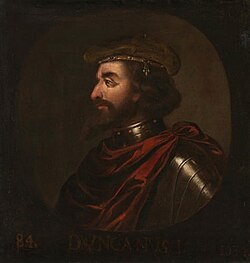
Key Facts
- Reign: 25 November 1034 – 14 August 1040.
- Dynasty: House of Dunkeld.
- Successor: Macbeth.
- Death: Killed in action at the Battle of Bothnagowan.
- Legacy: Father to two future kings, Malcolm III and Donald III.
The Rise to Power
Duncan ascended to the throne following the death of his grandfather, Malcolm II, on November 25, 1034. Unlike the chaotic successions common in the era, Duncan's rise appears to have been uneventful, suggesting he may have been the Tánaiste (a designated successor) or the acknowledged heir.
There is historical debate regarding his early career. Some earlier accounts, following the chronicler John of Fordun, claim Duncan ruled the Kingdom of Strathclyde as an appanage—a territory given to a younger member of the royal family—between 1018 and 1034. While the Oxford Dictionary of National Biography supports this, many modern historians discount the claim.
Family and Alliances
The identity of Duncan's spouse remains a point of scholarly contention. One variant of the Chronicle of the Kings of Alba identifies his wife as Suthen. Other accounts suggest a connection to the Anglo-Danish nobility, with John of Fordun claiming she was a relative of Siward, Earl of Northumbria. Frederic van Bossen proposed that Duncan married twice: first to Wonfrida (daughter of Earl Gigurt) and later to Astrida, the daughter of the King of Dublin.
Regardless of the maternal lineage, Duncan fathered several children who would shape Scottish history:
- Malcolm III: Later known as Malcolm Canmore, he reclaimed the throne in 1058.
- Donald III: Known as Donalbain, he succeeded his brother as king.
- Máel Muire: The Earl of Atholl, though his status as Duncan's son is less certain.
Conflict and Downfall
The early years of Duncan's reign were relatively quiet, possibly due to his youth. During this time, Macbeth served as his dux. In the context of the 11th century, a dux was a war leader, a rank between a prince and a marquess. This position suggests that Macbeth may have wielded significant influence as the military power behind the throne.
The stability of Duncan's reign fractured in 1039 when he led a large army south to besiege Durham. The expedition ended in disaster. Seeking to consolidate power or punish rivals, Duncan led another army north into Moray—Macbeth's domain—the following year.
This punitive expedition ended on August 14, 1040, at the Battle of Bothnagowan (near modern-day Pitgaveny, Elgin). Duncan was killed in action by the men of Moray under the leadership of Macbeth. He was initially buried at Elgin before his remains were later relocated to the sacred island of Iona.
Summary of King Duncan I
| Attribute | Details |
|---|---|
| Full Name | Donnchad mac Crinain |
| Nickname | An t-Ilgarach ("the Diseased") |
| Reign Dates | 1034–1040 |
| Predecessor | Malcolm II |
| Successor | Macbeth |
| Place of Death | Pitgaveny, near Elgin |
Duncan I in Fiction
The historical Duncan differs sharply from his fictional counterparts. In Shakespeare's Macbeth, he is an elderly, benevolent king murdered in his sleep. In contrast, Nigel Tranter's novel Macbeth the King portrays him as a calculating schemer who attempted to poison Macbeth before eventually dying of blood loss in battle due to haemophilia.
Frequently Asked Questions
Was the historical Duncan I an old man when he died?
No. While Shakespeare depicts him as elderly, historical evidence suggests Duncan was a young man, dying at approximately 38 years of age.
How did Duncan I actually die?
Duncan I died in battle on August 14, 1040, at Bothnagowan during a conflict with the forces of Moray led by Macbeth.
Who was the historical Macbeth to Duncan I?
Macbeth served as Duncan's dux, meaning he was a high-ranking war leader and likely a powerful military figure during the early part of Duncan's reign.
Where is Duncan I buried?
He was originally buried in Elgin, but his remains were later moved to the island of Iona, a traditional burial site for Scottish royalty.
Did Duncan I have any children who became king?
Yes, both of his sons, Malcolm III and Donald III, eventually ascended to the Scottish throne.