Desert Climates: Characteristics of Hot and Cold Arid Regions
A desert climate, also known as an arid climate, is defined by a severe imbalance where evaporation significantly exceeds precipitation. These environments are characterized by dry, often rocky or sandy surfaces that hold very little moisture, causing even the minimal rainfall they receive to evaporate almost instantly. Under the Köppen climate classification system, these regions are categorized as BWh (hot desert) or BWk (cold desert).
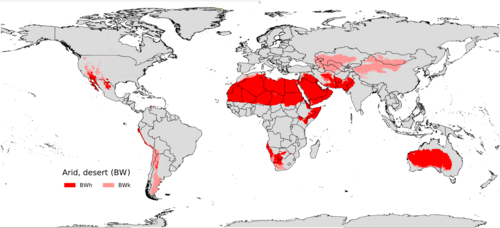
Key Facts
- BWh (Hot Desert) climates cover approximately 14.2% of Earth's land area.
- The dividing line between hot and cold deserts is a mean annual temperature of 18 °C (64.4 °F).
- Most arid regions receive between 25 and 200 mm of annual rainfall.
- Hot deserts are typically found under the subtropical ridge in lower middle latitudes.
- Cold deserts are often located in temperate zones, frequently in the rain shadow of mountains.
Understanding Aridity and Precipitation
To determine if a location qualifies as having an arid climate, scientists use a specific precipitation threshold. This calculation is based on the average annual temperature and the seasonality of rainfall. To find the threshold in millimeters, the average annual temperature in Celsius is multiplied by 20, and then a constant is added based on when the rain falls:
- +280 mm if 70% or more of precipitation occurs during the high-sun summer half of the year.
- +140 mm if 30–70% of precipitation occurs during that period.
- +0 mm if less than 30% of precipitation occurs during that period.
If a region's annual precipitation is less than 50% of this calculated threshold, it is classified as a BW (desert climate). If it falls between 50% and 100% of the threshold, it is considered a semi-arid climate.
| Feature | Hot Desert (BWh) | Cold Desert (BWk) |
|---|---|---|
| Mean Annual Temperature | Above 18 °C (64.4 °F) | Below 18 °C (64.4 °F) |
| Typical Latitudes | 20° to 33° North and South | 30s and 40s latitudes |
| Primary Cause | Subtropical high pressure | Rain shadows / Temperate zones |
| Common Landscapes | Sandy, rocky, intense sun | Barren, intermittent streams, hypersaline lakes |
Hot Desert Climates (BWh)
Hot desert climates are primarily driven by stable descending air and high pressure in the subtropics. This atmospheric setup clears clouds and creates conditions of intense sunshine and extreme heat. These deserts are found on every continent except Antarctica, spanning regions such as North Africa, West Asia, the Southwestern United States, and interior Australia.
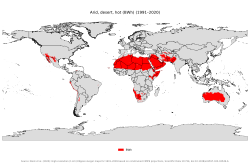
During the summer, these regions experience scorching heat. Average hot-month temperatures typically range between 29 and 35 °C (84 to 95 °F), with midday temperatures frequently reaching 43–46 °C (109–115 °F). Some locations, like Death Valley in the United States, have recorded extreme highs of 56.7 °C (134.1 °F). While days are intensely hot, night-time temperatures can drop to freezing due to rapid radiation loss under clear skies.
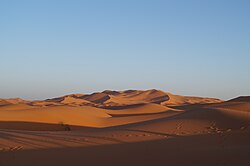
In certain tropical sections of Africa and Arabia, annual average temperatures can exceed 30 °C (86 °F) year-round. These environments are among the most inhospitable on Earth due to the nearly constant high pressure and the lack of low-pressure systems or atmospheric disturbances.
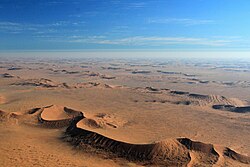
Cold Desert Climates (BWk)
Cold desert climates are generally found in temperate zones. A common cause for these climates is the leeward rain shadow effect, where high mountains block moisture-bearing winds. For example, the Patagonian Desert in Argentina is bounded by the Andes, while Central Asian deserts like the Taklamakan are restricted by mountain ranges that block the eastern monsoon.
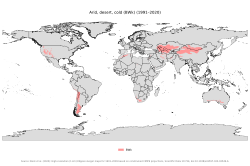
These regions include the Great Basin Desert in North America and parts of southeastern Spain. Unlike hot deserts, cold deserts are characterized by much lower temperatures. In polar regions, such as the McMurdo Dry Valleys in Antarctica, the air is so cold that most precipitation freezes, resulting in desert-like barrenness despite the extreme cold.
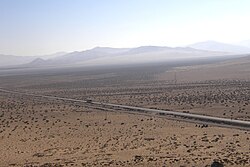
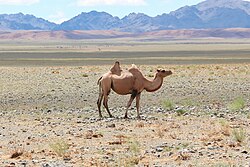
Significant examples of cold deserts include the Gobi Desert in Mongolia and the Ladakh region in the Himalayas. These areas often feature intermittent streams and hypersaline lakes within their barren landscapes.
Frequently Asked Questions
What is the main difference between BWh and BWk climates?
The primary distinction is the mean annual temperature. A BWh climate is a hot desert with a mean annual temperature above 18 °C (64.4 °F), while a BWk climate is a cold desert with a mean annual temperature below that threshold.
How dry can a desert actually be?
While most deserts receive between 25 and 200 mm of rain annually, some are extreme. The Atacama Desert has seen averages as low as 5 mm over 17 years, and parts of the Sahara have recorded as little as 0.86 mm annually.
Why are hot deserts so hot?
Hot deserts are located under the subtropical ridge, where stable descending air and high pressure prevent cloud formation. This allows for intense, direct sunshine and prevents the arrival of cooling weather fronts.
What causes a cold desert to form?
Cold deserts often form in the rain shadow of large mountain ranges, which strip moisture from the air before it reaches the land. They are also found in higher latitudes where temperatures remain low.
Are polar regions considered deserts?
Yes, polar regions like the Arctic and Antarctic can have desert-like features, such as extremely barren terrain and very low precipitation, because the cold air is unable to hold much moisture.