Humid Continental Climate: Seasons, Subtypes, and Global Patterns
Characterized by four distinct seasons and significant temperature swings, the humid continental climate is a dynamic weather regime found primarily in the mid-latitudes of the Northern Hemisphere. Defined by the Russo-German climatologist Wladimir Köppen in 1900, this climate type experiences warm to hot summers and cold, often snowy, winters. The dramatic shift between seasons makes these regions unique, offering everything from lush summer growth to deep winter snowpacks.
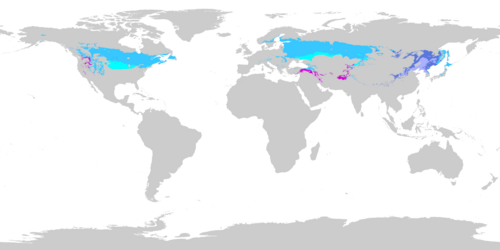
Key Facts
- Primary Location: Found between 40° N and 60° N latitudes in North America, Europe, and Asia.
- Defining Temperature: The coldest month must average below 0°C (32°F) or −3°C (27°F).
- Growing Season: At least four months must have a mean temperature of 10°C (50°F) or higher.
- Subtypes: Includes hot summer (Dfa/Dwa/Dsa) and warm summer (Dfb/Dwb/Dsb) variations.
- Precipitation: Generally distributed throughout the year, though some regions experience dry summers.
The Köppen Classification System
To accurately categorize these regions, climatologists use the Köppen climate classification. This system relies on specific temperature thresholds to distinguish continental climates from others. For instance, the 10°C (50°F) threshold is significant because it represents the approximate minimum temperature required for tree reproduction and growth.
The classification uses a three-letter code to provide detail:
- First Letter: Denotes the primary climate type (D for continental).
- Second Letter: Indicates seasonal rainfall. An "s" denotes a dry summer, where the driest month in the high-sun half of the year has less than 30–40 mm of rain and significantly less precipitation than the wettest month in the low-sun half.
- Third Letter: Describes summer heat. An "a" signifies a hot summer (warmest month $\ge$ 22°C), while a "b" signifies a warm summer (warmest month < 22°C).
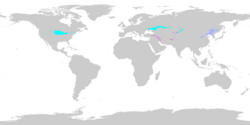
Temperature Isotherms and Regional Variations
An isotherm is a line on a map connecting points with the same temperature. In the United States, the 0°C (32°F) isotherm is commonly used to define the climate, whereas in Europe, the −3°C (27°F) isotherm is more frequent. This distinction often aligns with the southern extent of winter snowpacks.
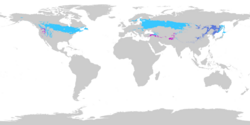
Climate Subtypes
Hot Summer Humid Continental (Dfa, Dwa, Dsa)
In these regions, the warmest month averages at least 22°C (71.6°F). These areas typically see summer highs in the high 20s to low 30s °C (80s °F), while January temperatures often hover near or well below freezing. Frost-free periods in these zones generally last between 4 and 7 months.
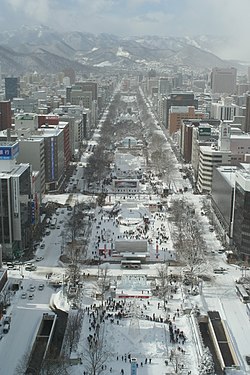
Warm Summer Humid Continental (Dfb, Dwb, Dsb)
Also known as hemiboreal climates, these regions feature milder summers where the warmest month averages below 22°C (72°F). Daytime temperatures typically range between 21–28°C (70–82°F), and the frost-free period is shorter, lasting only 3 to 5 months. Heat spells lasting over a week are relatively rare in this subtype.
Global Distribution
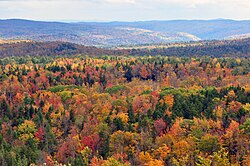
Humid continental climates are most prevalent in the central and northeastern portions of North America, Europe, and Asia. In the Northern Hemisphere, maritime-influenced areas like Hokkaido, Scandinavia, and parts of Canada and Russia exhibit climates comparable to oceanic climates, featuring significant year-round precipitation and high snow amounts.
These climates are rare in the Southern Hemisphere. Due to the vast ocean areas at those latitudes, the smaller land masses experience greater maritime moderation (the stabilizing effect of the ocean on temperature), which prevents the development of true continental patterns except in isolated high-altitude locations.
Summary of Climate Characteristics
| Feature | Hot Summer (Dfa/Dwa/Dsa) | Warm Summer (Dfb/Dwb/Dsb) |
|---|---|---|
| Warmest Month Avg | $\ge$ 22°C (71.6°F) | < 22°C (72°F) |
| Frost-Free Period | 4 to 7 months | 3 to 5 months |
| Common Summer Highs | High 20s to low 30s °C | 21–28°C |
| Alternative Name | N/A | Hemiboreal |
Frequently Asked Questions
What is the main difference between hot and warm summer subtypes?
The primary difference is the average temperature of the warmest month. Hot summer subtypes average at least 22°C (71.6°F), while warm summer subtypes average below that threshold.
Why are these climates rare in the Southern Hemisphere?
The Southern Hemisphere has much larger ocean areas and smaller land masses at these latitudes. This leads to greater maritime moderation, which prevents the extreme temperature swings characteristic of continental climates.
Does a humid continental climate always have snow?
While snowfall is not a defining factor in the official classification, snow is almost a guarantee during the winter months, either intermittently or persistently.
What does "hemiboreal" mean?
Hemiboreal is another term used to describe the cooler Dfb, Dwb, and Dsb subtypes of the humid continental climate.
How does the 10°C threshold affect vegetation?
The requirement for at least four months to average 10°C (50°F) is significant because this temperature is roughly the minimum needed for many trees to grow and reproduce.