Deep Brain Stimulation for Parkinson's and Neurological Disorders
Deep Brain Stimulation (DBS) is a surgical procedure that involves implanting electrodes into specific areas of the brain to deliver high-frequency electrical impulses. Primarily used to manage movement disorders, DBS acts as a tool to modulate abnormal signaling in the brain, helping patients regain control over motor functions when medications are no longer sufficient.
The procedure is most commonly utilized in Parkinson's disease to alleviate motor symptoms and reduce the reliance on dopaminergic medications. However, it is not a disease-modifying treatment; it manages symptoms rather than curing the underlying condition. The success of the surgery depends heavily on patient selection, as multidisciplinary teams must evaluate comorbidities, current medications, and the specific nature of the patient's symptoms.
Key Facts
- Primary Targets: The subthalamic nucleus (STN), globus pallidus internus (GPi), and ventrointermediate nucleus (VIM) of the thalamus.
- Ideal Candidates: Patients without dementia or severe depression who show a >30% response to dopamine.
- Stimulation Frequency: Typically high-frequency (>100 Hz) to effectively suppress tremors and motor fluctuations.
- Key Benefit: Significant reduction in "off" time and motor fluctuations, often allowing for a reduction in levodopa dosage.
- Major Limitation: Generally does not improve axial symptoms such as gait instability, posture, or mechanical falls.
DBS in Parkinson's Disease
For patients with Parkinson's, DBS is indicated when motor fluctuations or dyskinesias (involuntary movements) become disabling. The surgery targets the deep subcortical white matter of the basal ganglia. The right side of the brain is stimulated to treat symptoms on the left side of the body, and vice versa.
The choice of target nucleus is critical to the outcome. The subthalamic nucleus (STN) is the most frequent target for Parkinson's treatment.
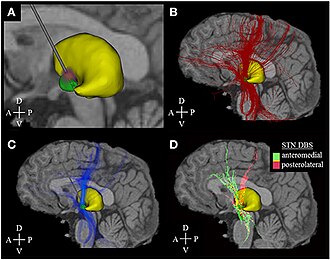
Alternatively, the globus pallidus internus (GPi) is targeted for both Parkinson's and dystonia.

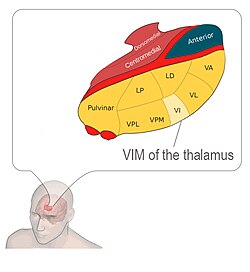
For those suffering primarily from tremors, the ventrointermediate nucleus (VIM) of the thalamus is the preferred target.
Comparing STN and GPi Targets
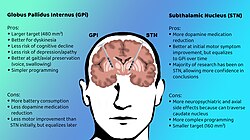
Research indicates that the STN is generally superior for improving overall motor symptoms and activities of daily living. It also allows for a more significant reduction in levodopa medication. However, the GPi is often better at preserving gait and postural stability and may have a more positive effect on depression post-surgery.
Adaptive DBS (aDBS)
Since 2015, adaptive DBS (aDBS)—also known as closed-loop stimulation—has been developed. Unlike conventional DBS (cDBS), which provides a constant stream of electricity, aDBS uses biomarkers, such as beta-band power of the subthalamic local field potentials (LFPs), to adjust stimulation in real-time. This approach has shown effectiveness in reducing dyskinesias and improving bradykinesia (slowness of movement) without inducing dysarthria (speech difficulty).
Comparison of Therapeutic Outcomes
The effectiveness of DBS is often measured using the Unified Parkinson's Disease Rating Scale (UPDRS) and the Parkinson's disease questionnaire (PDQ-39). While numerical improvements are common, clinicians look for the Minimal Clinically Important Difference (MCID) to determine if the change is meaningful to the patient's life.
| Symptom/Metric | Dopamine State | Most Effective Therapy | Patient Preference |
|---|---|---|---|
| Motor Symptoms (UPDRS III) | Unresponsive (Off) | Unilateral STN + Contralateral Subthalamotomy | 90% |
| Motor Symptoms (UPDRS III) | Responsive (On) | GPi = Unilateral Subthalamotomy + STN | 80% |
| Activities of Daily Living (UPDRS II) | Unresponsive (Off) | Unilateral STN + Contralateral Subthalamotomy | 90% |
| Activities of Daily Living (UPDRS II) | Responsive (On) | Jejunal Levodopa | 90% |
Complications and Adverse Effects
While beneficial, DBS carries surgical and neuropsychiatric risks. Surgical complications include intracranial hemorrhage (5% overall, 1% permanent deficit/death), infection (8%), and lead migration (10%).
Post-operative effects can be complex. While non-axial motor symptoms improve, patients may develop a chronic phenotype dominated by axial motor symptoms, including gait dysfunction and camptocormia (forward bending of the spine), which may worsen over time.
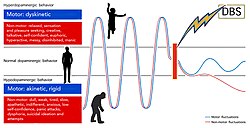
Neuropsychiatric risks are particularly associated with STN stimulation due to its small size (160 mm) and proximity to non-motor pathways. Potential issues include cognitive impairment, decreased verbal fluency, and an increased risk of dementia. Psychological effects can range from mania and euphoria in the short term to apathy, depression, and suicidal ideation in the long term.
![Persistent adverse effects after DBS can include a decline in speech, gait, loss of cognitive function, and depression, though problems with cognition mitigate after the first year.[43]](/images/49/61/49610d7f0f68adcf111d3fd954091dba597c485eda87162ac7b95d440760cc43.jpg)
Speech and Swallowing
Speech impairment is a notable risk, affecting nearly 40% of STN-DBS patients. In contrast, GPi-DBS may actually improve speech. VIM-DBS carries a speech impairment risk of up to 20%.
Other Clinical Applications
- Essential Tremor: Targeted at the VIM or zona incerta using frequencies between 80 and 180 Hz.
- Dystonia: Targeted at the GPi, with aDBS utilizing low-frequency oscillations (4-12 Hz) as biomarkers.
- Epilepsy: Managed via Vagus nerve stimulators.
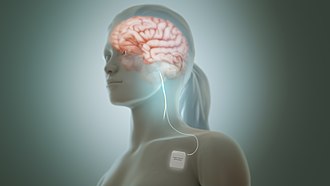
Vagus nerve stimulator for epilepsy. - Tourette Syndrome: An experimental application where aDBS is being studied to respond to tics using LFP data.
- OCD and Depression: Targeted at the frontal lobes or subcallosal cingulate region, though outcomes for depression have been mixed.
Frequently Asked Questions
Who is the ideal candidate for DBS surgery?
The best candidates are those with Parkinson's disease who experience disabling motor fluctuations or dyskinesias but do not have dementia or severe depression. A strong predictor of success is a greater than 30% responsiveness to dopamine medication.
What is the difference between STN and GPi targets?
STN stimulation is generally more effective for motor symptoms and reducing medication doses but carries a higher risk of cognitive decline and speech impairment. GPi stimulation is better for preserving gait and posture and is more favorable for speech and mood.
What is Adaptive DBS (aDBS)?
Adaptive DBS is a "closed-loop" system that monitors brain activity (local field potentials) and adjusts electrical stimulation in real-time based on the patient's current needs, potentially reducing side effects like dysarthria compared to conventional DBS.
Can DBS cure Parkinson's disease?
No, DBS is not a disease-modifying treatment. It does not stop or reverse the progression of Parkinson's but helps manage the symptoms to improve the patient's quality of life.
What are the most common surgical risks?
The most common risks include lead migration (10%), infection (8%), and lead fracture (8%). Serious but rarer complications include intracranial hemorrhage (5%) and stroke (1%).