Daguerreotype Photography: The Birth of the First Public Photographic Process
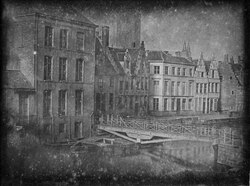
The daguerreotype was the first photographic process made available to the general public, dominating the visual landscape from the 1830s through the 1850s. More than just a technique, a "daguerreotype" refers to the unique, highly detailed image produced by this method. While it revolutionized how humanity captured reality, it was eventually superseded by 1856 by more affordable and accessible methods, such as the ambrotype.
Invented by Louis Daguerre and introduced to the world in 1839, the process created a mirror-like image on a silver-plated sheet of copper. Though it fell out of commercial favor for over a century, a modern revival has seen a small number of contemporary artists return to the medium for its distinct aesthetic and historical depth.
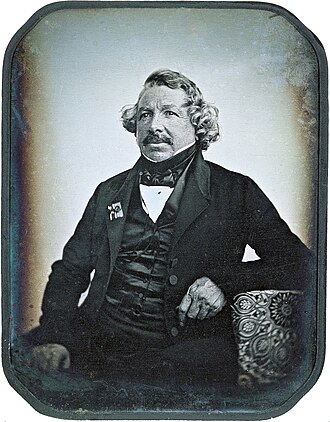
Key Facts
![Still life with plaster casts, made by Daguerre in 1837, the earliest reliably dated daguerreotype[note 3]](/images/5f/bb/5fbb812ae1e08a09924f90b76680dd205bc8cee4cbe3c6853b2c37e57223d530.jpg)
- Inventor: Louis Daguerre, building upon the earlier work of Nicéphore Niépce.
- Public Debut: Officially introduced worldwide in 1839.
- Primary Material: A silver-plated copper sheet.
- Peak Usage: Widely used between the 1830s and 1850s.
- Successor: Replaced largely by the collodion process (ambrotypes) by 1856.
The Evolution of the Process
![Daguerreotype possibly made in 1837 by Daguerre. The subject is believed to be Constant Huet, who worked at the Natural History Museum, where Daguerre took pictures in 1837.[41] If correct, this would be the oldest surviving portrait photograph of a person.[42]](/images/2c/fe/2cfe1060e9ee11e5ba40c2c77ad875cdd25cc4e6eeecc588a44172c27150a347.jpg)
From Heliography to Daguerreotype
The road to the daguerreotype began with Nicéphore Niépce, who is credited with taking the first permanent photograph around 1826 or 1827 using a process called heliography (sun writing), which utilized asphalt on a plate. While Louis Daguerre is often the name most associated with the birth of photography, he collaborated with Niépce, and it was later revealed that Niépce's foundational role had been downplayed during the initial public announcements in 1839.
![19th-century printed reproduction of a still life believed to be a c. 1832 Niépce physautotype (glass original accidentally destroyed c. 1900)[14]](/images/0d/4e/0d4ef431e45fbd315e0b0c601eecfd9e98052353d9a1e03e72e3ff69587e8b72.jpg)
The Role of the Camera Obscura
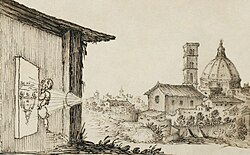
The daguerreotype relied on the camera obscura (dark chamber), an optical device that projects an image of its surroundings onto a screen or surface. This ancient tool provided the necessary framework for Daguerre to project images onto light-sensitive plates.
Technical Execution and Production
![The earliest reliably dated photograph of people, View of the Boulevard du Temple was taken by Daguerre one spring morning in 1837 or 1838 from the window of the Diorama, where he lived and worked. It bears the caption huit heures du matin (translation: eight o'clock in the morning).[note 4]](/images/99/a7/99a7e972f8f530f24f332d39cc639eba9034a18b865d52f2e85c41d8800e6d69.jpg)
Creating the Image
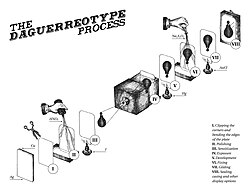
The production of a daguerreotype was a meticulous chemical process involving several critical stages:
- Polishing: The silver-plated copper sheet was polished to a mirror finish.
- Sensitization: The plate was exposed to iodine vapors to make it light-sensitive.
- Exposure: The plate was placed in the camera and exposed to light.
- Development: The latent image was brought out using mercury vapor.
- Fixing: The image was made permanent (fixed) so it would no longer react to light.
Equipment and Innovation
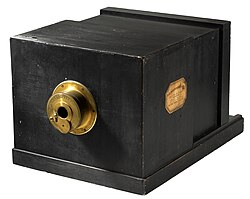
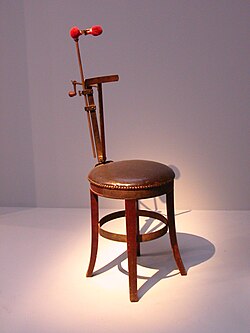
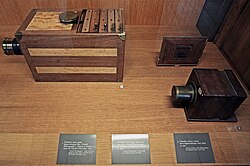
Early cameras, such as those built by La Maison Susse Frères or Charles Chevalier, were essential for the process. Because early exposure times were incredibly long—sometimes lasting several minutes—portrait photographers used specialized headrests to keep subjects perfectly still.
Impact and Applications
The Rise of Portraiture
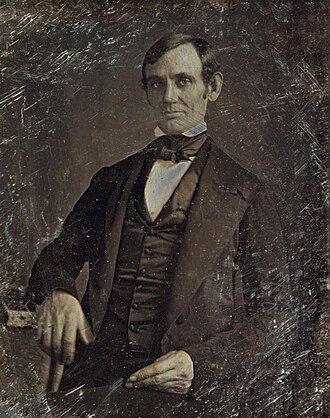
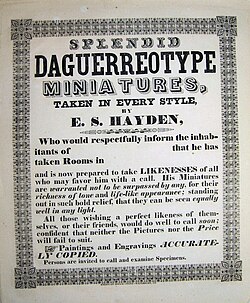
The daguerreotype democratized portraiture, allowing people to possess accurate likenesses of themselves and loved ones. Notable early examples include the first authenticated image of Abraham Lincoln in 1846. However, the process was physically demanding; subjects had to remain motionless for extended periods to avoid blurring.
Global Reach and Scientific Use
The technology spread rapidly beyond France. In the United States, figures like Samuel Morse experimented with the medium. It was also applied to astronomy and the documentation of nature, including the first known photograph of a living animal (excluding humans) taken in Rome between April and July 1842.
![The earliest known photograph of a living animal (excluding humans). This daguerreotype was taken by French photographer Joseph-Philibert Girault de Prangey while visiting Rome between April and July 1842.[63]](/images/38/41/3841e47f63debe535de8f43961578296c2142ca68528270f1f2f611a3c969d23.jpg)
Preservation and Display
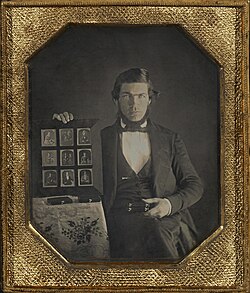
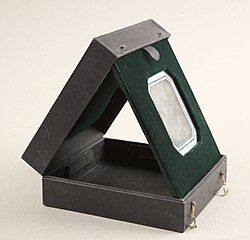
Because the silver surface was fragile and prone to tarnishing, daguerreotypes were typically sealed in airtight frames or mounted in decorative cases to protect the image from the air.
Summary of Early Photographic Milestones
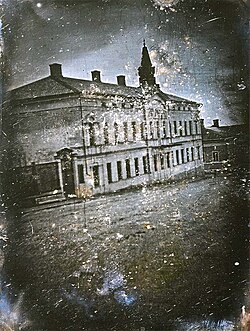
| Year | Event/Achievement | Key Figure |
|---|---|---|
| c. 1826-1827 | First permanent photograph (Heliography) | Nicéphore Niépce |
| 1837 | Earliest reliably dated daguerreotype (Still life) | Louis Daguerre |
| 1837-1838 | Earliest reliably dated photo of people (Boulevard du Temple) | Louis Daguerre |
| 1839 | Public worldwide introduction of the daguerreotype | Louis Daguerre / Arago |
| 1842 | First photograph of a living animal (non-human) | Joseph-Philibert Girault de Prangey |
| 1856 | Daguerreotype largely superseded by newer processes | N/A |
Frequently Asked Questions
What is the difference between a daguerreotype and a modern photo?
A daguerreotype is a unique image on a silver-plated copper sheet with no negative, meaning it cannot be reproduced. Modern photography typically uses negatives or digital sensors to create multiple copies of a single image.
Why did people have to sit so still for daguerreotypes?
Early photographic plates had low light sensitivity, requiring long exposure times. If a subject moved during these minutes, the resulting image would be blurred. This led to the invention of head-holding devices to ensure stability.
Who actually invented photography?
While Louis Daguerre publicized the first commercially viable process, Nicéphore Niépce is credited with the first permanent photograph using heliography in the 1820s. Both played critical roles in the medium's birth.
Why did the daguerreotype become obsolete?
The process was expensive, time-consuming, and produced a single image that was difficult to view due to its reflective surface. Newer processes like the ambrotype and collodion process were cheaper and allowed for easier reproduction.
Is the daguerreotype still used today?
Yes, though not commercially. A small community of artistic photographers has revived the process in the late 20th and 21st centuries to explore its unique aesthetic and historical significance.