Crown of Scotland: A History of the Scottish Regalia
The Crown of Scotland is the centerpiece of the Honours of Scotland, the traditional regalia used for the coronation of Scottish monarchs. From its earliest depictions in the 11th century to its current role in modern state ceremonies, the crown serves as a powerful symbol of Scottish sovereignty and national identity.
Key Facts
- Earliest Depiction: King Edgar (1097–1107) is the first monarch shown wearing a crown on his Great Seal.
- Major Remodel: The crown was significantly redesigned in 1540 by goldsmith John Mosman.
- Composition: The current crown incorporates 41 ounces of gold mined at Leadhills, Lanarkshire.
- Current Location: The crown is permanently housed in the Crown Room of Edinburgh Castle.
- Hereditary Bearer: The Duke of Hamilton is the hereditary bearer of the crown.
Origins and Early Evolution
The written record of the Scottish regalia first appears in 1296 during the abdication of John Balliol, describing a set consisting of a crown, sceptre, sword, and ring. These items were seized by Edward I of England that same year. Following this, Robert the Bruce was crowned at Scone Abbey in 1306 with a new gold circlet, though this was also captured by English forces after the Battle of Methven.
For centuries, the crown was an "open" crown—a circlet surmounted by fleurs de lis. This design persisted until the reign of James III (1460–1488). By 1484, evidence from silver coinage suggests a transition to an imperial crown, which is a "closed" design featuring four arches topped with a monde (a globe) and a cross.
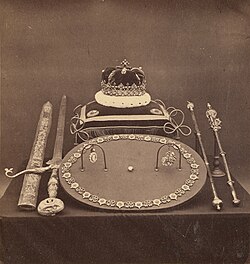
The Transition to Imperial Form
While early illustrations of the imperial form date to 1503, the crown was officially remodelled into this closed shape in August 1532. This change reflected a shift in royal status and style, though the crown remained delicate and required frequent repairs by goldsmiths such as Adam Leys and James Hamilton of Finnart.
The Great Remodelling of 1540
In January 1540, King James V commissioned royal goldsmith John Mosman to completely overhaul the crown. Mosman dismantled the existing structure, removing the gemstones, pearls, and the four arches. He melted down the old circlet and added 41 ounces of Scottish gold sourced from Leadhills in Lanarkshire.
Mosman used the original gemstones and pearls to decorate the new circlet, then added the arches, monde, and cross. To complete the piece, tailor Thomas Arthur of Edinburgh created a purple and ermine bonnet to fit inside. This bonnet was later changed to red in 1685 by James VII and was most recently replaced in 1993.
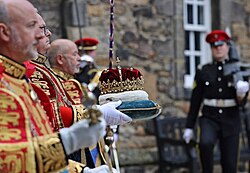
The Crown Through the Centuries
The remodelled crown debuted in February 1540 at the coronation of Mary of Guise. It was later used for the coronations of Mary, Queen of Scots (1543) and James VI (1567). After the Union of the Crowns in 1603, the Honours of Scotland were used to symbolize the monarch's presence at the Parliament of Scotland in Edinburgh.
Survival and Rediscovery
During the Wars of the Three Kingdoms, Oliver Cromwell attempted to destroy the Scottish Regalia. To save them, the Honours were secretly buried at Dunnottar Castle in Aberdeenshire until the restoration of Charles II in 1660. Following the Act of Union in 1707, the crown was locked away in Edinburgh Castle, where it remained forgotten in a chest until 1818, when it was rediscovered by a group including Sir Walter Scott.
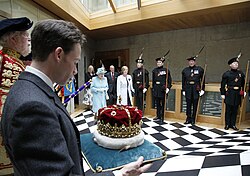
Modern Ceremonial Role
Since 1819, the crown has been displayed in the Crown Room of Edinburgh Castle. It is brought out only for significant state occasions, such as the visit of George IV in 1822 and the National Service of Thanksgiving for Elizabeth II in 1953.
In the modern era, the crown is featured during the opening ceremonies of the Scottish Parliament. In a tradition known as the Riding of Parliament, the Duke of Hamilton carries the crown immediately preceding the monarch. Most recently, the crown rested upon the coffin of Elizabeth II in September 2022 and was presented to Charles III in July 2023.
Summary of the Crown's History
| Period/Date | Key Event | Significance |
|---|---|---|
| 1097–1107 | Reign of Edgar | Earliest known depiction of a Scottish crown. |
| 1296 | Seizure by Edward I | First written reference to the regalia. |
| 1540 | John Mosman Remodel | Creation of the current gold circlet and imperial form. |
| 1650s | Burial at Dunnottar Castle | Protected from destruction by Oliver Cromwell. |
| 1818 | Rediscovery | Found in Edinburgh Castle by Sir Walter Scott and others. |
| 1999–Present | Parliamentary Openings | Used in the Riding of Parliament ceremonies. |
Frequently Asked Questions
What is an imperial crown?
An imperial crown is a "closed" crown design featuring arches that meet at the top, surmounted by a monde and a cross, as opposed to an "open" crown which is a simple circlet.
Who is the current bearer of the Crown of Scotland?
The Duke of Hamilton is the hereditary bearer of the Crown of Scotland and carries it during ceremonial processions.
Where is the gold for the current crown from?
The 41 ounces of gold added during the 1540 remodel were mined at Leadhills in Lanarkshire, Scotland.
Why was the crown hidden at Dunnottar Castle?
The crown and other regalia were buried there to protect them from Oliver Cromwell, who had already destroyed the English Crown Jewels and sought to destroy the Scottish ones.
Where can the Crown of Scotland be seen today?
The crown is on permanent display in the Crown Room of Edinburgh Castle, except when it is removed for specific state occasions.