Cretaceous-Paleogene Extinction Event: The Catastrophe That Ended the Dinosaurs
Approximately 66 million years ago, Earth experienced one of the most dramatic biological upheavals in its history. The Cretaceous-Paleogene (K-Pg) extinction event marked the end of the Cretaceous period and the beginning of the Paleogene, resulting in the disappearance of roughly 75% of all species on the planet. While most famous for the demise of the non-avian dinosaurs, this event reshaped the entire global ecosystem, clearing the path for the rise of mammals.
The transition is recorded in the geological record as the K-Pg boundary, a distinct layer of sediment found worldwide that separates the Mesozoic Era from the Cenozoic Era.
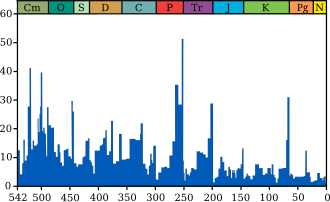
Key Facts
- Timing: Occurred approximately 66 million years ago.
- Primary Cause: A massive asteroid impact at the Chicxulub crater in Mexico.
- Major Victims: Non-avian dinosaurs, pterosaurs, and many marine reptiles.
- Environmental Impact: Triggered a global blackout and freezing temperatures (impact winter) lasting at least a decade.
- Contributing Factors: Volcanic activity from the Deccan Traps and sea-level regression.
The Chicxulub Impact: A Global Catastrophe
The most widely accepted cause of the mass extinction is the collision of a massive asteroid, several kilometers in diameter, with the Yucatán Peninsula in present-day Mexico. This event created the Chicxulub crater, a ring-shaped structure approximately 180 km (112 mi) wide.
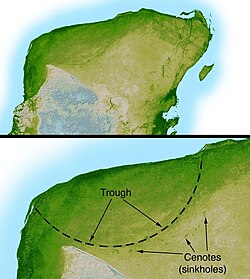
The energy released by this impact was equivalent to several million nuclear weapons detonating simultaneously. Because the asteroid struck a sulfur-rich region of shallow tropical seas, it spewed hundreds of billions of tons of sulfur and dust into the atmosphere. This created a worldwide blackout, blocking sunlight and causing temperatures to plummet, which disrupted photosynthesis and collapsed food chains globally.
![Artistic impression of the asteroid slamming into tropical, shallow seas of the sulfur-rich Yucatán Peninsula in what is today Southeast Mexico.[218] The aftermath of this immense asteroid collision, which occurred approximately 66 million years ago, is believed to have caused the mass extinction of non-avian dinosaurs and many other species on Earth.[218] The impact spewed hundreds of billions of tons of sulfur into the atmosphere, producing a worldwide blackout, and freezing temperatures which persisted for at least a decade.[218]](/images/db/4e/db4ea9a3d648c3af37c9c9834ff4daac6914c24d5015a34711da244930115c7a.jpg)
Evidence for the Impact
Scientists have identified several geological markers that prove the impact occurred. One of the most significant is the presence of shocked quartz—grains of quartz with a microscopic structure that only forms under extreme pressure—and sanidine spherules found in the boundary clays.
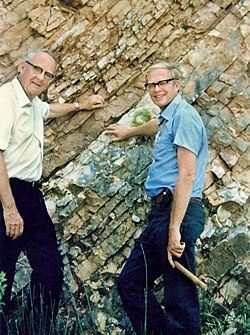
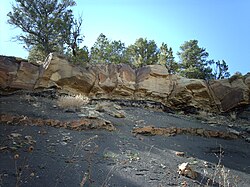
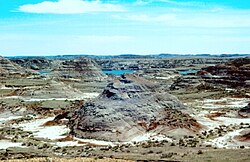
Additionally, the K-Pg boundary is often visible as an abrupt change in rock color, as seen in the Raton Basin of Colorado, where dark-colored Cretaceous rocks are topped by lighter-colored Paleogene sediments.
Extinction Patterns and Survivors
The extinction was not uniform; it was highly selective. While some groups were completely wiped out, others survived due to their diet or habitat.
Terrestrial Life
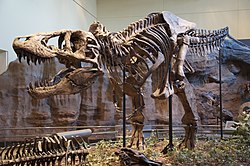
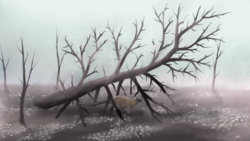
The most notable losses were the non-avian dinosaurs and pterosaurs. On land, plant communities suffered devastating losses, evidenced by a "fern spike" in the fossil record, where ferns—which are often the first to recolonize devastated landscapes—dominated shortly after the event.
Mammals, birds, and crocodilians generally fared better. Many of these survivors were small, lived in burrows, or were detritus feeders (organisms that eat dead organic matter), which provided a buffer against the collapse of living plant populations.
Marine Life
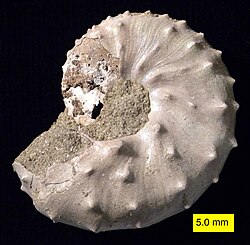
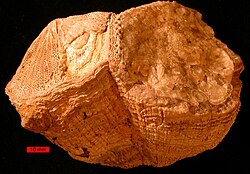
The oceans experienced massive losses, particularly among the ammonites (coiled cephalopods) and rudist bivalves. Planktonic foraminifera and calcareous nannoplankton also saw severe declines, which crippled the marine food web from the bottom up.
Other Contributing Factors
While the Chicxulub impact was the primary trigger, researchers have investigated other stressors that may have weakened global ecosystems prior to the asteroid's arrival.
- Deccan Traps: Massive volcanic eruptions in present-day India released vast amounts of carbon dioxide and sulfur, potentially causing climate instability.
- Sea-Level Regression: A significant drop in sea levels during the Maastrichtian stage may have reduced shallow marine habitats.
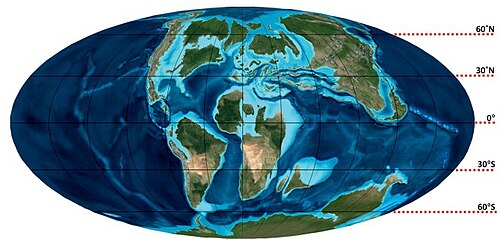
Current scientific consensus suggests that while volcanism played a role, the asteroid impact was the decisive blow that caused the rapid mass extinction.
Summary of the K-Pg Event
The following table summarizes the key aspects of the extinction event.
| Feature | Details |
|---|---|
| Approximate Date | 66 Million Years Ago |
| Primary Driver | Asteroid Impact (Chicxulub) |
| Key Geological Marker | Iridium-rich K-Pg boundary layer |
| Major Extinctions | Non-avian dinosaurs, Ammonites, Pterosaurs |
| Major Survivors | Mammals, Birds, Crocodilians, Turtles |
| Climate Effect | Impact Winter (Global cooling and darkness) |
![The river bed at the Moody Creek Mine, 7 Mile Creek / Waimatuku, Dunollie, New Zealand contains evidence of a devastating event on terrestrial plant communities at the Cretaceous–Paleogene boundary, confirming the severity and global nature of the event[163]](/images/d2/42/d242e5b4e1c56ed0e325fee711d1d30f3e0107fd3dcd9701fd8726c5ded158e7.jpg)
Frequently Asked Questions
Did all dinosaurs go extinct?
No. While non-avian dinosaurs were wiped out, avian dinosaurs—the ancestors of modern birds—survived the event.
What is the K-Pg boundary?
The K-Pg boundary is a thin layer of sediment found globally that marks the geological transition between the Cretaceous (K) and Paleogene (Pg) periods, characterized by high levels of iridium and shocked quartz.
How long did the "impact winter" last?
Evidence suggests that the freezing temperatures and worldwide blackout persisted for at least a decade following the collision.
Was the asteroid the only cause of the extinction?
While the asteroid is considered the primary cause, other factors such as the Deccan Traps volcanic eruptions and changing sea levels likely contributed to environmental stress.
Why did mammals survive when dinosaurs did not?
Many mammals were small, could burrow underground for protection, and had more flexible diets (such as eating detritus), making them less dependent on the immediate survival of living green plants.