Corals: Biology, Ecology, and the Struggle for Survival
Often mistaken for plants or rocks, corals are actually complex marine animals belonging to the phylum Cnidaria. These organisms are the architects of some of the most biodiverse ecosystems on Earth, creating massive calcium carbonate structures that provide shelter and sustenance for countless marine species. From the ancient depths of the fossil record to the vibrant reefs of the modern ocean, corals play a critical role in the planet's geochemical and biological balance.
Key Facts
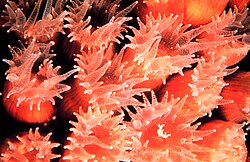
- Classification: Corals are animals in the phylum Cnidaria and subphylum Anthozoa.
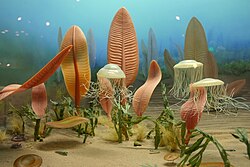
- Temporal Range: They have existed from approximately 535 to 0 million years ago.
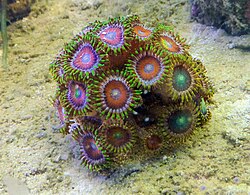
- Types: Divided primarily into soft corals (Octocorallia) and stony corals (Hexacorallia/Scleractinia).
- Symbiosis: Many corals exist as a holobiont, a symbiotic assembly of the coral animal, intracellular algae, and a diverse microbiome.
- Conservation Status: Approximately 10% of the world's coral reefs are already dead, with 60% at risk due to human activity.
Anatomy and Classification
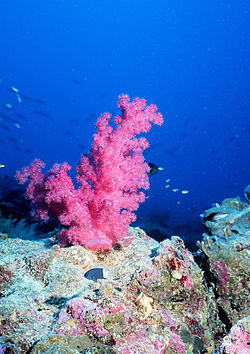
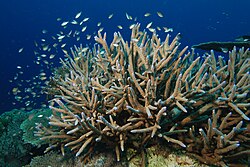
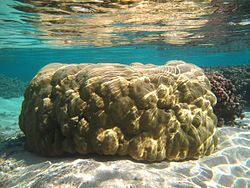
Corals are categorized based on their skeletal structure and symmetry. Stony corals (Scleractinia) secrete a hard exoskeleton of calcium carbonate, while soft corals lack this rigid structure, giving them a more flexible, plant-like appearance.
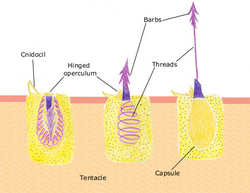
The basic unit of a coral is the polyp. A polyp consists of a soft body with a mouth surrounded by tentacles, which are equipped with nematocysts—specialized stinging cells used to capture prey and defend against predators.
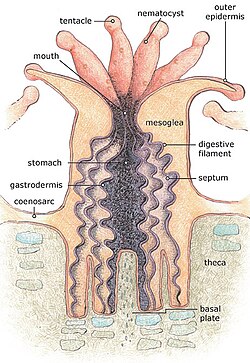
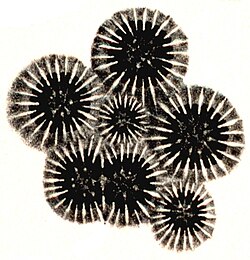
In stony corals, the polyp sits within a cup-like skeletal structure called a calyx. Over time, these polyps clone themselves through budding, creating vast colonies of genetically identical individuals sharing a common skeleton.
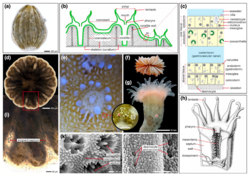
The Process of Calcification
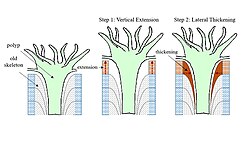
The formation of the coral skeleton is a geochemical process where the animal extracts calcium and carbonate ions from the seawater to build its rigid home. This process is essential for the growth of reef-building (hermatypic) corals.
Ecology and the Coral Holobiont
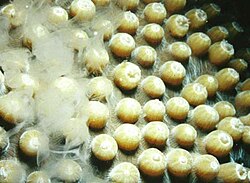
Corals do not live in isolation. They function as a holobiont, which is the collective entity comprising the coral host, its intracellular symbiotic algae (zooxanthellae), and a complex community of bacteria, fungi, and viruses.
The relationship with zooxanthellae is particularly vital; the algae provide the coral with oxygen and energy through photosynthesis, while the coral provides the algae with a protected environment and the compounds necessary for photosynthesis.
![Relationships between corals and their microbial symbionts[78]](/images/15/7a/157a1d3a508037de6d3b87aa9a2303f2b3cd590e3a57ff85f3a814430569ef84.jpg)
The Coral Microbiome
The microbiome of a coral is divided into stable and transient populations. Stable microbes are often transmitted vertically (from parent to offspring) or horizontally from the environment and persist in specific ecological niches. Transient microbes enter from seawater or prey and are typically removed by the coral's immune system or biophysical processes.
![Top-down and bottom-up control of microbiota structure in the coral holobiont Stable microbes may be introduced to the holobiont through horizontal or vertical transmission and persist in ecological niches within the coral polyp where growth (or immigration) rates balance removal pressures from biophysical processes and immune or ecological interactions. Transient microbes enter the holobiont from environmental sources (e.g., seawater, prey items, or suspension feeding) and removal rates exceed growth/immigration rates such that a dynamic and high-diversity microbiota results. Transient and stable populations compete for resources including nutrients, light and space and the outcome of resource-based competition (bottom-up control) ultimately determines population growth rate and thus ability to persist when subject to removal. Whether a population is categorized as stable or transient may depend on the timeframe considered.[83] AMP = antimicrobial peptides, ROS = reactive oxygen species](/images/9a/f0/9af025690f4edae4ec0e006a2be5ad28206dd430d03d806189cc95a4d41ae573.jpg)
Reproduction and Life Cycle
![Phylogenetic tree representing bacterial operational taxonomic units (OTUs) from clone libraries and next-generation sequencing. OTUs from next-generation sequencing are displayed if the OTU contained more than two sequences in the unrarefied OTU table (3626 OTUs).[66]](/images/bc/24/bc2499dcaf438c47a9252893a8f84e44579c0f1acf4c1eb06acaf51744c5eae5.png)
Corals employ both sexual and asexual reproduction strategies to ensure the survival and expansion of their colonies.
Sexual Reproduction
Corals are categorized by how they release their gametes:
- Broadcasters: These corals release eggs and sperm into the open water in synchronized events. The gametes float to the surface, fertilize, and develop into larvae.
- Brooders: These corals fertilize eggs internally and release well-developed larvae into the water.
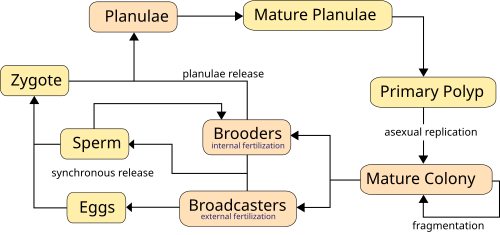
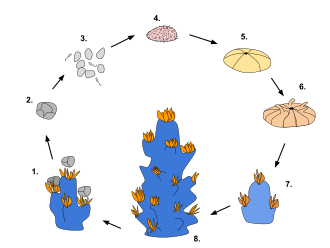
Once fertilized, the embryo becomes a planula—a free-swimming larva. The planula searches for a suitable hard surface to settle on, where it metamorphoses into a juvenile polyp and begins building its colony.
Asexual Reproduction
Asexual reproduction allows a colony to grow and expand. This occurs through budding, where a polyp produces a duplicate of itself, or division, where a colony splits into two separate entities.
The Global Importance of Reefs
![Trophic connections of the coral holobiont in the planktonic food web[84]](/images/9d/da/9dda5a997a4e6deae7474315ab9066d406eb1e9c7b6438bb54de40f7501ede69.jpg)
Coral reefs are often called the "rainforests of the sea" due to their immense biodiversity. They provide critical services to both marine life and human populations.
| Category | Benefit/Use |
|---|---|
| Environmental | Shoreline protection from storms and erosion; high biodiversity habitats. |
| Economic | Support for local economies through tourism and fisheries. |
| Medical/Industrial | Use in jewelry, construction, and potential applications in integrative medicine. |
| Scientific | Geochemical records of sea surface temperature and salinity. |
Threats and Conservation
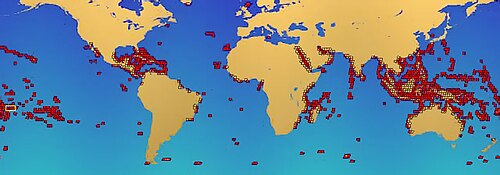
Modern coral reefs are facing an unprecedented crisis. Human-related activities have put approximately 60% of the world's reefs at risk, with Southeast Asia being particularly hard-hit, where 80% of reefs are endangered.
The primary threats include climate change, which leads to rising sea surface temperatures and ocean acidification. When water becomes too warm, corals may expel their symbiotic algae, a process known as bleaching, which can lead to coral death if the stress persists.
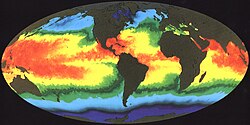
Current projections suggest that over 50% of the world's coral reefs could be destroyed by 2030. To combat this, many nations have implemented environmental laws to protect these keystone species and their habitats.
Frequently Asked Questions

![Depiction of coral in the Juliana Anicia Codex, a 6th-century copy of Dioscorides' De Materia Medica. The facing page states that coral can be used to treat ulcers.[138]](/images/5e/b5/5eb506127efddc9ad67db57b767bfdaa1e13d312674213d24a2ae157e21a9e4f.jpg)
Are corals plants or animals?
Corals are animals. Although they may look like plants or rocks, they are marine invertebrates belonging to the phylum Cnidaria.
What is coral bleaching?
Coral bleaching occurs when corals are stressed by changes in conditions, such as rising water temperatures. This causes them to expel the symbiotic algae living in their tissues, turning the coral white and leaving it vulnerable to disease and death.
What is the difference between soft and stony corals?
Stony corals (Scleractinia) build a hard calcium carbonate skeleton, which allows them to form massive reefs. Soft corals (Octocorallia) lack this rigid skeleton and have a more flexible structure.
How do corals reproduce?
Corals reproduce both sexually (via broadcasters or brooders who release gametes/larvae) and asexually (through budding or colony division).
Why are coral reefs important for humans?
They protect coastlines from storm surges, support global fisheries, drive tourism economies, and provide materials for jewelry and potential medical research.