Constitution of Argentina of 1853
The Constitution of Argentina of 1853 serves as the bedrock of the Argentine Republic's legal and political framework. Sanctioned on May 1, 1853, by a Constitutional Convention in Santa Fe, this document marked a pivotal transition from a period of fragmented provincial rule and authoritarianism toward a structured, liberal political regime. While it was approved by nearly all provincial governments, the Province of Buenos Aires remained separate from the Argentine Confederation until 1859.
Promulgated by Justo José de Urquiza, a prominent member of the Federalist Party, this was the third constitution in the nation's history, following the short-lived attempts of 1819 and 1826. For the "Generation of '80," the founders of Argentina's liberal tradition, the 1853 text was a foundational act that ended the long-standing government of Juan Manuel de Rosas and established a European-style liberal state.
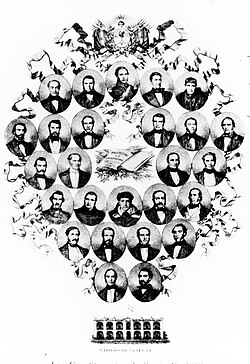
Key Facts
- Ratification Date: May 1, 1853.
- Promulgator: Justo José de Urquiza.
- Primary Influence: The 1787 U.S. Constitution and the writings of Juan Bautista Alberdi.
- Key Political Shift: Transitioned the country from the hegemony of Juan Manuel de Rosas to a federal republic.
- Initial Exclusion: The Province of Buenos Aires did not join the Confederation until 1859.
- Core Principles: Abolition of slavery, nobility titles, and the promotion of European immigration.
Historical Background and Evolution
The path to the 1853 Constitution was marked by decades of conflict between Unitarians (who favored a strong central government in Buenos Aires) and Federalists (who advocated for provincial autonomy).
Early Constitutional Attempts
The first major effort began with the Assembly of the Year XIII (1812), which worked until 1815 to establish a fundamental law. Although it failed to produce a full constitution, it created essential administrative regulations. This was followed by the Constitution of 1819, which was heavily centralist, granting the Director of State vast powers over provincial governments.
In 1826, Bernardino Rivadavia attempted a more republican approach, but the Constitution of 1826 was rejected by the provinces. This failure led to the rise of provincial Caudillos (regional military-political leaders), such as Facundo Quiroga, who sought to break the hegemony of Buenos Aires.
The Influence of Juan Bautista Alberdi
The intellectual foundation of the 1853 document was heavily influenced by Juan Bautista Alberdi. Writing from exile, Alberdi proposed a model that adapted Unitarian republicanism to a federal structure. His work, Bases, provided the theoretical framework that Justo José de Urquiza and other federal leaders used to organize the state after the defeat of Rosas at the Battle of Caseros.
The Constitutional Convention of 1853
Following the Battle of Caseros, Urquiza convened a Constitutional Congress in August 1853, based on the terms of the Federal Pact of 1831. The convention took place in Santa Fe, mirroring the precedent of the 1787 Philadelphia Convention in the United States.
The Delegates
The convention was presided over by Facundo de Zuviría. Despite the ongoing armed conflict with Buenos Aires, the delegates—comprising lawyers, priests, and military officers—decided to proceed with urgency to establish a legal order.
| Name | Representing | Profession |
|---|---|---|
| Facundo de Zuviría | Salta | Doctor in Law |
| Juan María Gutiérrez | Entre Ríos | Intellectual/Writer |
| Pedro Ferré | Catamarca | Military (Brigadier General) |
| José Benjamín Gorostiaga | Santiago del Estero | Lawyer |
| Luciano Torrent | Corrientes | Lawyer and Medic |
Structure and Core Principles
The drafters drew from several international models, including the constitutions of the United States, Switzerland, Spain, France, and Chile.
Rights and Civil Liberties
The 1853 Constitution established juridical equality by abolishing nobility titles and slavery. To stimulate national growth, it extended legal protections to all inhabitants—not just citizens—to encourage immigration, as explicitly stated in Articles 20 and 25.
Government Organization
- Legislative Power: A bicameral system consisting of the Chamber of Deputies (representing the population) and the Senate (representing the provinces).
- Executive Power: Led by the President. A notable compromise was that only the President was required to be Catholic, a rule that persisted until 1994.
- Judicial Power: Established a National Supreme Court to ensure the rule of law across the confederation.
The Question of the Capital
A major point of contention was the status of Buenos Aires. The Convention designated Buenos Aires as the capital in Article 3, but because the province was in rebellion, a special law was created to manage the capital's administration until the city could be formally integrated.
Political Legacy and Interpretation
The 1853 Constitution is viewed differently across Argentine political spectrums. The liberal "Generation of '80" saw it as a triumph of civilization over the "barbarism" of Rosas. Conversely, social-democratic groups like the UCR (Unión Cívica Radical) viewed it as an unfulfilled ideal, arguing that the ruling oligarchy used electoral fraud to bypass the constitution's democratic promises.
In the 20th century, nationalist movements criticized the document for its liberal European influences, claiming it represented a renunciation of authentic national identity in favor of foreign economic models.
Frequently Asked Questions
Why was the Province of Buenos Aires excluded from the 1853 Constitution?
Buenos Aires remained separate because it disagreed with the federalist structure and the loss of its exclusive control over customs revenues and the port, remaining independent of the Argentine Confederation until 1859.
What was the role of Juan Bautista Alberdi in the constitution?
Alberdi provided the intellectual and theoretical basis for the constitution through his writings, specifically his work Bases, which advocated for a federal system and the promotion of immigration and trade.
How did the U.S. Constitution influence the Argentine version?
The Argentine delegates viewed the U.S. Constitution as the "most perfect" model for a federal republic. They adopted its division of powers and the structure of a bicameral legislature to balance population-based representation with provincial equality.
Which social changes were mandated by the 1853 Constitution?
The constitution formally abolished slavery and nobility titles, established legal equality for all inhabitants, and officially promoted European immigration to modernize the country.
Who was Justo José de Urquiza?
Urquiza was a leader of the Federalist Party and the provisional director of the national executive government who promulgated the 1853 Constitution after defeating Juan Manuel de Rosas at the Battle of Caseros.