Confederate Battle Flag: Origins and Evolution
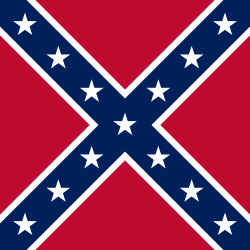
During the early stages of the American Civil War, the Confederate States of America faced a practical military crisis: their national flag, known as the Stars and Bars, looked too similar to the United States' Stars and Stripes. In the chaos of 19th-century warfare, where regiments relied on flags to help commanders observe and assess troop movements, this similarity led to dangerous confusion on the battlefield.
The need for a distinct military identifier became painfully clear during the First Battle of Manassas in Virginia. Following the engagement, General P. G. T. Beauregard determined that his command required a "Battle flag" that was entirely different from any existing State or Federal design to ensure soldiers could distinguish friend from foe.
The Design Process and Religious Considerations
Beauregard collaborated with William Porcher Miles, the former chairman of the Confederate Congress's Committee on the Flag and Seal. While the committee had previously rejected Miles' national flag designs by a four-to-one vote, Beauregard proposed a compromise: the Confederacy would maintain a "peace" or parade flag for official use and a separate "war" flag for the field of battle.
The design was inspired by secessionist flags flown during the December 1860 South Carolina secession convention in Charleston. One such flag featured a blue St. George's Cross (an upright Latin cross) on a red field. However, Charles Moise, a Southerner of Jewish persuasion, critiqued the design, arguing that the symbol of a specific religion should not represent the nation.
To address these concerns, Miles replaced the upright cross with a saltire—a heraldic diagonal cross (X-shape). Miles argued that the saltire was more heraldic than ecclesiastical, avoiding religious objections from Jewish and various Protestant sects while symbolizing strength and progress.
Formal Adoption and Production
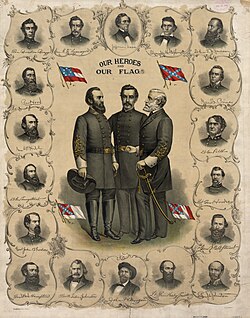
While Miles' original designs were rectangular, General Joseph E. Johnston suggested a square shape to conserve fabric. In September 1861, Generals Beauregard and Johnston, along with Quartermaster-General Cabell, approved the 12-star design at the Ratcliffe home near Fairfax Court House. The 12th star represented the state of Missouri.
President Jefferson Davis reviewed the design at the Ratcliffe House shortly after its approval. Prototypes were hand-sewn by Hetty Cary, her sister, and their cousin Constance Cary Harrison. Today, these early prototypes are preserved in the Museum of the Confederacy in Richmond and the Confederate Memorial Hall Museum in New Orleans.

Deployment and Post-War Legacy
On November 28, 1861, the Army of Northern Virginia officially received the new battle flags during ceremonies at Centreville and Manassas. General Beauregard urged his soldiers to treat the "fighting colors" with honor and never surrender them. The flags served as a significant morale booster for troops who had experienced the confusion of the First Battle of Manassas.
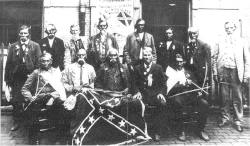
As the Confederacy grew, the number of stars increased to thirteen to include secessionist factions from Kentucky and Missouri, resulting in a decrease in the distance between the stars. After the war, the square flag of the Army of Northern Virginia became the copyrighted emblem of the United Confederate Veterans (U.C.V.) and was later used by the Sons of Confederate Veterans (S.C.V.) and the United Daughters of the Confederacy (U.D.C.), cementing its status as the "soldier's flag."
Regional Variations
While the Army of Northern Virginia's square flag is the most recognized, other variations existed. In 1863, General Johnston introduced a new battle flag for the Army of Tennessee to boost morale. These flags were rectangular, measuring 37 by 54 inches for infantry and cavalry, and 30 by 41 inches for artillery. They featured a white edging cross, often filled with battle honors.
| Army/Unit | Shape | Key Characteristics |
|---|---|---|
| Army of Northern Virginia | Square | Red field, blue saltire, white stars; known as "Beauregard's flag." |
| Army of Tennessee | Rectangular | White edging cross often containing battle honors; specific sizes for infantry/artillery. |
| Other Units | Various | Includes flags for Forrest's Cavalry Corps, Army of Central Kentucky, and Bragg's Corp. |
Key Facts
- Origin: Created to solve battlefield confusion between the "Stars and Bars" and the U.S. "Stars and Stripes."
- Design Change: The upright St. George's Cross was changed to a diagonal saltire to avoid religious objections.
- Shape: Changed from rectangular to square by General Joseph E. Johnston to save material.
- Approval: Finalized in September 1861 at the Ratcliffe home in Fairfax, Virginia.
- Symbolism: The stars represented the number of states in the Confederacy, eventually reaching thirteen.
Frequently Asked Questions
Why was the Confederate Battle Flag created?
It was created because the national "Stars and Bars" flag was too similar to the U.S. flag, causing military confusion during the First Battle of Manassas.
Who designed the battle flag?
The design was primarily the work of William Porcher Miles, with input and approval from General P. G. T. Beauregard and General Joseph E. Johnston.
Why is the cross diagonal instead of upright?
The diagonal saltire was chosen over the upright St. George's Cross to ensure the flag was not seen as a religious symbol, specifically to accommodate Southern Jews and certain Protestant sects.
What is the difference between the Army of Northern Virginia and Army of Tennessee flags?
The Army of Northern Virginia flag was square, while the Army of Tennessee flag was rectangular and often featured a white border containing battle honors.
How many stars were on the original approved battle flag?
The design approved in September 1861 featured 12 stars, with the 12th star representing Missouri.