Chicken Meat: Production, Nutrition, and Culinary Uses
Chicken is the most commonly consumed animal worldwide, serving as a versatile staple in diets across every continent. From high-end dining to fast-food staples, its adaptability in the kitchen and efficient production make it a cornerstone of global food security. In 2011, the United Nations estimated there were 19 billion chickens on Earth, outnumbering humans more than two to one.
Key Facts
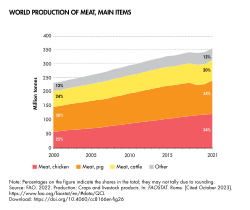
- Global Dominance: Chicken was the most produced meat type in 2021, slightly ahead of pig meat.
- Nutritional Profile: High in protein (24.68g per 100g) and relatively low in fat compared to beef.
- Production Efficiency: Modern hybrids like the Cornish Rock Cross are bred for rapid growth and high feed conversion ratios.
- Food Safety: The recommended safe minimum internal cooking temperature is 165°F (74°C).
The Evolution of Poultry Production
The history of chicken consumption has shifted dramatically over the last two centuries. In the 1800s, chicken was a luxury in the United States, sought primarily by the wealthy. However, shortages of beef and pork during World War II drove a surge in consumption.
Following the war, the USDA and other organizations sought to create the "chicken of tomorrow." By applying the breeding techniques of agriculturist Robert Bakewell, they developed the Cornish Rock Cross in the late 1940s. This breed featured an efficient feed conversion ratio (FCR)—the efficiency with which an animal converts feed into body mass—allowing for faster rearing and better meat quality. This industrial model spread from the USA to Europe and beyond.

In Europe, chicken consumption surpassed beef and veal in 1996, a shift largely attributed to consumer concerns over bovine spongiform encephalopathy (mad cow disease). Today, mass production relies on fast-growing breeds such as the Cobb 500 and Ross 308, though some regions are transitioning to slower-growing breeds like the Hubbard JA787 to improve animal welfare.
Nutritional Value and Composition
Chicken is prized for its lean protein content. While fat is concentrated in the skin, the meat itself is relatively low-fat. For comparison, 100 grams of raw chicken breast contains approximately 2 grams of fat and 22 grams of protein, whereas raw beef flank steak contains 9 grams of fat and 20 grams of protein for the same portion.
| Nutrient | Amount | % Daily Value (%DV) |
|---|---|---|
| Energy | 219 kcal (916 kJ) | - |
| Protein | 24.68 g | - |
| Total Fat | 12.56 g | - |
| Vitamin A equiv. | - | 5% |
| Pantothenic acid (B5) | - | 13% |
| Iron | - | 6% |
| Sodium | - | 3% |
Edible Components and Market Cuts
Chickens raised specifically for meat are known as broilers. In the U.S., these are butchered at young ages; for example, Cornish Cross hybrids may be processed at 8 weeks for fryers or 12 weeks for roasting birds.
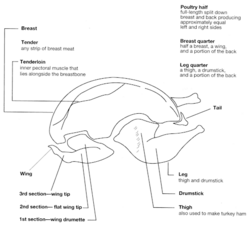
Primary Cuts
- Breast: Often sold boneless; the leanest part of the bird.
- Leg: Consists of the drumstick (dark meat) and the thigh.
- Wing: Divided into the drumette (white meat), the wingette (middle flat), and the tip (often used for stock).
Market Classifications
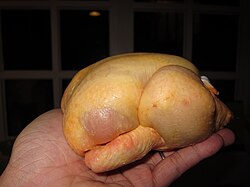
In the U.S., chickens are marketed by size, which dictates the best cooking method based on the surface area to volume ratio:
- Fryers: The smallest (2.5–4 lbs), ideal for fast cooking methods like frying.
- Broilers: Slightly larger than fryers.
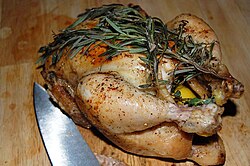
- Roasters: The largest common commercial birds (6–8 lbs), requiring slower cooking to ensure the center is cooked through.
Health and Safety Considerations
Chemicals and Antibiotics
Industrial farming has faced scrutiny over the use of roxarsone, an organoarsenic compound used to control pathogens and promote growth. A 2013 study found that 70% of U.S. samples from producers who didn't prohibit it exceeded FDA safety limits. Consequently, manufacturers voluntarily withdrew approval for roxarsone and other arsenic drugs by 2013, and nitarsone was banned by the end of 2015.
Antibiotic resistance is another concern. Research indicates that nearly half of meat and poultry in U.S. stores were contaminated with S. aureus, with over half of those bacteria being antibiotic-resistant. Some estimates suggest 90–100% of conventional chicken contains at least one form of antibiotic-resistant microorganism, compared to 84% in organic chicken.
Contamination and Handling
Fecal contamination is a risk during the transport of chickens to the abattoir, where birds are often crowded in crates. To mitigate foodborne illnesses such as Salmonella, the U.S. Department of Health & Human Services recommends a minimum internal temperature of 165°F (74°C).
Culinary Applications and Storage
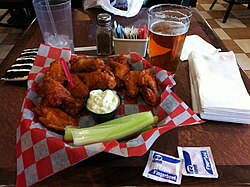
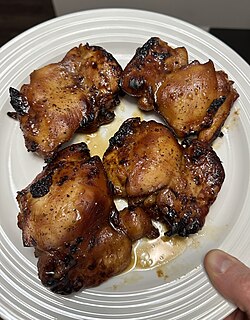
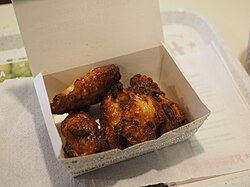
Chicken is prepared in countless ways globally, from the deep-fried Buffalo wings of New York to the air-fried teriyaki thighs popular in modern kitchens. While most cultures cook chicken thoroughly, some Japanese preparations include torisashi (raw sliced chicken) or toriwasa (lightly seared).
For long-term storage, freezing is recommended to maintain quality. While nutrient value remains stable, the maximum recommended storage times are 12 months for whole uncooked chickens, 9 months for parts, and 4 months for cooked chicken. Users may notice "bone darkening" during freezing, where pigment seeps from porous bones into the surrounding meat.
Frequently Asked Questions
What is the difference between a fryer and a roaster?
The difference is primarily size and age. Fryers are smaller (2.5–4 lbs) and cook quickly, making them ideal for frying. Roasters are larger (6–8 lbs) and require slower cooking methods to ensure the interior reaches a safe temperature.
Why is the internal temperature of 165°F important?
This temperature is the safe minimum recommended by the U.S. Department of Health & Human Services to kill bacteria and parasites, specifically Salmonella, which can be present in raw poultry.
What is a Cornish Rock Cross?
The Cornish Rock Cross is a hybrid chicken developed in the late 1940s. It was bred for a high feed conversion ratio, meaning it grows quickly and produces high-quality meat efficiently.
How long can I keep chicken in the freezer?
For optimal quality, uncooked whole chickens can be stored for up to 12 months, while uncooked parts should be used within 9 months. Cooked chicken is best consumed within 4 months of freezing.