Exploring Changdeokgung: A Journey Through Korea's Royal Heritage
Located in the heart of Seoul, South Korea, the Changdeokgung Palace Complex stands as a profound testament to the architectural elegance and historical depth of the Joseon Dynasty. Recognized as a UNESCO World Heritage Site since 1997, this expansive complex covers 57.9 hectares of meticulously designed landscape, blending royal authority with the natural beauty of its surroundings.
Unlike many other palaces that follow a rigid, symmetrical layout, Changdeokgung is celebrated for its harmonious integration with the natural topography. This unique design philosophy has preserved its status as one of the most significant cultural landmarks in East Asia.
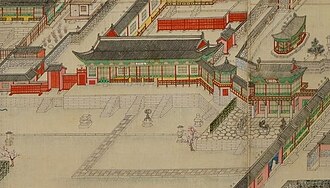
![This painting, Donggwoldo, depicts Changdeokgung (left) and Changgyeonggung (right) in c. 1824 – c. 1830[27]](/images/b7/04/b704c3f959a3d9f5163399de3d725c4d65b96a3d940e5a52835c52de4cf0b969.jpg)
Key Facts
- Location: Seoul, South Korea
- UNESCO Designation: 1997 (Cultural criteria ii, iii, iv)
- Total Area: 57.9 hectares (0.224 sq mi)
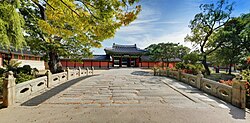
- Primary Gate: Donhwamun (the oldest extant gate of all Joseon palaces)
- Historical Significance: A major royal residence and site of significant state ceremonies.
Historical Overview
The history of Changdeokgung is a saga of destruction and resilient reconstruction. Originally established during the Joseon period, the palace faced significant devastation during the Imjin War in 1592. Following this period of conflict, the palace was rebuilt and served as a primary residence for many subsequent monarchs.
Throughout the late Joseon and Korean Empire periods, the palace remained a central hub of political life. However, the 20th century brought further challenges during the colonial period, leading to the demolition of various structures. In the post-liberation era, extensive efforts have been made to restore the palace to its former glory, ensuring that its architectural integrity remains intact for future generations.
![A map[g] of Changdeokgung, Changgyeonggung, and the rear gardens (c. 1908)](/images/d6/23/d62319929b21f338316c79386cb9f488503999b746e70435d364ae95a768327f.jpg)
The Architecture and Layout of the Palace
The palace is organized into distinct functional zones: the Oejo (outer court), the Naejo (inner court), and the Naejon (the residential quarters for the king and queen). Each area served a specific purpose, from conducting state affairs to providing private sanctuary for the royal family.
The Outer Court (Oejo) and Main Landmarks
The entrance to the palace is marked by Donhwamun, the main south gate. Completed in 1412, it is a designated Treasure of South Korea. Beyond the gates lie the administrative heart of the palace, including Injeongjeon (the Hall of Benevolent Governance). As the primary throne hall, Injeongjeon was the site of major state events, such as enthronement ceremonies.
Other notable structures in this area include:
- Injeongmun: The gate leading to the throne hall.
- Seonjeongjeon: A hall used for governance.
- Government Offices: Various buildings such as the Hongmungwan and Naeuiwon, which handled scholarly and medical duties respectively.
The Inner Court (Naejon) and Residential Areas
The Naejon served as the living quarters for the king, queen, and palace women. This area is characterized by more intimate spaces. Huijeongdang, originally a king's bed chamber, eventually transitioned into a council hall. Another significant site is Nakseonjae, a residence for palace women built in 1848, which later became the home of Empress Sunjeonghyo.
The Secret Garden (Huwon)
Perhaps the most enchanting part of the complex is the Secret Garden. This area is a collection of pavilions, ponds, and walkways designed to allow the royal family to enjoy nature. Key landmarks within the garden include:
- Juhamnu: A two-story building atop a hill that once housed the royal library, Kyujanggak.
- Buyongjeong: The "Lotus Flower Pavilion," a serene spot for contemplation.
- Huiujeong: A small pavilion named after a legendary moment when rain fell during a drought following a king's prayer.
Summary of Major Palace Structures
| Structure Name | Function/Type | Notable Feature |
|---|---|---|
| Donhwamun | Main South Gate | Oldest extant gate of all Joseon palaces |
| Injeongjeon | Throne Hall | Site of major state ceremonies and enthronements |
| Huijeongdang | Residential/Council Hall | Originally a bed chamber for the king |
| Juhamnu | Two-story Pavilion | Housed the royal library (Kyujanggak) |
| Nakseonjae | Residential Complex | Residence for palace women and Empress Sunjeonghyo |
Frequently Asked Questions
What makes Changdeokgung a UNESCO World Heritage Site?
Changdeokgung was designated due to its exceptional cultural value, specifically its unique architectural design that harmonizes perfectly with the natural landscape, a characteristic that distinguishes it from other royal palaces.
What is the significance of the Donhwamun gate?
Donhwamun is the main south gate of the palace and holds the status of a Treasure of South Korea. It is significant for being the oldest surviving gate among all the palaces built during the Joseon Dynasty.
What was the purpose of the Secret Garden?
The Secret Garden, or Huwon, was designed as a private retreat for the royal family, providing a space for relaxation, study, and communion with nature through various pavilions and scenic landscapes.
How has the palace changed over time?
The palace has undergone numerous cycles of destruction—most notably during the Imjin War and the colonial period—and subsequent reconstructions. Many buildings seen today are careful restorations of their original historical forms.
Where was the royal library located?
The royal library, known as Kyujanggak, was located on the first floor of the Juhamnu building within the Secret Garden area.