The Legacy of King Sejong the Great: A Golden Age of Joseon
King Sejong the Great, the fourth monarch of the Joseon Dynasty, is widely regarded as one of the most influential leaders in Korean history. Reigning from 1418 to 1450, his era was defined by an unprecedented explosion of scientific discovery, cultural refinement, and social reform. His commitment to the welfare of his people and the advancement of knowledge transformed the Korean peninsula during the 15th century.
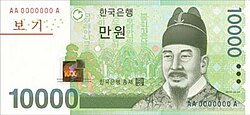
Born Lee Do in 1397, Sejong ascended to the throne following his predecessor, Taejong. Throughout his reign, he fostered an environment where scholars and scientists could thrive, leading to breakthroughs in everything from timekeeping to linguistics. His legacy is so profound that his portrait graces the 10,000 won banknote in South Korea today.
Key Facts
- Reign: September 18, 1418 – April 8, 1450
- Greatest Achievement: The creation of Hangul, the Korean alphabet.
- Scientific Advancements: Significant progress in astronomy, meteorology, and timekeeping.
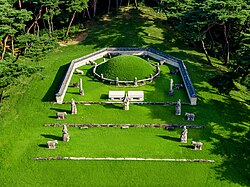
- Burial Site: Yeongneung in Yeoju, South Korea.
- Dynasty: House of Yi (Joseon Dynasty).
Scientific and Technological Advancements
![Cover of a volume of Ŭibangyuch'wi [ko]](/images/78/fe/78fef64618818b5738aa58d5afb442d75b483498032c07a754e35181a5c35feb.jpg)
One of the most striking aspects of Sejong's reign was the rapid advancement of science and technology. He supported researchers in developing tools to better understand the natural world, which was essential for an agrarian society.
Astronomy and Timekeeping
To improve agricultural efficiency, Sejong prioritized accurate calendars and timekeeping. This led to the development of sophisticated instruments, such as the Borugak Jagyeongnu, a water clock designed to relay the time to the rest of the city through automated ringing mechanisms.
![Part of the water clock Borugak Jagyeongnu. Built during Sejong's reign, when it rang the time would be relayed to the rest of the city.[69]](/images/3e/5d/3e5d3112658ba26f5dfd4ddd5e324c6ea87aa0321c975143ea6dd713a8f1ab28.jpg)
Agriculture and Medicine
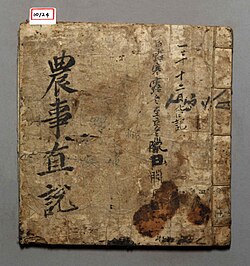
Sejong's administration focused heavily on practical knowledge. He promoted advancements in agriculture to ensure food security and supported the study of medicine to improve public health. His reign saw the compilation of vital texts and the implementation of health policies aimed at the well-being of the populace.
Cultural and Intellectual Flourishing
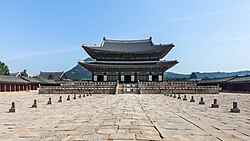
Sejong believed that a strong nation required a highly educated citizenry and a rich cultural identity. He established the Hall of Worthies (Jiphyeonjeon), a royal research institute located within the Gyeongbokgung Palace, where scholars gathered to study and produce literature.
![During Sejong's reign, the building Sujeongjeon in Gyeongbokgung hosted the Hall of Worthies[57]](/images/ed/f0/edf0c84c3dfad1630d618b58552aadf798069a79a6c65bfd7e17556fdc5d8212.jpg)
The Invention of Hangul
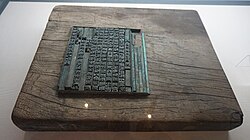
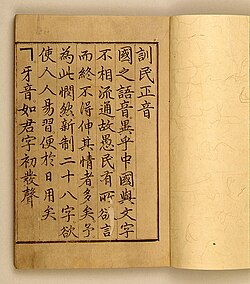
Perhaps his most enduring contribution was the creation of Hangul. Before its invention, Koreans used Chinese characters, which were difficult for the common people to learn. Sejong introduced this new writing system to increase literacy and allow all citizens to express themselves and communicate effectively.
Arts, Music, and Literature
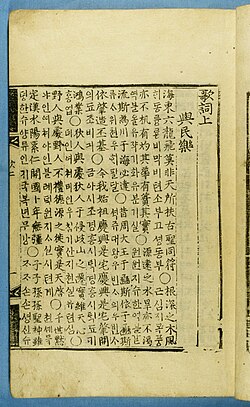
The era was also a period of immense artistic growth. Sejong himself was involved in the composition of music, including the song Yŏmillak. The period saw significant developments in calligraphy, painting, and the refinement of ceremonial rites, ensuring that the Joseon court maintained a sophisticated cultural standard.
![The landmark painting Mongyudowŏndo [ko] was produced during Sejong's reign](/images/d7/c4/d7c4ba628da31cc91a13449c072f1947e96dac75cf9462dd25b52a7a0b84e44d.jpg)
Governance, Law, and Defense
Beyond science and art, Sejong was a master of domestic policy and foreign relations. He worked to refine the legal system, taxation, and economic structures to create a more stable and equitable society.
National Defense and Foreign Policy
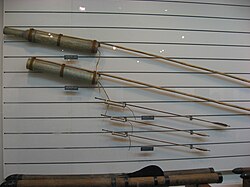
Sejong maintained a complex balance in foreign policy, managing relations with China and Japan while securing the northern frontiers against Jurchen tribes. He strengthened national defense through advancements in weaponry and strategic military positioning.
![Wokou (center), depiction from Samganghaengsilto [ko], produced during Sejong's reign](/images/f0/8b/f08b6fd8d47a12fe734d2e1e90c0181e59546a06d1c0883c9e6c5d4de939528a.jpg)
Social and Moral Education
To instill Confucian values, the administration utilized educational tools like the Samganghaengsilto, an illustrated guide designed to teach the principles of social and moral conduct to the public.
![A copy of the Samganghaengsilto [ko]](/images/d7/9f/d79f4b4f42fa72e46b7b778edd84016cf6b10748831ffe9e3e49de439d394ed9.jpg)
Summary of King Sejong's Reign
| Category | Key Contributions/Details |
|---|---|
| Linguistics | Creation of Hangul (the Korean alphabet) |
| Science | Water clocks, improved calendars, and astronomical tools |
| Institutions | Establishment and support of the Hall of Worthies |
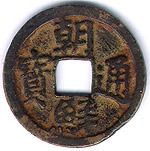
| Governance | Tax reform, legal refinements, and agricultural improvements |
| Defense | Securing northern frontiers and managing Japan-Korea relations |
Frequently Asked Questions
![Placenta Chambers of King Sejong's Sons [ko]](/images/7a/bd/7abd616cbd0255d1ec35f97ae563301eda16826ac0a74bb2b3746bbf4027c501.jpg)
What was the Hall of Worthies?
The Hall of Worthies was a royal research institute established during Sejong's reign. It served as a hub for scholars to conduct research, study Confucianism, and develop new technologies and literature for the state.
Why did King Sejong create Hangul?
Sejong created Hangul to solve the problem of low literacy rates. Because Chinese characters were complex and difficult to master, most commoners could not read or write. Hangul provided a simple, phonetic system that allowed everyone to communicate.
How did Sejong improve agriculture?
Sejong promoted agricultural advancements through the study of meteorology, the development of more accurate calendars, and the dissemination of practical farming knowledge to help ensure stable food production.
What is the significance of the Borugak Jagyeongnu?
The Borugak Jagyeongnu was a sophisticated water clock built during Sejong's reign. It was used to keep precise time, and its automated ringing system helped relay the time to the citizens, aiding in the organization of daily life.
Where is King Sejong buried?
King Sejong is buried at Yeongneung, located in Yeoju, South Korea.