Hunminjeongeum: The Foundation of the Korean Alphabet
In 1446, a revolutionary document was published in the Joseon Dynasty that would forever change the linguistic landscape of Korea. Known as Hunminjeongeum (meaning "The Correct Sounds for the Instruction of the People"), this work formally introduced the first native Korean writing system. While today the alphabet is globally recognized as Hangul, the original text serves as the essential blueprint for how these characters were designed, used, and understood.
Key Facts
- Author: King Sejong the Great of Joseon.
- Publication Date: Circa October 1446.
- Original Language: Classical Chinese (Hanja).
- Core Purpose: To provide a script that commoners could easily learn and use to express their feelings.
- Global Recognition: Included in the UNESCO Memory of the World Register.
The Need for a New Script
Before the creation of Hangul, Korea relied on Hanja, which are Chinese characters. However, Hanja presented significant challenges for the Korean population. Because Chinese and Korean belong to different language families, their structures are fundamentally different; for instance, Classical Chinese follows a subject–verb–object order, while Middle Korean uses a subject–object–verb order.
This linguistic mismatch meant that Hanja was difficult to master, effectively limiting literacy to the upper classes. Commoners often found themselves unable to record their thoughts or communicate effectively. Recognizing this inequality, King Sejong the Great took a leading role in developing a new, phonetic script that was better suited to the sounds of the Korean language.
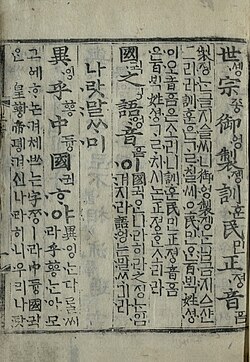
Understanding the Text and Its Editions
The term "Hunminjeongeum" is used in several ways depending on which version or section of the text is being discussed. To understand the history, one must distinguish between the different editions:
The Base Text (Yeui)
The Yeui refers to the base Hunminjeongeum authored by King Sejong. It consists of a brief preface and a technical description of the new alphabet. It was originally written in Classical Chinese using the Hanja script.
The Commentary (Haerye)
The Haerye is a detailed commentary section written by a group of scholars led by Chŏng Inji. For centuries, this section was considered lost to history until its miraculous rediscovery in 1940. The "Kansong copy" of this edition is a designated National Treasure of South Korea.
The Korean Translation (Eonhae)
The Eonhae editions are versions where the original Classical Chinese text was translated into the Korean language using a mixed script of Hangul and Hanja. These versions made the instructions more accessible to a wider audience.
The Structure of the Alphabet
The original Hunminjeongeum introduced 28 letters. The text provides specific instructions on how to form syllables and pronounce sounds. The system is divided into consonants and vowels:
- Consonants: 17 consonants were introduced, including shapes that represent the mechanics of speech.
- Vowels: 11 vowels were introduced to complete the phonetic system.
The text also outlines sophisticated orthographic principles (rules for writing). For example, it explains how initial and terminal consonants can be combined and how vowels are positioned—either underneath or to the right of a consonant—to form a complete syllable. Additionally, the system utilized bangjeom (side dots) to indicate different tones, such as level, departing, and rising tones.
Historical Versions and Discoveries
Because many early copies were lost due to war or time, scholars rely on several surviving versions to reconstruct the history of the script. The Veritable Records of Sejong contains excerpts of the text, while the Wŏrin sŏkpo provides one of the oldest known examples of the Eonhae (translated) edition.
The discovery of the Sangju copy in 2008 provided further evidence of the text's history, though it remains a subject of legal and private ownership discussions in South Korea.
| Edition Type | Primary Language | Key Characteristics |
|---|---|---|
| Yeui | Classical Chinese | The base text containing the preface and alphabet description. |
| Haerye | Classical Chinese | A scholarly commentary; rediscovered in 1940. |
| Eonhae | Korean (Mixed Script) | Translated versions intended for easier reading. |
Frequently Asked Questions
What is the difference between Hunminjeongeum and Hangul?
Hunminjeongeum was the original name of the writing system and the title of the 1446 document that introduced it. Hangul is the modern name used for the alphabet today.
Why was the alphabet created?
It was created by King Sejong the Great to solve the problem of illiteracy among commoners. Because Chinese characters (Hanja) did not fit the Korean language structure, a new, easier-to-learn script was necessary.
Is the Hunminjeongeum recognized internationally?
Yes. A copy of the full text, including the Haerye commentary, is entered into the UNESCO Memory of the World Register.
How many letters were in the original version?
The original 1446 version introduced 28 letters, consisting of 17 consonants and 11 vowels.