Buenos Aires Central Business District
The Buenos Aires Central Business District (CBD) serves as the primary commercial, financial, and corporate engine of Argentina. While not an official city ward, this unofficial barrio encompasses several key neighborhoods that drive the nation's economy. From the historic corridors of the Microcentro to the sleek, modern skyline of Puerto Madero, the CBD is a blend of colonial history and cutting-edge urban development.
The district is broadly centered around the San Nicolás ward, extending into northern Montserrat, the southern portion of Retiro, and the western edge of Puerto Madero. It is bounded by the Buenos Aires Ecological Reserve to the east and Ninth of July Avenue to the west.
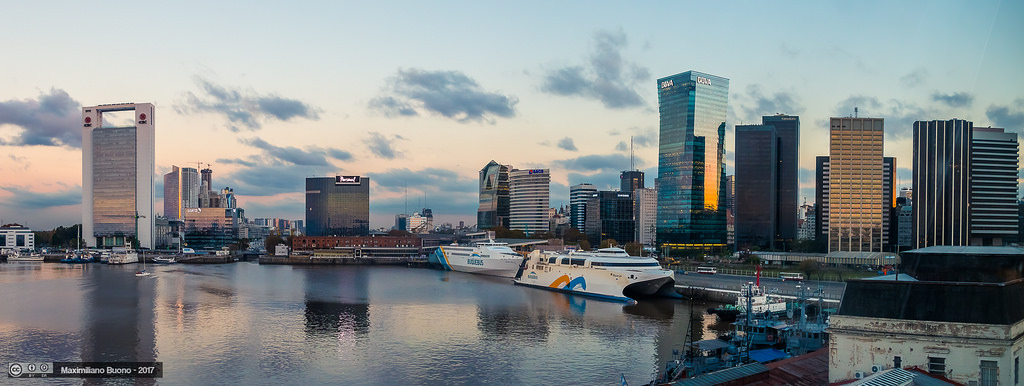
Key Facts
- Economic Status: The financial and corporate hub of Argentina.
- Key Sub-districts: Microcentro (the core), La City (banking sector), and Catalinas Norte (modern high-rises).
- Population: Approximately 20,000 residents.
- Strategic Asset: The Port of Buenos Aires, a major South American distribution hub connecting to Brazil, Uruguay, and Paraguay.
- Human Development: Recorded a high HDI of 0.925 in 1998.
Geography and Urban Evolution
Much of the CBD is situated in the Pampa region, though significant portions—including Puerto Madero and the main port—were constructed on reclaimed land along the Río de la Plata, the world's largest estuary.
The area's geography was historically shaped by creeks and lagoons, such as the Maldonado and Vega. To prevent infrastructure damage from flooding, many of these were channeled or tubed starting in 1908. Flood control efforts began in 1846 under Governor Juan Manuel de Rosas, who built a six-block contention wall, which was later extended to Recoleta and San Telmo by 1865.
A major turning point occurred in 1881 when President Julio Roca commissioned an ambitious port project. Financed by London's Barings Bank, this project reclaimed over 200 hectares of underwater land and led to the creation of the wide Leandro Alem Avenue.
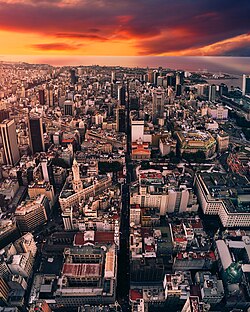
Architectural Heritage
The CBD is an open-air museum of architectural styles. Following the overthrow of Juan Manuel de Rosas in 1852, French and Italian influences became dominant. The "Generation of 1880" introduced eclectic designs drawing from Beaux-Arts, French Academy, and Second Empire styles.
Notable historic landmarks include the Teatro Colón, the National Congress, the Buenos Aires Stock Exchange, and the Central Post Office. In the mid-20th century, the Rationalist style emerged, exemplified by the Alas Building, which remained Argentina's tallest building until 1995.
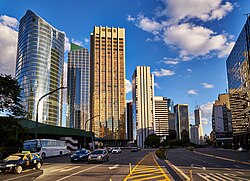
Modern architecture took hold in the 1960s with contributions from architects like César Pelli and Clorindo Testa. Today, the skyline is defined by high-technology structures such as the Repsol-YPF Tower and the Catalinas Norte office park.
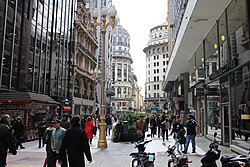
The Core Districts
San Nicolás and Microcentro
San Nicolás houses the financial heart of the city. The area east of 9 de Julio Avenue is known as the Microcentro, while the specific sector concentrating the nation's banking headquarters is called La City. This district is home to the Central Bank, the National Bank, and the Argentine Supreme Court.
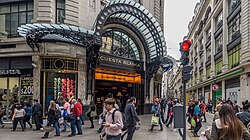
Florida Street is the most famous pedestrian thoroughfare here, featuring the Galerías Pacífico shopping arcade. The area also hosts global firms including IBM, Microsoft, and HSBC.
Retiro
Retiro is Argentina's premier transportation hub, featuring the Estación Retiro for rail and the city's main long-distance bus terminal. It is a high-traffic zone for commuters entering the CBD via Avenida del Libertador.
Key landmarks include the Kavanagh Building—the tallest in Latin America upon its 1936 completion—and the Torre Monumental. The area also features Plaza San Martín, which honors the hero of the Argentine War of Independence.
Montserrat
Montserrat is the historic and governmental soul of the district. It was the site of the first European settlement and the colonial town hall (Cabildo). The district is characterized by the Avenue of May, which connects the Plaza de Mayo to Congressional Plaza.
Major government buildings here include the Pink House (Casa Rosada), City Hall, and the Ministry of Defense. Once a bohemian quarter for tango artists, it has seen a resurgence in tourism since 1990 due to its preserved 19th-century cityscape.
Puerto Madero
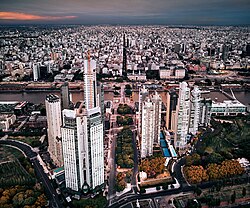
The newest borough, Puerto Madero, is a global example of successful waterfront renewal. Originally inaugurated in 1897, the docks fell into dereliction until a massive revitalization began in 1994.
Old warehouses have been converted into luxury lofts and offices, while the eastern side features high-rise residential towers and corporate headquarters. A unique feature of the neighborhood is that all its streets are named after women, and it is linked by the iconic Puente de la Mujer (Women's Bridge), designed by Santiago Calatrava.
CBD Summary Table
| District | Primary Character | Key Landmark | Main Focus |
|---|---|---|---|
| San Nicolás | Financial Core | Galerías Pacífico | Banking & Corporate |
| Retiro | Transport Hub | Kavanagh Building | Logistics & Commuting |
| Montserrat | Governmental/Historic | Casa Rosada | Politics & History |
| Puerto Madero | Modern Waterfront | Puente de la Mujer | Luxury Real Estate & Tech |
Frequently Asked Questions
What is the difference between Microcentro and La City?
Microcentro refers to the broader commercial and office core within San Nicolás and Montserrat. La City is a smaller, more specific sector within the Microcentro where the majority of Argentina's banking headquarters are concentrated.
Which building was the tallest in Latin America in 1936?
The Kavanagh Building, located in the Retiro area, was the tallest building in Latin America when it was completed in 1936, reaching a height of 120 metres.
How was Puerto Madero created?
Puerto Madero was built on reclaimed land along the coast of the Río de la Plata. After falling into disuse, it underwent a massive urban renewal project starting in 1994, transforming old warehouses into upscale offices and residences.
What architectural styles are most prominent in the CBD?
The district features a mix of French and Italian influences, including Beaux-Arts and Second Empire styles from the early 20th century, mid-century Rationalism, and contemporary high-technology architecture.
Why is the Port of Buenos Aires economically significant?
It is one of South America's busiest ports, serving as a critical distribution hub for northeastern Argentina, Brazil, Uruguay, and Paraguay via the navigable rivers of the Río de la Plata.