Puerto Madero: The Transformation of Buenos Aires' Luxury Waterfront
Located in the heart of the Central Business District of Buenos Aires, Puerto Madero is a premier barrio that represents one of the most successful waterfront renewal projects globally. Occupying a strategic stretch of the Río de la Plata riverbank, this district has evolved from a decaying industrial port into a hub of high-rise luxury, cutting-edge architecture, and high-end real estate. Today, it boasts the highest property values of any neighborhood in Buenos Aires, doubling the value of the city's second-most expensive area.
Key Facts
- Location: Comuna C1, Autonomous City of Buenos Aires, Argentina.
- Total Area: 2.1 square kilometers (0.81 sq mi).
- Population: 6,629 (as of 2010).
- Defining Feature: Every street in the neighborhood is named after a woman.
- Economic Status: The most expensive real estate market in Buenos Aires.
- Key Landmark: The Puente de la Mujer, designed by Santiago Calatrava.
The Evolution of the Port
19th Century Ambitions
In the early days of Buenos Aires, the city struggled to accommodate large cargo ships. The shallow waters of the river prevented direct docking at Puerto La Boca, forcing ships to moor far from the shore and transfer goods and passengers via barges and ferries.
To solve this, the national government contracted businessman Eduardo Madero in 1882 to build a modern port. Construction spanned from 1887 to 1897. While it was an engineering marvel of its time, the port became obsolete just ten years after completion due to the rapid increase in the size of cargo ships.
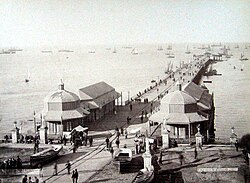
This obsolescence led to the creation of the Puerto Nuevo (New Port), designed by engineer Luis Huergo. His plan for staggered docks opening directly onto the river—a concept previously rejected in the 1880s—became the standard, with the first section opening in 1911.
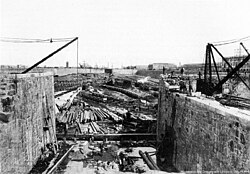
20th Century Decay and Recovery
By 1926, the completion of the New Port rendered the Madero docks superfluous. The area entered a period of steep decline, transforming into a desolate landscape of warehouses and undeveloped land. Despite numerous urbanization proposals between 1925 and 1985, no plan was successfully implemented for decades.
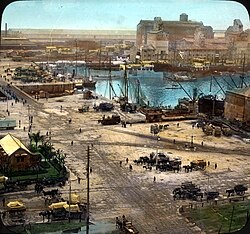
The turning point came on November 15, 1989, with the creation of the Corporación Antiguo Puerto Madero. This joint-stock company, formed by the federal and city governments, was tasked with the urbanization of the 170-hectare site. This agreement consolidated overlapping jurisdictions from the Argentine railroads, the National Grain Board, and the General Administration of Ports into a single entity.
Modern Regeneration and Architecture
The 1990s sparked a massive regeneration effort fueled by local and foreign investment. The west side of the district saw its historic warehouses recycled into lofts, offices, private universities, and luxury restaurants. Meanwhile, the east side developed into a modern corporate and leisure hub, anchored by the 1999 opening of the Hilton Buenos Aires.
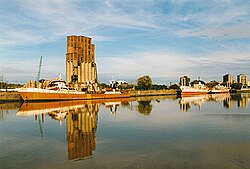
The district has attracted world-renowned architects and designers, including Norman Foster, César Pelli, Philippe Starck, and Santiago Calatrava. This international influence has made Puerto Madero a magnet for young professionals, retirees, and foreign investors seeking premium properties.
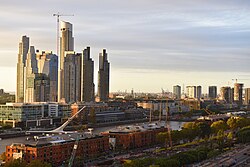
Urban Layout and Landmarks
The east side's infrastructure consists of three wide east-west boulevards intersected by Juana Manso Avenue, complemented by several pedestrianized streets. A notable architectural highlight is the Puente de la Mujer (Women's Bridge), a rotating footbridge designed by Santiago Calatrava that connects the east and west docks.
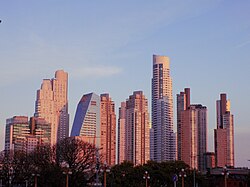
The skyline is dominated by residential and office towers, particularly along Dock 3. The Alvear Tower stands as the tallest at 239 meters, followed by other significant structures like Renoir II and the Repsol-YPF Tower. Additionally, the Harbour Tower (198 meters) is currently under construction at Dock 1, expected to be Argentina's second-tallest skyscraper upon its 2024 completion.
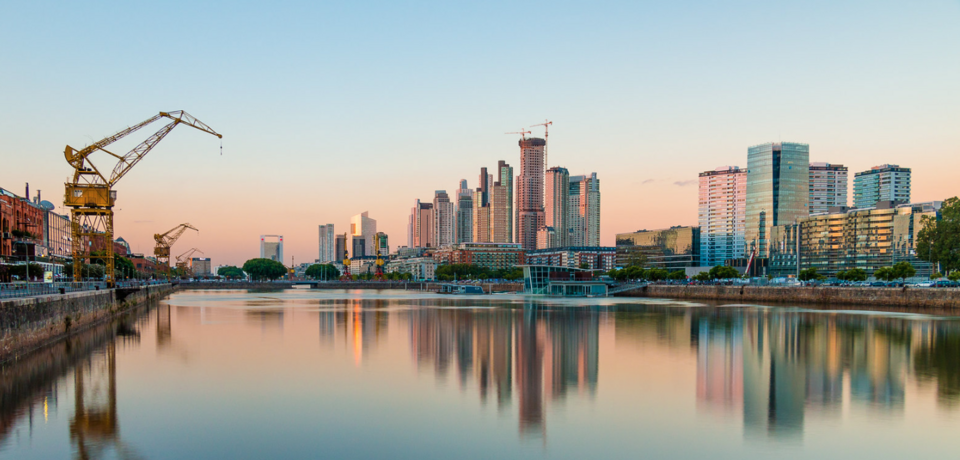
Culture and Education
Puerto Madero is home to several prestigious institutions and galleries, including the Fortabat Art Collection, the Faena Arts Center, and the De la Cárcova Museum. The area also preserves maritime history through museum ships like the ARA Uruguay and ARA Presidente Sarmiento. Education is represented by the Universidad Católica Argentina, which maintains several buildings and an Arts Pavilion at Dock 2.
Infrastructure and Controversies
Transport Challenges
Despite its luxury, the neighborhood lacks robust integration with the city's transit network. The Tranvía del Este (East Tram), which operated from 2007 to 2012, provided some connectivity, but currently, there are no subway lines serving the area and very few bus routes. While there are plans to link Retiro and Constitución stations via tramway, the area remains relatively isolated from mass transit.
The Expressway Debate
A long-standing controversy surrounds the proposal for an expressway connecting the north and south of the city through Puerto Madero. Various plans have been suggested, including elevated, underground, and even an underwater route. However, these have faced heavy criticism due to high costs, potential construction disruptions, and environmental opposition—particularly regarding proposals to place the road near the Buenos Aires Ecological Reserve.
| Category | Details |
|---|---|
| Administrative Area | Comuna C1, Buenos Aires |
| Primary Use | Residential, Corporate, Tourism |
| Tallest Building | Alvear Tower (239m) |
| Key Architect | Santiago Calatrava (Puente de la Mujer) |
| Key Museums | Fortabat Art Collection, Faena Arts Center |
Frequently Asked Questions
Why is Puerto Madero so expensive?
Its high property values are driven by its status as a successful urban renewal project, its modern infrastructure, the presence of luxury hotels and corporate offices, and its appeal to high-net-worth foreign investors.
Who is the Puente de la Mujer named after?
While the bridge is a tribute to women in general, the naming convention of the entire neighborhood—where every street is named after a woman—reflects a thematic dedication to female figures.
What happened to the original docks?
The original docks became obsolete due to the increasing size of cargo ships. After a period of decay, they were refurbished; the west side warehouses were converted into lofts and offices, while the east side was developed into a modern high-rise district.
How is the neighborhood connected to the rest of Buenos Aires?
Currently, connectivity is limited. There is no subway (subte) access and few bus routes, making it less integrated into the city's public transit network than other barrios.
What are the most notable skyscrapers in the area?
The most prominent include the Alvear Tower (239m), Renoir II (171m), and the Mulieris Towers (161m), most of which are concentrated along Dock 3.