Bombus occidentalis: The Vital Western Bumble Bee in Decline
The Bombus occidentalis, commonly known as the western bumble bee, is a cornerstone of the ecosystems found across the western United States and western Canada. As one of approximately 30 bumble bee species in this region, it plays a critical role in pollination. However, this once-common insect is currently facing significant survival challenges, leading to its classification as Vulnerable by the IUCN.
Key Facts
- Scientific Name: Bombus occidentalis
- Conservation Status: Vulnerable (IUCN 3.1)
- Primary Role: Generalist pollinator, including "buzz pollination."
- Population Trend: Declined by approximately 40.32% in the last decade.
- Legal Status: Protected under the California Endangered Species Act.
Biological Classification and Identification
Taxonomically, the western bumble bee belongs to the order Hymenoptera and the family Apidae. While it shares close genetic ties with Bombus terricola, DNA evidence confirms it is a distinct species. Scientists have even noted a potential subspecies divide between northern and southern populations, distinguished by hair length—southern bees tend to have shorter hair.
Physical Characteristics
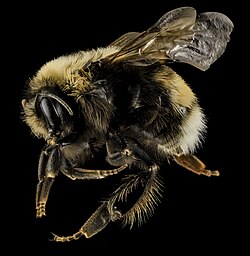
Like all insects, the western bumble bee possesses three main body parts: the head, thorax, and abdomen. Identification often relies on the coloration of the abdominal segments, which are numbered T1 through T6 (or T7 in males). In certain regions, such as northern California to British Columbia, workers exhibit yellow hair on the front of the thorax, black hair on the basal section of the fourth abdominal segment, and whitish edges on the fourth and fifth segments.
Determining Sex and Life Stages
Distinguishing between males (drones) and females (queens and workers) involves looking at several anatomical markers:
- Abdominal Segments: Males have seven segments, while females have six.
- Antennae: Drones possess 13 segments; females possess 12.
- Legs and Stingers: Females have wider hind legs equipped with a pollen basket and possess a stinger. Drones have thinner legs and no stinger.
- Seasonal Appearance: Queens emerge first in the spring, followed by workers. Drones appear later in the late summer and early fall.
Ecological Role and Foraging Behavior
As generalist foragers, western bumble bees are highly effective pollinators because they are not dependent on a single flower type. They are uniquely capable of buzz pollination—a process where the bee vibrates its wing muscles while gripping a flower to dislodge pollen from anthers. This is essential for crops like tomatoes, peppers, and cranberries.
In commercial settings, they have been used to pollinate alfalfa, avocados, apples, cherries, blackberries, and blueberries. Interestingly, they exhibit "foraging activation," where returning foragers stimulate nestmates to search for food, likely through pheromones or the scent of high-quality nectar.
Nectar Robbing and Energy Needs
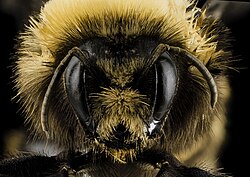
Due to their relatively short tongues, B. occidentalis sometimes engages in nectar robbing. Instead of entering the flower normally, they use their specialized, toothed mandibles to cut holes in the flower to reach the nectar directly. Maintaining high nectar levels is vital for the colony; low energy levels can make a colony less active and more susceptible to predators.
Colony Life Cycle
A colony begins in early spring with a solitary queen that finds an underground nest site, often in abandoned rodent burrows. She constructs a wax structure and begins laying eggs. As the first brood of female workers matures, they take over the duties of foraging, defending the nest, and feeding the larvae, allowing the queen to focus solely on egg production.
A large colony can consist of up to 1,600 workers. As the season ends in the fall, reproductive members called gynes are produced. While the old queen, workers, and males die with the onset of winter, the gynes hibernate to start new colonies the following spring.
Threats and Conservation Status
The population of B. occidentalis has seen a dramatic decline, particularly in California, western Oregon, and western Washington. Several factors contribute to this:
- Pathogens: The parasite Nosema is a suspected driver of decline. Some studies suggest populations may be rebounding due to evolutionary resistance.
- Invasive Species: The introduction of European honey bees and other non-native parasites.
- Habitat Loss: Urban and agricultural development fragments food supplies and nesting sites.
- Chemical Exposure: Pesticides and insecticides pose a direct threat to ground-nesting bees.
In 2019, the California Fish and Game Commission added the western bumble bee to the list of protected species under the California Endangered Species Act.
Summary of Species Data
| Feature | Details |
|---|---|
| Order/Family | Hymenoptera / Apidae |
| Max Colony Size | Approximately 1,600 workers |
| Primary Threats | Parasites (Nosema), Habitat loss, Pesticides |
| Pollination Method | Generalist and Buzz Pollination |
Frequently Asked Questions
What is buzz pollination?
Buzz pollination occurs when a bee vibrates its wing muscles while holding onto a flower, causing pollen to be dislodged from the anthers. This is necessary for certain plants like tomatoes and blueberries.
Why is the western bumble bee population declining?
The decline is attributed to several factors, including the spread of parasites like Nosema, habitat fragmentation from urban development, and competition or disease transmission from invasive honey bees.
How do I tell a male bumble bee from a female?
Males (drones) have seven abdominal segments and 13 antennae segments, and they lack a stinger. Females (queens and workers) have six abdominal segments, 12 antennae segments, and possess a stinger and pollen baskets on their hind legs.
Is the western bumble bee protected by law?
Yes, in California, the species is listed as a protected species under the California Endangered Species Act.
What is nectar robbing?
Nectar robbing is when a bee uses its mandibles to cut a hole in a flower to access nectar directly, bypassing the flower's reproductive parts. This is often done by bees with shorter tongues.