Belarus and Russia: A History of Disputed Elections and Failed Revolutions
For decades, the political landscapes of Belarus and Russia have been defined by a recurring cycle of disputed elections, mass public outcry, and stringent state crackdowns. From the "Jeans Revolution" in Minsk to the "Snow Revolution" in Moscow, citizens in both nations have attempted to challenge authoritarian rule through street protests, often facing severe consequences from state security apparatuses.
The Jeans Revolution in Belarus
By March 2006, President Alexander Lukashenko had held power in Belarus for twelve years. His path to a third term was paved by a 2004 referendum that cancelled term limits—a move internationally condemned as neither free nor fair. Under his rule, the Belarusian parliament became a rubber stamp (a legislative body that approves government decisions without debate), and civil society faced increasing restrictions.
The 2006 presidential election saw Lukashenko challenged by Alexander Milinkevich, a proponent of liberal democratic values supported by a coalition of opposition parties. The campaign was marked by state-sponsored intimidation; Milinkevich's meetings were disrupted, and his agents were detained. Another candidate, Alyaksandr Kazulin, was beaten by police, sparking international outrage. With the government controlling all media and expelling foreign observers, the regime sought to prevent a "colour revolution" similar to those that had recently ousted leaders in Georgia and Ukraine.
Russia provided strong support for Lukashenko, viewing his continued rule as a necessary bulwark against Western influence in the region.
The Outbreak of Protests
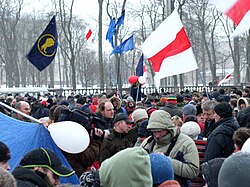
Lukashenko was declared the winner with 83% of the vote, a result international monitors deemed illegitimate. In response, approximately 30,000 people gathered in Minsk. Thousands established a tent camp in October Square, signaling a rare foothold for the opposition. However, on March 24, riot police stormed the camp, detaining hundreds. The following day, a larger rally of 40,000 people attempted to march toward the jail where activists were held, resulting in further arrests, including that of Alyaksandr Kazulin.
Symbols of Resistance
The movement adopted the white-red-white flag used in Belarus prior to 1995, mirroring symbols used during Ukraine's Orange Revolution. The protests were dubbed the Jeans Revolution (or Denim Revolution) because blue jeans were viewed as a symbol of freedom. Some activists even hung ribbons made from denim in public spaces.
Lukashenko later appeared to admit the election was rigged, claiming in Belarusian media that the original result was 93.5% but was lowered to 86% to appear more like a "European number," though this did not satisfy international critics.
The 2020 Belarusian Election
Fourteen years later, Belarus saw another wave of mass protests following the 2020 presidential election. Sviatlana Tsikhanouskaya, the main opposition candidate, claimed a landslide victory and established the Coordination Council, which the European Parliament recognized as a legitimate interim government. Despite the scale of the unrest, many analysts believe the movement failed to oust Lukashenko, who successfully prevented a repeat of the Euromaidan events seen in Ukraine.
The Snow Revolution in Russia
Similar patterns of dissent emerged in Russia starting in 2011. After serving as president from 2008 to 2012, Dmitry Medvedev announced that Vladimir Putin would return to the presidency. This choreographed swap of power was met with public disdain, highlighted when Putin was loudly booed by a crowd of 20,000 at a televised event.
The tension peaked during the parliamentary elections, where Putin's party, United Russia, was declared the winner despite evidence of widespread fraud. Independent estimates suggested over a million votes were altered, sparking the "Snow Revolution." This movement, beginning on December 4, 2011, in Moscow, was characterized by protesters wearing white ribbons.
The Aftermath and Crackdown
Putin won the 2012 presidential election by a massive margin, though video evidence later surfaced showing blatant vote rigging. Following his return to power, Putin transitioned into a more authoritarian style of governance, reducing civil liberties and eventually changing the constitution in 2020 to allow him to potentially rule until 2036.
The cost for the leaders of the Snow Revolution was high. Boris Nemtsov was assassinated in 2015. Alexei Navalny was poisoned in 2020, imprisoned, and died in a labor colony in 2024. Vladimir Kara-Murza survived two suspected poisonings before receiving a 25-year sentence in 2022. Other figures, such as Ilya Yashin and Dmitry Bykov, also faced politically motivated convictions or poisoning attempts.
Key Facts
- Jeans Revolution (2006): A Belarusian protest movement against Alexander Lukashenko's disputed third term, using denim as a symbol of freedom.
- Snow Revolution (2011-2012): Russian protests against Vladimir Putin's return to the presidency and parliamentary election fraud, symbolized by white ribbons.
- Election Rigging: Lukashenko later admitted to adjusting his 2006 victory percentage to look more "European."
- Political Repression: Key Russian opposition figures including Boris Nemtsov and Alexei Navalny faced assassination or suspicious deaths.
- Constitutional Changes: Both Lukashenko (2004) and Putin (2020) altered laws to extend their hold on power.
| Feature | Jeans Revolution (Belarus) | Snow Revolution (Russia) |
|---|---|---|
| Primary Target | Alexander Lukashenko | Vladimir Putin / United Russia |
| Key Symbol | Blue Jeans / White-red-white flag | White Ribbons |
| Trigger | 2006 Presidential Election | 2011 Parliamentary Elections |
| Outcome | Suppressed by riot police | Increased authoritarianism |
Frequently Asked Questions
Why was the 2006 Belarusian protest called the Jeans Revolution?
It was called the Jeans Revolution because blue jeans were adopted by protesters as a symbol of freedom and Western democratic values.
What was the purpose of the Coordination Council in 2020?
The Coordination Council was established by Sviatlana Tsikhanouskaya to act as a legitimate interim government following the disputed 2020 Belarusian election.
What triggered the Snow Revolution in Russia?
The protests were triggered by the perceived rigging of the 2011 parliamentary elections and the choreographed return of Vladimir Putin to the presidency.
How did Russia influence the Belarusian elections?
Russia generally supported the authoritarian Belarusian authorities to prevent a "colour revolution" and to stop Belarus from shifting its political alignment toward the West.
What happened to the leaders of the Russian protest movement?
Many leaders faced severe persecution; Boris Nemtsov was assassinated, Alexei Navalny died in prison after a poisoning, and Vladimir Kara-Murza was sentenced to 25 years in prison.