Beit Achiqbash: The Architectural Legacy of Aleppo's Christian Quarter
Located in the heart of the Al-Jdayde Christian quarter of Aleppo, Beit Achiqbash stands as a testament to the city's rich mercantile history and eclectic architectural evolution. This historic courtyard mansion, renowned for its opulent ornamentation and cultural significance, offers a window into the lifestyle of 18th-century Syrian elites.
The mansion was constructed in 1757 by Qarah Ali (Karaly), a prosperous Christian merchant. Following Karaly's relocation to Alexandretta, the property was acquired by a Turk named Ashiqbash, from whom the house derives its current name.
Key Facts
- Built: 1757 CE
- Location: Al-Jdayde quarter, Aleppo, Syria
- Architectural Style: Ottoman, featuring Mamluk-Rococo and Baroque influences
- Current Use: Home to the Popular Traditions Museum
- Ownership: Government of Syria (Directorate-General of Antiquities and Museums)
Architectural Splendor and Design
Beit Achiqbash is most celebrated for its central courtyard, which showcases an extravagant Mamluk-Rococo style—a fusion of traditional Mamluk elements with the ornate flourishes of the Rococo period. The design was heavily influenced by European Baroque decorative traditions, resulting in fine carved ornaments that adorn the courtyard walls and ceilings.
Over time, the layout of the mansion has shifted. Due to urban development and the creation of the street running in front of the property, the rooms on the eastern side of the building were removed.
The Popular Traditions Museum
In 1973, the building was converted into a museum, with subsequent restorations taking place in the 1980s. Today, it serves as the Popular Traditions Museum, housing a curated collection of Aleppine art and various artifacts that illustrate the daily lives of the city's past inhabitants.
War Damage and Modern Restoration
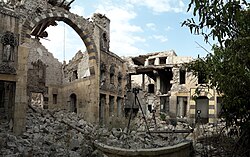
The Syrian civil war brought severe challenges to the preservation of Aleppo's old city. Beit Achiqbash suffered significant damage and looting as a result of intense street fighting.
To address this destruction, the Directorate-General of Antiquities and Museums, in collaboration with UNESCO, completed a comprehensive survey of the site in November 2017. This survey was essential for planning the emergency consolidation of the building's structure.
Physical consolidation work began in 2019. Under the leadership of main architect Eng. Pierre Ghassan Zarz, restoration efforts focused on the courtyard and facades. These works utilized original elements, such as old chasuble stones, to maintain historical authenticity. The second phase of this critical restoration project was successfully completed on September 2, 2021.
Summary of Beit Achiqbash
| Feature | Details |
|---|---|
| Year Built | 1757 |
| Original Owner | Qarah Ali (Karaly) |
| Style | Ottoman / Mamluk-Rococo / Baroque |
| Museum Status | Popular Traditions Museum (est. 1973) |
| Restoration Lead | Eng. Pierre Ghassan Zarz |
| Coordinates | 36°12′21.79″N 37°09′23.69″E |
Frequently Asked Questions
Who originally built Beit Achiqbash?
The mansion was built in 1757 by Qarah Ali (Karaly), who was a wealthy Christian merchant.
What makes the architecture of the house unique?
The house is famous for its courtyard, which blends Ottoman architecture with Mamluk-Rococo and Baroque decorative styles, featuring intricate carved ornaments.
What is currently housed inside the mansion?
The building serves as the Popular Traditions Museum, which displays Aleppine art and artifacts from local history.
How was the building affected by the Syrian civil war?
The mansion suffered severe damage and looting due to street fighting in the old city of Aleppo.
Who led the recent restoration efforts?
The reconstruction and restoration work, which included structural consolidation and facade repair, was led by architect Eng. Pierre Ghassan Zarz.