Bearded Reedling: The Unique Specialist of the Reed Beds
The bearded reedling (Panurus biarmicus) is a small, specialized passerine bird known for its striking appearance and its deep reliance on wetland ecosystems. Often found weaving through dense reed beds, this bird is more than just a visual marvel; it is a biological enigma that occupies its own unique place in the avian family tree.
Key Facts
- Scientific Name: Panurus biarmicus
- Family: Panuridae (a monotypic family, meaning it is the only species in its family).
- Habitat: Specialized for reed beds, swamps, and brackish water lakes.
- Conservation Status: Least Concern (IUCN 3.1).
- Population: Estimated at over 3 million adults globally.
- Distinctive Feature: Males possess black "moustaches," though they lack an actual beard.
Taxonomy and Evolutionary History
First described by Carl Linnaeus in 1758, the bearded reedling has a complex taxonomic history. Initially placed with the tits in the genus Parus, it was later associated with parrotbills, Old World flycatchers, and typical warblers. However, modern molecular phylogenetic studies—the analysis of genetic relationships—revealed that the bearded reedling is a unique passerine with no close living relatives.
Today, it is placed in the monotypic family Panuridae. While it lacks a sibling species, it is most closely related to the lark family (Alaudidae), having split from them during the Early Miocene epoch. The genus name Panurus is derived from Ancient Greek, meaning "exceedingly tail," referring to its notably long tail.
Appearance and Identification
The bearded reedling is a small bird, measuring between 14.5 and 17 cm in length. Its plumage is primarily orange-brown with a whitish throat and chest, complemented by black and white wing accents and white-edged tail feathers.
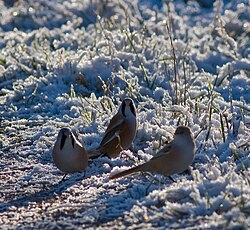
Sexual dimorphism—the physical difference between males and females—is evident in the adults. Males feature a grey head, black undertail coverts, and the signature black "moustaches." Females are generally paler with brownish heads and lack the moustaches, though some may exhibit black streaks or spots on their crown and back.
Distribution and Habitat
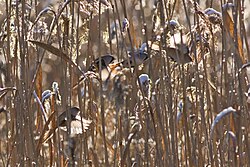
This species is a habitat specialist, meaning it requires very specific environmental conditions to survive. It is primarily found in reed beds, particularly those dominated by common reed, near rivers, swamps, or lakes of fresh or brackish water. While they prefer these wetlands, they can also be found in tall grass-like vegetation such as sedges and bulrushes.
Their range is vast, spanning from sea level to altitudes as high as 3,050 meters in China. In Europe, they have shown a capacity for eruptive dispersal, where populations suddenly expand into new territories. This behavior allowed them to establish breeding populations in Denmark, Sweden, Estonia, and Finland between the 1960s and 1980s.
Life Cycle and Behavior
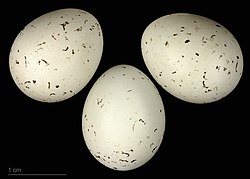
Both males and females collaborate to build a cup-shaped nest (7.5 to 17 cm in diameter) attached to reeds, usually within 0.7 meters of the water or ground. The breeding process is highly efficient:
- Incubation: Lasts up to two weeks for a clutch of 3 to 11 eggs.
- Nestling Period: Young stay in the nest for about two weeks.
- Independence: From the start of nest building to full independence, the process takes approximately 40 days.
In highly successful years, the bearded reedling can produce more young per season than any other European passerine. In some cases, pairs may even start a second brood before the first has fully left the nest.
Conservation and Population Dynamics
While the species is listed as Least Concern, local populations are highly volatile. They are particularly vulnerable to severe winters, which can cause massive die-offs in specific regions.
Despite these crashes, their high breeding capacity allows them to recolonize areas quickly. However, habitat loss remains a threat. For example, the subspecies P. b. kosswigi, found in southern Turkey and Syria, has not been recorded since 1962 and may be extinct due to the draining of Lake Amik.
Regional Focus: United Kingdom and Ireland
In the UK, the species nearly vanished after the severe winter of 1946–47, with only a few pairs remaining in Norfolk and Suffolk. The population recovered thanks to internal growth and immigrants from the Netherlands. As of 2019, there are over 500 pairs in England and a significant colony of over 250 pairs at the mouth of the River Tay in Scotland. In Ireland, breeding has been confirmed in coastal southeastern areas, including County Wexford and County Wicklow.
| Feature | Details |
|---|---|
| Scientific Classification | Family Panuridae, Genus Panurus |
| Average Length | 14.5–17 cm |
| Primary Habitat | Fresh/Brackish Reed Beds |
| Global Population | > 3,000,000 adults |
| Key Threat | Severe winters and habitat loss |
Frequently Asked Questions
Why is it called a "bearded" reedling?
The name comes from the black plumage on the sides of the male's face, which resembles moustaches or a beard, although it is not a true beard.
Is the bearded reedling related to the tit family?
No. Although it was originally classified as a tit (genus Parus), molecular studies proved it is a unique lineage in its own family, Panuridae, and is more closely related to larks.
How do they survive severe winters?
They often struggle; hard winters can cause significant population crashes. However, they recover through high breeding rates and the ability to disperse from stable populations into depleted areas.
Where is the largest UK population located?
The largest known breeding site in the United Kingdom is at the mouth of the River Tay in Perth and Kinross, Scotland, with possibly over 250 pairs.
What is eruptive dispersal?
Eruptive dispersal is a behavior where a species suddenly expands its range into new regions, often driven by population pressure in their primary strongholds, such as the expansion from the Netherlands into Northern Europe.