Basal Clades in Phylogenetics: Mapping the Roots of Evolutionary History
In the complex study of evolutionary relationships, scientists use phylogenetics to map how different species are connected through time. A central concept in this field is the "basal" position. When looking at a cladogram—a diagram representing evolutionary lineages—the term "basal" refers to the direction of the base or root. While the term is often used to describe groups that appear close to the root of a tree, it has specific scientific implications regarding how we understand the history of life.
Understanding these early-branching lineages is essential for reconstructing the past, yet it requires careful interpretation. A basal clade is not necessarily "more evolved" than others; rather, it represents a lineage that diverged early from the main group. In a strict sense, a basal group forms a sister group to the rest of a larger clade, meaning it is the closest relative to everything else in that group.

Key Facts
- Basal clades are lineages that branch off near the root of a phylogenetic tree.
- A group is considered more basal than another if the second group is a subgroup of the first group's sister group.
- No extant (living) taxon is closer to the root of life than any other.
- Basal positions in trees can provide vital clues about the geographic origins of entire superorders.
- The term "core clade" refers to the grouping that remains after the lowest-rank basal clades are removed.
The Science of Basal Positions
In a rooted phylogenetic tree, there must always be at least two equally basal clades sprouting from the root. These clades can vary significantly in their taxonomic rank (the level of classification, such as family or order) and their species diversity. For example, one basal clade might consist of a single species, while its sister clade contains hundreds of thousands of species.
It is a common misconception that basal lineages automatically possess "primitive" traits. While some basal groups exhibit archaic characters, they often possess a mix of ancient and apomorphic (derived) features. Scientists must use comparative evidence rather than assuming a group is ancestral simply because of its position on the tree.
Key Concepts in Evolutionary Mapping
- Clade: A grouping that includes a common ancestor and all its descendants.
- Sister Group: Two clades that are each other's closest relatives.
- Key Innovation: An evolutionary advancement that may correlate with increased diversification.
| Term | Definition | Context |
|---|---|---|
| Basal Clade | A lineage branching near the root. | Used to identify early divergence. |
| Core Clade | The main group excluding basal lineages. | Used to define the primary cluster. |
| Sister Group | The closest relative to a specific clade. | Used to define branching relationships. |
| Extant Taxon | A group that is currently living. | Used to study modern evolutionary states. |
Real-World Examples in Biology
The application of basal positioning helps biologists solve mysteries regarding where species originated and how they migrated across the globe.
Flowering Plants (Angiosperms)
The family Amborellaceae, found only in New Caledonia, serves as a primary example. It is a basal clade of extant angiosperms, meaning it is sister to all other flowering plants. The single species, Amborella trichopoda, provides unique insights into plant evolution due to its simple wood structure and unsealed carpels.
Marsupials and Biogeography
The study of marsupials demonstrates how phylogeny informs geography. The monito del monte occupies a basal position within the superorder Australidelphia. This placement suggests that the origins of this group lie in South America, a conclusion supported by the fact that the South American order Didelphimorphia is also basal within the infraclass Marsupialia.
![The phylogenetic tree of marsupials derived from retroposon data shows the basal position of South American Didelphimorphia within Marsupialia, and the basal position of South American Dromiciops within otherwise Australasian Australidelphia.[18]](/images/79/14/79140ce194036d2b212d8d8d404207b8433085e31b46af0613918d58f9ce0337.png)
Bat Superfamilies and Migration Patterns
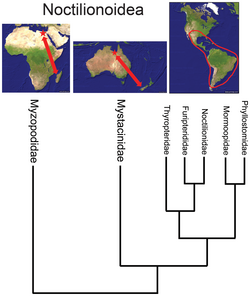
In the bat superfamily Noctilionoidea, the basal position of the Malagasy family Myzopodidae suggests a complex migratory history. When combined with the fossil record, this position implies the superfamily may have originated in Africa before migrating eastward to South America.
Frequently Asked Questions
Does being basal mean a species is "primitive"?
Not necessarily. While basal lineages can show archaic traits, they often possess derived features as well. A basal position indicates the timing of divergence, not necessarily a lack of evolutionary change.
What is a core clade?
A core clade is the grouping that encompasses all constituent clades within a larger group, excluding the basal clades of the lowest rank.
Can a basal clade be very small?
Yes. A basal clade can consist of a single species, even if its sister group contains hundreds of thousands of species.
How does phylogeny help determine where an animal originated?
By identifying the basal members of a group and looking at their current geographic distribution, scientists can infer the most likely ancestral home of that lineage.
Is any living creature closer to the "root of life" than others?
No. In phylogenetic terms, no extant taxon is closer to the root of life than any other living organism.