Axial Skeleton: The Central Core of the Human Body
The axial skeleton serves as the central axis of the vertebrate endoskeleton, forming the medial core of the body. In humans, this system is primarily designed for protection and stability, housing the most vital organs and providing a sturdy foundation for the rest of the body. It consists of 80 bones that organize the head and trunk, connecting to the appendicular skeleton—the structure supporting the limbs—via the pelvis and shoulder girdles.
Beyond structural support, the axial skeleton protects the brain, spinal cord, heart, and lungs. It also provides critical attachment points for the muscles that enable movement of the head, neck, and back, as well as muscles that operate across the hip and shoulder joints.
Key Facts
- Total Bone Count: The human axial skeleton consists of 80 bones.
- Primary Function: Protects the central nervous system and vital thoracic organs.
- Core Components: Comprises the skull, vertebral column, rib cage, and the hyoid bone.
- Connection: Joins the appendicular skeleton through the shoulder girdles and pelvis.
- Bone Durability: While most bones weaken with age, the skull remains strong to protect the brain.
The Human Skull
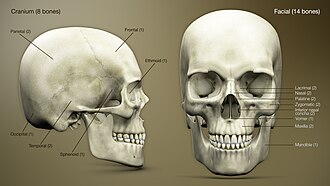
The skull is a complex structure divided into the cranium and the facial bones. The cranium consists of eight plate-shaped bones that fit together at joints called sutures, creating the cranial vault that shields the brain. The facial region is composed of 14 bones, including the maxilla (upper jaw), mandible (lower jaw), zygomatic (cheek) bones, and nasal bones. Together, these 22 bones create essential cavities for the eyes, nose, mouth, and internal ears.
At birth, the skull consists of separate plates to allow flexibility as the infant passes through the birth canal. Over time, these plates fuse into a single solid structure, with the exception of the mandible, which remains a separate bone to allow for jaw movement.
The Rib Cage
The rib cage is composed of 25 bones: 12 pairs of ribs and one sternum (breastbone). This structure acts as a protective cage for the heart and lungs. The ribs are crescent-shaped, attaching to the thoracic vertebrae at the back and extending toward the sternum in the front.
Ribs are categorized into three types based on their attachment to the sternum:
- True Ribs: The first seven pairs, which attach directly to the sternum via costal cartilage.
- False Ribs: The 8th through 10th pairs, which connect to the ribs above them rather than directly to the sternum.
- Floating Ribs: The final two pairs, which do not attach to the sternum or other ribs, remaining "free."
In terms of dimensions, the first rib is the shortest, broadest, and most curved. Rib length generally increases from the first to the seventh pair before decreasing toward the twelfth.
The Vertebral Column
The vertebral column provides the main structural support for the trunk. While humans are typically born with 33 separate vertebrae, several fuse during development. In most adults, this results in 26 distinct bone units: 24 separate vertebrae, the sacrum, and the coccyx.
The column is divided into five distinct regions:
- Cervical: 7 vertebrae forming the junction between the column and the cranium.
- Thoracic: 12 vertebrae that connect to the ribs.
- Lumbar: 5 vertebrae supporting the lower back.
- Sacral: 5 fused vertebrae forming the sacrum, which connects the column to the pelvis.
- Coccygeal: 3 to 5 fused vertebrae forming the coccyx (tailbone).
Axial Skeleton Summary
| Component | Bone Count | Key Elements |
|---|---|---|
| Skull | 22 | 8 Cranial, 14 Facial |
| Middle Ear | 6 | 3 Ossicles per ear |
| Hyoid Bone | 1 | Located in the neck |
| Vertebral Column | 26 | Vertebrae, Sacrum, Coccyx |
| Rib Cage | 25 | 24 Ribs, 1 Sternum |
| Total | 80 | Core Body Axis |
Frequently Asked Questions
What is the difference between the axial and appendicular skeleton?
The axial skeleton forms the central axis of the body (head and trunk), while the appendicular skeleton consists of the limbs and the girdles (shoulder and pelvis) that attach those limbs to the axial core.
Why are some ribs called "floating ribs"?
Floating ribs are the 11th and 12th pairs of ribs. They are called "floating" because they do not attach to the sternum or to other ribs, leaving them unconnected at the front of the body.
How many vertebrae are in the human spine?
The count varies based on whether you count fused bones. There are 24 separate vertebrae plus the sacrum and coccyx (totaling 26 bones). If all fused segments are counted individually, the total is between 32 and 34.
Which bone in the skull remains separate after fusion?
The mandible, or lower jaw bone, is the only bone of the skull that does not fuse with the other plates, allowing for the movement necessary for eating and speaking.
What is the primary purpose of the cranium?
The cranium consists of eight plate-shaped bones that form the cranial vault, which serves to hold and protect the brain from external injury.