Avian Brains: Structure, Evolution, and Metabolic Efficiency
The avian brain is the central command center of a bird's nervous system, responsible for processing environmental data and coordinating complex bodily responses. While the term "bird brain" is often used colloquially to imply a lack of intelligence, the biological reality is quite the opposite. Birds possess large, complex brains that enable high-level cognition, precise motor control, and sophisticated sensory integration.
Contained within the skull bones of the head, the avian brain is organized into specialized sections that manage everything from basic survival instincts to advanced learning and decision-making.
Key Facts
- High Neuron Density: Birds maintain high absolute numbers of neurons despite smaller brain volumes compared to some mammals.
- Energy Efficiency: Avian neurons consume more than three times less glucose than mammalian neurons.
- Nuclear Structure: Unlike the layered mammalian cortex, the bird telencephalon uses a nuclear structure of three-dimensionally arranged neuron clusters.
- Evolutionary Links: The nidopallium caudolaterale, used for goal-directed action, is also found in crocodylians.
- Thermal Advantage: Higher brain temperatures (up to 42°C in pigeons) help reduce the energy required to activate ion channels.
Anatomy and Functional Organization
The avian brain is divided into several distinct regions, each serving a specific purpose in the bird's survival and interaction with its environment.
The Telencephalon and Pallium
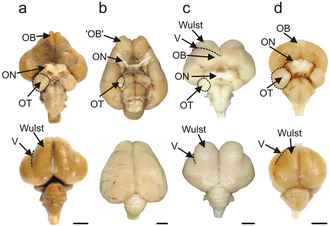
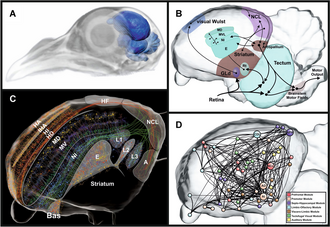
The telencephalon (or cerebrum) is split into two hemispheres and governs higher-order functions. It is dominated by the pallium, the avian equivalent of the mammalian cerebral cortex. The pallium is responsible for cognition and is composed of several key structures: the hyperpallium (a dorsal bulge unique to birds), the nidopallium, the mesopallium, and the archipallium. These areas are primarily associated with perception, learning, and cognitive processing.
Unlike mammals, who have a clear separation of grey and white matter, the bird telencephalon features a nuclear structure where neurons are grouped in clusters, though they still maintain column-like and layer-like connections.
Subpallium and Hindbrain
Located beneath the pallium is the subpallium, consisting of the striatum and pallidum. This region acts as a connector for different parts of the telencephalon and is critical for various behaviors. To the rear of the telencephalon lie the thalamus, midbrain, and cerebellum, while the hindbrain serves as the bridge to the spinal cord.
Physiology and Metabolic Efficiency
Neurons are typically energy-expensive cells, yet birds manage to maintain high neuron densities without an unsustainable energy cost. Approximately 70-80% of the brain's energy is consumed by neurons.
Research using pigeons has revealed that avian neurons have significantly lower specific energy demands than those of mammals. While the exact cause is still being studied, researchers point to two primary factors:
- Neuron Size: It is speculated that bird neurons are smaller than mammalian neurons. Smaller cells have less surface area, fewer receptors, and lower membrane capacitance, requiring less energy for maintenance and potential changes.
- Body Temperature: Birds maintain higher brain temperatures—reaching 42°C (108°F) in pigeons—which speeds up the activation and deactivation of ion channels, thereby reducing energy expenditure.
Evolutionary History
The avian brain diverged from the mammalian lineage during the Permian period and from other reptiles during the Triassic. One striking example of evolutionary continuity is the nidopallium caudolaterale, which manages goal-directed action. This structure is found in both birds and crocodylians, suggesting their last common ancestor likely possessed it.
Development in the Jurassic and Cretaceous
Birds evolved from non-avian dinosaurs, a process marked by the significant enlargement and reshaping of the brain. By studying endocasts (internal casts of the braincase), scientists have tracked this growth:
- Coelurosauria: This group, including tyrannosauroids, had brains at least twice as large as other dinosaurs of similar size.
- Maniraptoriformes: This group saw another doubling in brain size.
- Maniraptora: This group developed the brain shape seen in modern birds, including a large cerebellum and optic lobes.
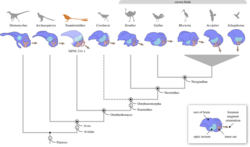
Interestingly, Archaeopteryx, often called the "Urvogel" (original bird), had a brain adapted for flight, but its telencephalon was not significantly larger than that of related dinosaurs. Some oviraptorosaurs and troodontids actually possessed larger brains relative to their body size than Archaeopteryx, suggesting the neurological capacity for flight may have existed in several maniraptoran dinosaurs.
Scientific History and Nomenclature
Our understanding of the bird brain has shifted dramatically over the last century. In the early 20th century, the "accretionary theory" proposed by Ludwig Edinger and C.U. Ariéns-Kappers suggested that bird brains were "primitive" and composed mostly of basal ganglia (the striatum). This view persisted in scientific literature and atlases until the late 20th century.
By the late 1990s and early 2000s, new research into bird cognition and anatomy proved that these structures were actually pallial in origin. This led to a complete overhaul of avian brain nomenclature in 2002, replacing the outdated "primitive" model with a modern understanding of the avian brain's complexity.
| Feature | Avian Brain | Mammalian Brain |
|---|---|---|
| Structure | Nuclear (clusters) | Layered (cortex) |
| Energy Demand | Low glucose demand per neuron | High glucose demand per neuron |
| Cognitive Center | Pallium | Cerebral Cortex |
| Neuron Density | Very High | Variable/Lower per unit volume |
Frequently Asked Questions
Is the bird brain primitive compared to the mammal brain?
No. While early 20th-century theories suggested they were primitive, modern research shows that birds have complex pallial structures that perform cognitive functions similar to the mammalian cerebral cortex.
How do birds maintain so many neurons with limited energy?
Birds achieve this through high metabolic efficiency. Their neurons are likely smaller and operate at higher temperatures, both of which significantly reduce the amount of glucose required to maintain and fire neurons.
What is the nidopallium caudolaterale?
It is a region of the avian brain responsible for goal-directed action. It is an evolutionary link shared with crocodylians, the closest living relatives of birds.
Did the first birds have larger brains than dinosaurs?
Not necessarily. Some non-avian dinosaurs, such as certain oviraptorosaurs and troodontids, had larger brains relative to their body size than Archaeopteryx, the traditional "first bird."
What is the difference between the pallium and the subpallium?
The pallium is the outer region responsible for higher cognitive functions like learning and perception, while the subpallium (consisting of the striatum and pallidum) connects different brain regions and manages critical behaviors.