Sauropsids: The Evolutionary Lineage of Reptiles and Birds
The Sauropsida, a term meaning "lizard faces," represents a vast and diverse clade of amniotes—vertebrates that lay eggs on land—that includes all living reptiles and birds, as well as a multitude of extinct species. Spanning from the Late Carboniferous period to the present day, this lineage has shaped the terrestrial landscape for millions of years, evolving from early land-dwellers into the dominant predators and flyers of the Mesozoic era.
Understanding the sauropsids requires a look at the deep history of biological classification and the shifting scientific perspectives on how birds relate to the reptile family tree.
Key Facts
- Temporal Range: From the Late Carboniferous (Pennsylvanian) to the present.
- Core Members: Includes modern reptiles (lizards, snakes, turtles, crocodilians) and all birds.
- Defining Characteristic: A distinct branch of the Amniota, separate from the synapsid lineage (which led to mammals).
- Historical Origin: The term was coined by Thomas Henry Huxley in 1863.
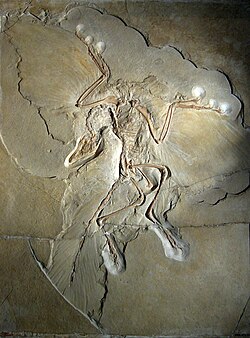
- Key Evolutionary Link: Archaeopteryx serves as a critical fossil bridging the gap between non-avialan dinosaurs and birds.
The History of Sauropsid Classification
The classification of sauropsids has evolved significantly since the 19th century. Thomas Henry Huxley first introduced the term "sauroids" in 1863, later refining it to Sauropsida. Huxley was one of the first to argue that birds had risen from dinosaurs, basing his theory on early fossils such as Hesperornis and Archaeopteryx.
In his early lectures, Huxley grouped vertebrates into mammals, sauroids, and ichthyoids (anamniotes) based on the physiological gaps and the lack of transitional fossils available at the time. Interestingly, Huxley's original definition was broader than today's; he included certain synapsids, such as Dicynodon, within the sauropsids. By 1867, he famously noted that birds so closely resemble reptiles in their fundamental structure that they could be described as "greatly modified Reptiles."
Phylogeny and the Reptile Family Tree
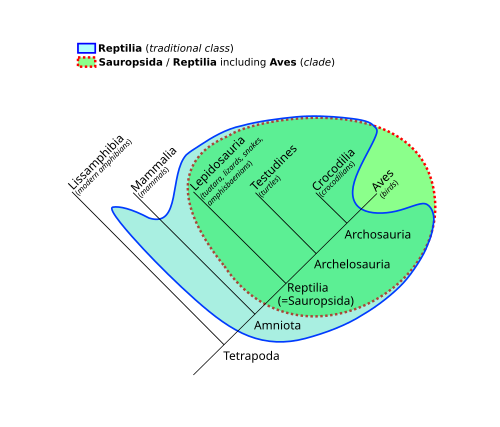
Modern science uses cladistics—a method of classifying organisms based on shared derived characteristics—to map the sauropsid tree. The primary division in the amniote lineage is between the Sauropsida and the Synapsida (the lineage leading to mammals).
Traditional vs. Revisionist Views
Historically, the class Reptilia was viewed as a distinct group. However, modern cladograms show that the traditional conception of "Reptilia" often excludes birds, whereas Sauropsida includes them. This shift highlights the difference between a grade-based classification and a clade-based one, where a clade must include a common ancestor and all its descendants.
Major Subdivisions
The sauropsid lineage is further divided into several key groups:
- Neodiapsida: A massive group including the ancestors of modern lizards, snakes, crocodilians, and birds.
- Parareptilia: A group of early reptiles, often highlighted in traditional views, though their exact placement is sometimes debated in revisionist models.
- Eureptilia: A clade that includes the diapsids and their closest extinct relatives.
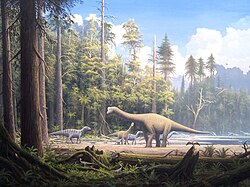
During the Mesozoic era, these groups diversified wildly. Non-avialan dinosaurs and early birds like Archaeopteryx coexisted, illustrating the transition from ground-dwelling reptiles to avian flight.
Summary of Sauropsid Classification
The following table summarizes the scientific hierarchy and temporal range of the Sauropsida.
| Rank/Category | Classification |
|---|---|
| Kingdom | Animalia |
| Phylum | Chordata |
| Clade | Tetrapoda |
| Clade | Reptiliomorpha |
| Clade | Amniota |
| Clade | Sauropsida |
| Temporal Range | Late Carboniferous to Present |
Frequently Asked Questions
What is the difference between Sauropsida and Reptilia?
While often used interchangeably in casual conversation, Sauropsida is a cladistic term that includes all descendants of the common ancestor of reptiles and birds. "Reptilia," in a traditional sense, often excluded birds, making it a paraphyletic group rather than a complete evolutionary clade.
Who first proposed the term Sauropsida?
The term was proposed by Thomas Henry Huxley in 1864, following his 1863 lectures where he initially used the term "sauroids."
Are birds considered sauropsids?
Yes. Modern phylogenetic evidence confirms that birds evolved from theropod dinosaurs, which are part of the sauropsid lineage. Therefore, birds are biologically classified as sauropsids.
When did the first sauropsids appear?
The sauropsid lineage dates back to the Late Carboniferous period (specifically the Pennsylvanian), marking the emergence of early amniotes that could reproduce away from water.
How do sauropsids differ from synapsids?
Sauropsids and synapsids are the two primary branches of amniotes. Synapsids are the lineage that eventually led to mammals, while sauropsids led to the modern reptiles and birds. They differ in brain structure, secretion methods, and thermal regulation.