Avenel Station: A History of Rail Service and Urban Development
The evolution of rail service in Woodbridge Township is a story of community ambition, infrastructure struggles, and urban renewal. From its 19th-century origins as a spur line to its modern role as a transit hub, Avenel station has mirrored the growth and shifting economic landscape of New Jersey.
Early History (1864–1896)
Railroad service in the region began with the Perth Amboy and Woodbridge Railroad, a spur of the New Jersey Railroad connecting Rahway to Perth Amboy. Construction started on July 1, 1858, and concluded in October 1864. Upon opening on October 11, the branch utilized a steam car and trailer, providing service every half-hour.
The area now known as Avenel was originally called Demarest on the Hill, named after the daughter of Captain Demarest, a local developer. In 1867, Demarest proposed a station named "Avanel" in her honor. By May 1869, the area saw a surge in development as 150 construction plots were auctioned, marketed for their high elevation and views of the Watchung Mountains and Staten Island.
To fund the growth, the Demarest family pledged 10 percent of every plot sale toward the construction of a railroad station depot and general area improvements. The planned community featured roads 60 feet wide, with Rahway Avenue serving as a primary artery at 100 feet wide.
Grade Crossing Elimination (1934–1937)
By the 1930s, the danger of grade crossings—intersections where a railroad track and a road cross at the same level—became a critical safety issue. Following the death of a student from the New Jersey College for Women, local outrage pressured the Pennsylvania Railroad to eliminate six crossings in Woodbridge Township.
The process was fraught with financial and bureaucratic hurdles. While the Board of Public Utility Commissioners ordered the work, funding became a point of contention. Woodbridge officials sought aid from the Works Progress Administration (WPA), but initial requests were rejected because the funds were primarily for land and materials rather than labor.
Eventually, a funding agreement was reached involving the state of New Jersey, the federal government (via the Bureau of Public Roads and the PWA), and the railroad companies. A total of $3.231 million was allocated for twelve crossings.
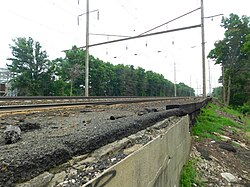
In Avenel, the project focused on Avenel Street and Leesville Avenue. The Avenel Street crossing, costing $218,000, involved depressing the roadway 14 feet under the tracks, constructing a two-track railroad bridge, and installing new retaining walls and platforms. A pedestrian underpass was added in 1937 despite railroad opposition. The project was completed on November 1, 1937.
Station Upgrades and the Threat of Closure (1979–1993)
By 1979, the line was operated as the North Jersey Coast Line by Conrail and the New Jersey Department of Transportation. Due to the "deplorable shape" of the facilities, a $300,000 upgrade plan was launched for several stations, including Avenel. By 1981, improvements included new shelters and repaved asphalt platforms.
Despite these repairs, the station faced a period of decline. In October 1985, NJ Transit cut several non-rush hour stops. By 1992, daily ridership had plummeted to under 75 passengers. NJ Transit began internal discussions to close Avenel station and the North Rahway stop on the Northeast Corridor Line, citing the $600,000 cost required for necessary repairs.
The closure was fought by local legislators and the Woodbridge municipality. They argued that the station was vital for local industry, specifically General Dynamics, which employed over 300 people at the time. After intense political pressure and a budget allocation of $310,000 to keep the station open through 1994, NJ Transit officially decided to retain the service on a permanent basis in October 1993.
Modern Reconstruction (1994–1998)
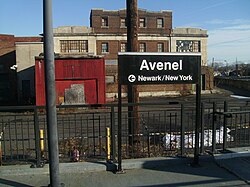
The decision to keep the station led to a comprehensive $2.1 million reconstruction project. The new design focused on accessibility and rider experience, incorporating Americans with Disabilities Act (ADA) compliance through the installation of ramps and an elevator.
Ground was finally broken on June 11, 1998, with funding provided by the Transportation Trust Fund. The project included new platforms with shelters, improved stairs, and enhanced parking. The modernized station officially opened on December 22, 1998.
Development and Service Restoration (2000–2019)
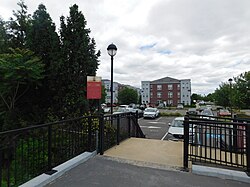
The surrounding area underwent a significant transformation starting in March 2015 with the demolition of the General Dynamics plant. This cleared the way for the Avenel Arts Village and Station Loft, a project supported by a $6 million grant from the Middlesex County Cultural and Arts Trust Fund.
This urban renewal spurred a return in ridership. In response, NJ Transit expanded weekday service from 27 to 38 stops on September 8, 2019, and restored full weekend service for the first time since 1985. Further weekday trains were added in November 2020 to accommodate the growing commuter base.
Key Facts
- Opening: The branch line opened on October 11, 1864.
- Infrastructure: Avenel Street was depressed 14 feet under the tracks in 1937 to eliminate grade crossings.
- ADA Compliance: The 1998 reconstruction added elevators and ramps for accessibility.
- Service Recovery: Weekend service was restored in 2019 after a 34-year hiatus.
- Urban Renewal: The former General Dynamics site was repurposed into the Avenel Arts Village.
| Period/Year | Key Event | Impact/Outcome |
|---|---|---|
| 1864 | Branch Line Opening | Established rail link between Rahway and Perth Amboy. |
| 1937 | Grade Crossing Elimination | Improved safety via road depression and new bridge. |
| 1993 | Closure Averted | Station saved due to local industry and political advocacy. |
| 1998 | Full Reconstruction | Modernized platforms and ADA accessibility. |
| 2015-2019 | Arts Village & Service Expansion | Economic redevelopment and restoration of weekend service. |
Frequently Asked Questions
Why was Avenel station almost closed in the early 1990s?
NJ Transit considered closing the station due to a decline in daily ridership (falling to under 75 passengers) and the high cost of necessary repairs, which were estimated at $600,000 when combined with the North Rahway stop.
What is a grade crossing and why were they eliminated?
A grade crossing is where a road and railroad tracks intersect at the same level. They were eliminated in Avenel during the 1930s to improve safety and reduce accidents, resulting in the road being depressed under the tracks.
How did the General Dynamics plant affect the station?
The plant was a major local employer of over 300 people, and its presence was a key argument used by legislators to prevent the station's closure in 1993. Its later demolition made room for the Avenel Arts Village.
When did weekend service return to Avenel?
Full weekend service was restored on September 8, 2019, marking the first time the station had weekend operations since April 1985.
What improvements were made during the 1998 reconstruction?
The reconstruction included new platforms with shelters, new stairs, and the installation of ramps and an elevator to ensure the station was compliant with the Americans with Disabilities Act (ADA).