Autonomous Rail Rapid Transit: Benefits and Limitations of Trackless Trams
Autonomous Rail Rapid Transit (ART), commonly known as the trackless tram, has emerged as a proposed middle ground between traditional bus rapid transit (BRT) and light-rail systems. By utilizing optical guidance technology—a system where vehicles follow virtual tracks painted on the road—ART aims to provide the capacity and feel of a train without the need for physical steel rails.
While some sustainability experts suggest that ART could replace both light-rail and BRT due to lower costs and faster installation, the technology remains a subject of significant debate among urban planners and engineers.
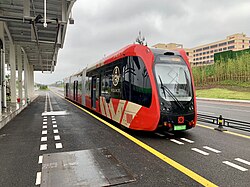
Key Facts
- Guidance: Uses optical sensors rather than physical rails to navigate.
- Turning Radius: Features a minimum turning radius of 15 m (49 ft 3 in), similar to standard buses.
- Deployment: As of 2022, systems are primarily located within China.
- Capacity: A 32-metre vehicle is claimed to hold 307 passengers, though realistic estimates suggest approximately 170.
- Infrastructure: Requires rubber-tired vehicles, which may necessitate significant road reinforcement.
The Promise of Trackless Trams
Proponents of ART argue that the absence of physical rails drastically reduces construction costs and timelines. To improve maneuverability, these vehicles employ multi-axle hydraulic steering and a bogie-like wheel arrangement. This configuration allows for a lower swept path during turns, meaning the vehicles require less side clearance than traditional long buses.
These cost advantages have led some cities to revive abandoned light-rail proposals. For example, a 2020 proposal for the City of Wyndham near Melbourne estimated costs at $AU23.53M per km for roadworks, vehicles, and depots—significantly lower than the $AU80M to $AU150M per km typically seen in Australian light rail projects.
Technical and Operational Limitations
Despite the projected savings, critics argue that ART may simply be a repackaging of the bus as a rail-replacement technology. Several operational hurdles persist:
- Ride Quality: Because it is not rail-based, the ride quality is comparable to a bus rather than a train.
- Traffic Interference: Without dedicated rights of way, vehicles can become stuck in standard road traffic.
- Autonomy: The systems are not yet fully autonomous.
- Procurement: The technology is proprietary, meaning vehicles cannot be purchased through competitive open tenders.
Infrastructure and Energy Concerns
One of the most significant disputes involves road wear. Because ART is a guided system, the wheels follow the exact same path repeatedly. Researchers in 2021 found evidence that this creates ruts and depressions, requiring significant road strengthening. This suggests that the infrastructure work may be as disruptive as installing actual rails.
Additionally, rubber tires have higher rolling resistance than steel wheels, meaning ART vehicles require more energy for propulsion than light rail vehicles. There are also remaining questions regarding how the system performs in winter climates involving ice and snow.
Capacity and Reliability Comparisons
The actual capacity of ART is a point of contention. Official specifications for the 32-metre ARRT assume a standing density of eight passengers per square meter. However, the Auckland Light Rail Group noted that most transit systems typically operate at four passengers per square meter. At this realistic density, capacity drops from the claimed 307 passengers to roughly 170.
This puts ART's capacity slightly above a conventional bi-articulated bus (~150 passengers) but below a typical 33 m long light rail vehicle (LRV), which carries between 210 and 225 passengers.
| Feature | Trackless Tram (ART) | Light Rail (LRV) | Bi-Articulated Bus |
|---|---|---|---|
| Guidance | Optical/Virtual | Steel Rails | Driver-steered |
| Est. Capacity (32-33m) | ~170 (Realistic) | 210–225 | ~150 |
| Infrastructure Cost | Lower (Projected) | Higher | Lowest |
| Energy Efficiency | Lower (Rubber Tires) | Higher (Steel Wheels) | Lower |
| Road Impact | High (Rutting) | Low (on road) | Moderate |
Frequently Asked Questions
Is the trackless tram fully autonomous?
No, current systems are not fully autonomous, which remains one of the primary limitations cited by experts.
How does ART differ from a standard bus?
Unlike a standard bus, ART uses optical guidance to follow a virtual track and employs multi-axle hydraulic steering to handle turns more efficiently, though it still uses rubber tires.
Why is road reinforcement necessary for ART?
Because the vehicles follow a precise guided alignment, the wheels repeatedly hit the same spots on the pavement, which can lead to significant road wear, ruts, and depressions.
Is ART more cost-effective than light rail?
While initial projections suggest lower capital costs for roadworks and vehicles, some organizations, such as the Australian Railways Association, question the long-term reliability and suggest the savings may be illusory.
What is the actual passenger capacity of a 32-metre ART vehicle?
While claimed to hold 307 passengers, realistic estimates based on standard transit standing densities suggest a capacity of approximately 170 passengers.