Australian Mudnesters: The Social World of Choughs and Apostlebirds
In the diverse landscapes of eastern Australia, a unique family of passerine birds—known as the Australian mudnesters (family Corcoracidae)—has evolved a fascinating way of life. These birds are defined not only by their distinctive nesting habits but by an extraordinary level of social cooperation that is rare in the avian world.
The family consists of only two endemic species: the white-winged chough (Corcorax melanorhamphos) and the apostlebird (Struthidea cinerea). While they share many behavioral traits, they occupy slightly different ecological niches and possess distinct physical characteristics.
Key Facts
- Endemicity: Both species are found exclusively in Australia.
- Social Structure: They live in cooperative groups of 2 to 20 birds led by a dominant pair.
- Nesting: They build bowl-shaped nests using mud, which are often reused.
- Parental Care: They exhibit an exceptionally long fledgling care period, sometimes lasting up to 200 days.
- Habitat: Primarily found in open eucalypt woodlands, though they adapt well to suburban areas.
Distribution and Habitat
Both mudnesters thrive in the open habitats of eastern Australia. Their preferred environments include open eucalypt woodlands and forests that lack a closed canopy. The apostlebird is notably more resilient to arid conditions, frequently inhabiting shrublands and arid woodlands.
These species are highly adaptable to human presence. It is common to find them in farmlands, suburban neighborhoods, and even city parks and gardens, where they often become tame around people.
Physical Characteristics and Ecology
While both are medium-sized passerines with long legs and short, rounded wings suited for ground feeding, they differ significantly in appearance and diet.
The Apostlebird
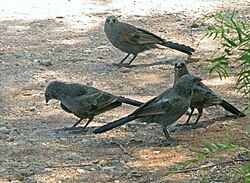
The smaller of the two, the apostlebird measures approximately 31 centimeters (12 inches). It features grey plumage with brown wings and a black tail. Its bill is short and deep, similar to that of a finch, which it uses for "sparrow-like picking" while foraging.
The White-winged Chough
The white-winged chough is larger, averaging 47 centimeters (19 inches). It is characterized by black plumage with striking white patches on the wings. Its bill is long and curved, which it uses to flick through leaf litter to find food.
Social Behavior and Group Dynamics
The most striking feature of the Australian mudnesters is their sociality. They spend their days foraging in groups, communicating constantly through vocalizations. When threatened, they fly heavily to nearby trees, where they often engage in allopreening (the act of grooming another bird) in small clusters.
Their social structure is centered around a dominant male and female. Group sizes vary: white-winged choughs typically travel in groups of six, while apostlebirds usually number between seven and nine, though groups can reach up to 20 individuals.
Cooperative Breeding and "Kidnapping"
These birds are non-migratory and defend territories of roughly 20 hectares during the breeding season. Breeding success relies heavily on "helpers"—youngsters from previous seasons who remain with the group to assist in raising new chicks.
The importance of group size is so critical that white-winged choughs have been observed kidnapping nearly fledged chicks from other groups to artificially increase their own group's numbers.
Nesting and Development
As their common name suggests, these birds construct bowl-shaped nests from mud. This process takes several days and is dependent on the availability of muddy puddles caused by rain. Once built, these nests may be reused in subsequent seasons.
A typical clutch consists of three to five oval eggs, which are incubated for about 20 days. In a display of total group cooperation, all members of the social group share the duties of incubation, brooding, and feeding. The transition to independence is slow, with some fledglings requiring up to 200 days of care before becoming fully independent.
Comparison of Australian Mudnesters
| Feature | Apostlebird (S. cinerea) | White-winged Chough (C. melanorhamphos) |
|---|---|---|
| Average Length | 31 cm (12 in) | 47 cm (19 in) |
| Plumage | Grey with brown wings, black tail | Black with white wing patches |
| Bill Shape | Short and deep (finch-like) | Long and curved |
| Typical Group Size | 7 to 9 birds | 6 birds |
| Feeding Style | Picking | Flicking leaf litter |
| Habitat Preference | Woodlands, shrublands, and arid zones | Open eucalypt woodlands and forests |
Frequently Asked Questions
Why are they called mudnesters?
They are called mudnesters because they construct their bowl-shaped nests using mud, which they collect from puddles after rainfall.
How do these birds raise their young?
They use a cooperative breeding system where the dominant pair is assisted by other members of the group (often offspring from previous years) who help incubate eggs and feed the chicks.
What happens to the group when a dominant breeder dies?
The group typically breaks up. The remaining dominant bird will then take some immature birds from the group and pair with a lone bird to establish a new social unit.
Do white-winged choughs really kidnap other birds?
Yes, white-winged choughs have been reported to kidnap nearly fledged chicks from other groups to increase the size and strength of their own social group.
Where can these birds be found in the wild?
They are endemic to eastern Australia, primarily inhabiting open eucalypt woodlands, though they are also common in suburban parks, gardens, and farmlands.