Australian Border Control: The Role and Responsibilities of the Customs Service
Maintaining the integrity of a nation's borders is a complex and diverse operation. For Australia, the Customs Service served as the predominant border control agency, tasked with the critical mission of ensuring the safety and security of people and goods entering and leaving the country. From managing international travellers at airports to monitoring overseas mail and maritime trade, the agency's effectiveness was vital to protecting the Australian community and maintaining stable international trade relations.
To manage these vast responsibilities, the Service employed an intelligence-led, risk-based approach. Rather than treating all arrivals equally, the agency focused on specific targets that posed the highest risk. This strategic focus allowed for seamless coordination with various government bodies, including the Australian Federal Police, the Australian Crime Commission, and the Department of Defence, among others.
Key Facts
- Primary Mission: Ensuring the safety and security of all people and goods crossing Australian borders.
- Operational Reach: Managed airports, seaports, postal entries, and remote international waters.
- Specialized Units: Operated the Customs Marine Unit for air and sea patrols.
- Financial Role: Collected Goods and Services Tax (GST) on taxable imports and administered the Tourist Refund Scheme (TRS).
- Maritime Authority: Lead agency for patrolling the Exclusive Economic Zone (EEZ) to deter illegal foreign fishing.
Import and Export Control
The Customs Service exercised strict control over the movement of goods to prevent the entry of prohibited or restricted items. This included the interception of harmful materials such as weapons, narcotics, and objectionable computer games. To identify high-risk cargo and travellers, the agency utilized a suite of advanced technologies, including container X-ray facilities, Smartgates (automated border processing kiosks), and closed-circuit television (CCTV) monitoring.
Customs officers were stationed at air and sea ports to assess arrival and departure cards and search passenger baggage. While they handled basic immigration control, any materials posing a quarantine risk were referred to the Australian Quarantine and Inspection Service (AQIS). Similarly, overseas mail was cleared by both Customs and AQIS before being handed over to Australia Post.
Beyond security, the agency played a significant fiscal role by collecting the Goods and Services Tax (GST) on taxable imports. They also managed the Tourist Refund Scheme (TRS), which allowed eligible temporary visitors or returning residents to claim refunds on GST or Wine Equalisation Tax for items purchased within Australia.
Maritime Security and People Smuggling
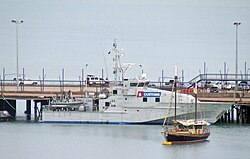
In collaboration with the Australian Defence Force, the Service was the lead agency in responding to people-smuggling operations. This involved monitoring Australian waters for suspected irregular entry vessels—often originating from South-East Asia—and using Bay Class vessels to intercept immigrants without valid visas. Once intercepted, these individuals were transported to Australian territory for necessary immigration and quarantine assessments.
To address the root of the problem, the agency also coordinated overseas education and awareness campaigns designed to deter individuals from attempting to smuggle people into the country.
National Security and Law Enforcement
Counter-Terrorism
Operating under the National Counter-Terrorism Plan, the Service worked with other government departments to mitigate terrorism risks. This involved rigorous screening of air and sea passengers, maritime surveillance, and the inspection of all cargo, including mail, to identify potential threats.
Controlled Substances and Prohibited Material
A major priority for the agency was the prevention of narcotics, precursor substances, and illegal tobacco smuggling. Officers utilized trace detection technology, X-rays, and detector dogs to screen aircraft, vessels, and mail.
Additionally, the Service enforced laws against the importation of offensive or objectionable material. This included content refused classification by the Australian Classification Board, such as child pornography, material depicting sexualized violence, or terrorist and criminal content, whether stored on DVDs, CDs, or hard drives.
Illegal Foreign Fishing
The Service was responsible for patrolling Australia's Exclusive Economic Zone (EEZ)—the sea zone over which a state has special rights regarding the exploration and use of marine resources. Through a combination of aerial surveillance and on-water patrols, the agency detected and deterred foreign fishing vessels, leading to a steady decline in illegal fishing activities.
Summary of Agency Responsibilities
| Area of Responsibility | Key Activities | Tools/Methods Used |
|---|---|---|
| Border Security | Passenger and cargo screening | Smartgates, X-ray, Detector dogs |
| Maritime Patrol | EEZ monitoring, People smuggling interception | Customs Marine Unit, Bay Class vessels |
| Revenue | GST collection, TRS administration | Tax assessment and refunds |
| Law Enforcement | Narcotics and prohibited material seizure | Intelligence-led profiling, Trace detection |
Frequently Asked Questions
What was the role of the Customs Marine Unit?
The Customs Marine Unit was the agency's own air and sea patrol unit, responsible for patrolling remote Australian and international waters, conducting aerial surveillance of the coastline, and intercepting illegal vessels.
How did the agency handle prohibited materials?
The Service prevented the import of materials refused classification by the Australian Classification Board, including child pornography, terrorist material, and offensive violence, across all media formats including electronic games and hard drives.
What is the Exclusive Economic Zone (EEZ)?
The EEZ is the maritime area where the Service conducted regular aerial and on-water patrols to detect and deter illegal foreign fishing vessels.
How were high-risk travellers and cargo identified?
The agency used an intelligence-led, risk-based approach incorporating computer-based profiling, analysis, detector dogs, and X-ray facilities to target specific threats.
What financial services did the Customs Service provide?
The agency collected the Goods and Services Tax (GST) on taxable imported goods and administered the Tourist Refund Scheme (TRS) for eligible tourists and residents.