Austral Snipes: The Rare Tutukiwi of New Zealand's Islands
The austral snipes, known locally in New Zealand as tutukiwi, are a genus of small birds belonging to the sandpiper family (Scolopacidae). These elusive birds are now found exclusively on the outlying islands of New Zealand. Once widespread across the South Pacific—including Fiji, New Caledonia, and Norfolk Island—their range has been drastically reduced due to the introduction of mammalian predators.
Currently, the genus Coenocorypha consists of three living species and six known extinct species. Among the survivors is the Subantarctic snipe, which includes the Campbell Island snipe, a subspecies discovered as recently as 1997.
Key Facts
- Scientific Name: Genus Coenocorypha.
- Current Status: Three living species; six extinct species.
- Physical Traits: Small, stocky birds (19–24 cm) with long bills and brown plumage.
- Diet: Carnivorous, feeding primarily on soil-dwelling invertebrates.
- Primary Threat: Predation by introduced mammals, particularly rats, stoats, and cats.
- Unique Behavior: Males perform nocturnal aerial displays known as "hakawai."
Taxonomy and Distribution
The evolutionary relationship between Coenocorypha and the more common Gallinago snipes remains uncertain, though some researchers suggest they may be a relict taxon of an ancient lineage. The first specimen was collected from the Auckland Islands in 1845 during the voyage of HMS Erebus and HMS Terror, later described by George Gray.
Historically, these birds were far more common. Fossil evidence reveals that the Little Barrier Island form once inhabited the North Island, while the Stewart Island form was widespread across the South Island. Both are now extinct. The genus also once extended to Fiji, New Caledonia, and Norfolk Island before prehistoric extinctions occurred.
Recent morphological and behavioral studies have led scientists to reclassify several forms. While previously considered subspecies of the Auckland Island snipe, the forms from the Snares, Little Barrier, and Stewart Islands are now often recognized as distinct species.
Physical Characteristics
Austral snipes are smaller and stockier than their Gallinago relatives, featuring relatively shorter bills. They typically measure between 19 and 24 cm in length, with wingspans ranging from 28 to 35 cm and weights between 75 and 120 g. The smallest of the group is the Chatham Island snipe.
Their plumage is predominantly brown, often featuring a dark stripe through the eye. The scapulars (wing feathers) are mottled, and in some species, these feathers possess white tips.
Diet and Foraging Behavior
These birds are carnivorous, specializing in invertebrates found within soil and compacted vegetation. They hunt both day and night, though the majority of their activity occurs during the early morning and nighttime hours.
Feeding is a systematic process; snipes probe the soil with their bills, creating approximately 18 holes for every 100 cm of ground. They likely detect prey using touch and Herbst's corpuscles—specialized clusters of cells capable of detecting pressure changes. While smaller prey is swallowed directly through flexible mandibles, larger items are extracted from the soil for easier consumption. Their diet consists mainly of earthworms, amphipods, beetle larvae, and adult beetles.
Breeding and Parental Care
Most austral snipes are monogamous, though some males attempt polygamy. They defend specific territories, though they generally tolerate non-breeding birds within their boundaries. Courtship involves males feeding females and performing the "hakawai"—a nocturnal aerial display involving calls and a non-vocal roar produced by air rushing across the tail feathers (rectrices) during a dive.
Nesting sites are chosen by both partners, but the female is solely responsible for building the nest. A typical clutch consists of two eggs laid three days apart, with an incubation period of 22 days shared by both parents. However, if a male maintains two females, he may only incubate one nest, leaving the other female to incubate alone for a longer period of 38 days.
Once the eggs hatch, the parents split the brood, with each raising one chick. Chicks are typically fed for 41 days and remain with a parent for an additional 20 days. The Chatham Island snipe matures faster, becoming independent at 41 days after only 30 days of feeding.
Conservation and Threats
Because they evolved on islands without land mammals, austral snipes are ecologically naive, meaning they lack natural defense mechanisms against mammalian predators. The introduction of Polynesian rats, followed by black rats, stoats, and feral cats, led to rapid declines.
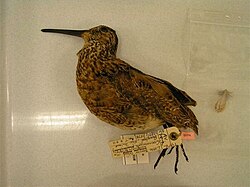
The South Island snipe survived until 1964 on Taukihepa (Big South Cape Island) before rats reached the sanctuary. Efforts to translocate the species were unsuccessful, as the only two captured birds died shortly after. Today, conservationists focus on protecting remaining populations. Successful rat eradication on Campbell Island in 2001 has allowed the Campbell snipe to recolonize the main island from Jacquemart Island.
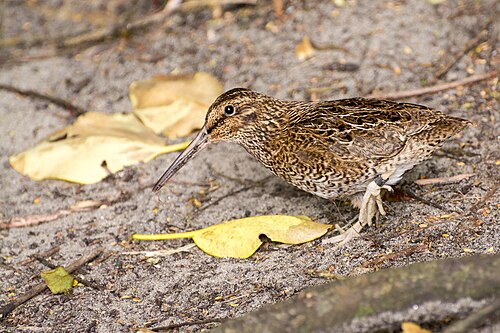
Additionally, new translocation techniques have enabled the establishment of a small Snares Island snipe population off Stewart Island.
Species Summary
| Species/Subspecies | Location | Status |
|---|---|---|
| Chatham snipe (C. pusilla) | Chatham Islands | Extant |
| Auckland snipe (C. a. aucklandica) | Auckland Islands | Extant |
| Antipodes snipe (C. a. meinertzhagenae) | Antipodes Islands | Extant |
| Campbell snipe (C. a. perseverance) | Campbell Island | Extant |
| Snares snipe (C. huegeli) | Snares Islands | Extant |
| North Island snipe (C. barrierensis) | North Island / Little Barrier | Extinct |
| South Island snipe (C. iredalei) | South Island / Stewart Island | Extinct |
| Forbes's snipe (C. chathamica) | Chatham Islands | Extinct |
| Viti Levu snipe (C. miratropica) | Fiji | Extinct |
| New Caledonian snipe (C. neocaledonica) | New Caledonia | Extinct |
| Norfolk snipe (Coenocorypha sp.) | Norfolk Island | Extinct |
Frequently Asked Questions
What is a tutukiwi?
Tutukiwi is the Māori name for the austral snipes, a genus of small, brown, carnivorous birds found on New Zealand's outlying islands.
Why did so many species of austral snipes go extinct?
These birds evolved without land mammals and were ecologically naive. The introduction of predators like rats, cats, and stoats by humans led to their rapid decline and extinction on several islands.
What is the "hakawai" display?
The hakawai is a nocturnal aerial courtship display performed by males, characterized by specific calls and a non-vocal roar created by air moving across their tail feathers during dives.
How do austral snipes find their food?
They use a technique called probing, where they push their bills into the soil. They likely detect invertebrates using touch and Herbst's corpuscles, which are pressure-sensitive cell clusters.
Are there any successful conservation efforts for these birds?
Yes. The removal of rats from Campbell Island in 2001 allowed the Campbell snipe to return to the main island. Additionally, Snares Island snipes have been successfully translocated to a safe site off Stewart Island.