Kōkako: The Rare Wattlebirds of New Zealand
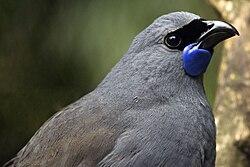
The kōkako is a distinctive forest bird endemic to New Zealand. Belonging to the genus Callaeas, these birds are recognized by their slate-grey plumage, black facial masks, and striking fleshy growths known as wattles. Once widespread across both the North and South Islands, the kōkako now faces a precarious future due to the impact of invasive mammalian predators.
Historically referred to as the New Zealand crow due to its appearance from a distance, the kōkako is not closely related to actual crows. Instead, it is part of the Callaeidae family, a group of New Zealand wattlebirds that includes the tīeke (saddleback) and the now-extinct huia.
Key Facts
- Endemic Status: Found only in New Zealand.
- Species: Includes the endangered North Island kōkako and the presumed extinct South Island kōkako.
- Physical Traits: Slate-grey feathers, black masks, and colorful wattles.
- Movement: Poor fliers that prefer hopping and gliding through the canopy.
- Diet: Omnivorous, eating leaves, fruit, flowers, fern fronds, and invertebrates.
- Cultural Significance: Featured in Māori mythology and on the New Zealand $50 note.
Taxonomy and Classification
The genus Callaeas was established in 1788 by German naturalist Johann Reinhold Forster. The name is derived from the Ancient Greek word kallaia, meaning a cock's wattles. The South Island kōkako (Callaeas cinereus) serves as the type species for the genus.
Taxonomically, the kōkako represents a remnant of an early expansion of passerines (perching birds) in New Zealand. While they share a family with the stitchbird and other wattlebirds, their exact relationship to other bird groups remains a subject of scientific study.
Species Comparison and Description
While both species share a similar grey appearance, they are primarily distinguished by the color of their wattles. The North Island kōkako (Callaeas wilsoni) possesses blue wattles, though these start as light pink in juvenile birds and develop their blue hue as the bird matures.
In contrast, the South Island kōkako (Callaeas cinereus) featured largely orange wattles, with only a small amount of blue visible at the base.
Behavior and Ecology
Vocalizations
The kōkako is renowned for its clear, organ-like song, which is powerful enough to carry for several kilometers. Breeding pairs are known to perform bell-like duets that can last up to an hour during the early morning. Interestingly, different populations across the North Island exhibit distinct regional songs.
Movement and Habitat
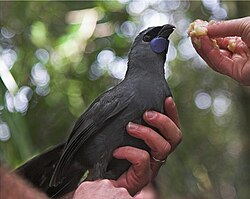
The kōkako is a poor flier with short, rounded wings, rarely flying more than 100 meters at a time. Instead, it relies on powerful grey legs to hop and leap between branches. To move across the forest, the bird typically scrambles up tall trees—often New Zealand podocarps like rimu and mataī—and glides down to the next destination. This unique movement pattern has led ecologists to compare its niche to that of a flying squirrel.
Relationship with Humans
The kōkako holds a special place in Māori culture. In one myth, a kōkako helped the hero Māui during his battle with the sun by providing water stored in its plump wattles. In gratitude, Māui stretched the bird's legs, making them long and strong to help the kōkako navigate the forest more effectively.
Today, the bird is recognized as a national treasure and is depicted on the reverse side of the New Zealand $50 banknote.
Summary of Kōkako Species
| Feature | North Island Kōkako | South Island Kōkako |
|---|---|---|
| Scientific Name | Callaeas wilsoni | Callaeas cinereus |
| Wattle Color | Blue (Pink in juveniles) | Largely Orange |
| Conservation Status | Endangered | Presumed Extinct |
| Plumage | Slate-grey | Slate-grey |
Frequently Asked Questions
Why was the kōkako once called the New Zealand crow?
It was called the New Zealand crow because its slate-grey color and general shape make it look similar to a crow from a distance, although they are not closely related.
What caused the decline of kōkako populations?
Populations were decimated by invasive mammalian predators, specifically possums, stoats, cats, and rats, which led to a significant contraction of their natural range.
How does the kōkako move through the forest?
Because it is a poor flier, the kōkako primarily hops and leaps between branches using its strong legs and glides from the tops of tall trees to nearby foliage.
What do kōkako eat?
Their diet is varied and consists of invertebrates, flowers, fruit, leaves, and fern fronds.
What is the difference between the two kōkako species?
The primary difference is the color of their wattles: the North Island species has blue wattles, while the South Island species had largely orange wattles.