Asian Woolly-necked Stork
The Asian woolly-necked stork (Ciconia episcopus) is a striking large wading bird belonging to the stork family Ciconiidae. Known for its distinctive appearance and adaptable nature, this species inhabits a diverse range of environments across Asia, from dense forest marshes to open agricultural landscapes and freshwater wetlands.
Whether breeding in small, loose colonies or foraging as solitary individuals, the Asian woolly-necked stork is a fascinating example of avian resilience. While once thought to be strictly dependent on protected forest reserves, recent research reveals a bird far more comfortable navigating the intersection of nature and human activity.
Key Facts
- Scientific Name: Ciconia episcopus
- Conservation Status: Near Threatened (IUCN 3.1)
- Height: 75–92 cm
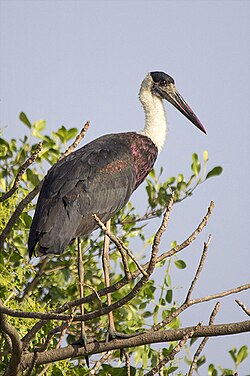
- Distinctive Feature: A downy white neck and a glowing orange-red skin band on the underside of the forearm.
- Diet: Primarily amphibians, reptiles, and insects.
- Distribution: Found across Asia, including India, Indochina, the Philippines, and Indonesia.
Taxonomy and Classification
The species was first described in 1780 by the French polymath Georges-Louis Leclerc, Comte de Buffon, based on a specimen from India's Coromandel Coast. In 1783, Dutch naturalist Pieter Boddaert provided the binomial name Ardea episcopus. Today, it is classified under the genus Ciconia (Latin for "stork"), with the specific epithet episcopus meaning "bishop".
Currently, two recognized subspecies exist:
- C. e. episcopus: Found from India to Indochina, the Philippines, the Malay Peninsula, and north Sumatra.
- C. e. neglecta: Found in south Sumatra, Java, Sulawesi, and the Lesser Sunda Islands.
Taxonomists have recently reclassified the African population (C. e. microscelis) as a separate species, the African woolly-necked stork. This split is based on geographical isolation, though researchers note that genetic and morphological evidence is still needed to fully support this distinction.
Physical Description
The Asian woolly-necked stork is a medium-sized stork, standing between 75 and 92 cm tall. Its plumage is predominantly glistening black, featuring a black "skull cap" and a white lower belly and under-tail coverts. The bird derives its name from the downy white feathers on its neck, while the fore-neck displays iridescent coppery-purple feathers that can be erected during displays.
Other notable physical traits include:
- Eyes: Deep crimson or wine-red irises.
- Bill and Legs: Long red legs and a heavy blackish bill (though some exhibit dark-red bills).
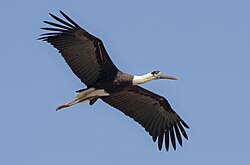
- Tail: Deeply forked and white, though often hidden by black coverts.
- Hidden Detail: When in flight or displaying, a narrow band of "neon, orange-red" unfeathered skin is visible on the underside of the forearm.
Juveniles are duller than adults, often possessing a feathered forehead with black-and-white streaks. While males are generally larger, the sexes are otherwise identical in appearance.
Distribution and Habitat
The Asian woolly-necked stork is highly adaptable, occupying various wetlands and agricultural zones. It is not limited to lowlands; individuals have been recorded at significant altitudes, including 3,790 meters in China's Napahai wetland and 3,540 meters in Nepal's Annapurna Conservation Area.
Behavior and Diet
These storks are typically seen alone, in pairs, or in small family groups of four to five. While large flocks are uncommon, they do occur seasonally. In arid regions, flocking peaks in summer as water sources dwindle, whereas in wetter areas, it occurs in winter after chicks have fledged. In agricultural areas with artificial irrigation, flocking can occur year-round.
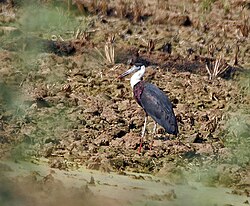
Their foraging strategy is simple: they walk slowly and steadily across the ground, hunting for amphibians, reptiles, and insects.
Breeding and Nesting
The Asian woolly-necked stork typically builds large stick nests in trees. While they use forest trees, they frequently utilize scattered trees in agricultural landscapes. In India, they have occasionally nested on artificial structures like cell phone towers or electricity pylons, and occasionally on riverside cliffs.
Nesting Preferences and Success
In Haryana, India, the birds prefer trees such as Dalbergia sissoo, Ficus religiosa, and Eucalyptus sp., often choosing sites near irrigation canals. Research indicates that these storks are not obligate wetland species—meaning they do not require nests to be immediately adjacent to wetlands to successfully breed.
Clutch sizes typically range from two to six eggs. In some regions, brood success is high, with some nests fledging four, five, or even six chicks. Additionally, over 44% of nest sites are reused across multiple years.
Inter-species Relationships
The nests of the woolly-necked stork provide critical infrastructure for other birds. In Nepal, black kites (Milvus migrans) have been known to reuse these nests. In Haryana, dusky eagle-owls (Bubo coromandus) preferentially choose stork nests over other available options, suggesting a commensal relationship where the stork supports the well-being of large raptors.
Conservation Status
The conservation history of the Asian woolly-necked stork has seen significant shifts. In 2014, it was listed as "Vulnerable" due to fears that deforestation in Southeast Asia was causing catastrophic declines. However, it was down-listed to Near Threatened in 2019.
This change occurred after evidence from Myanmar and South Asia showed that population estimates were severely underestimated. It was discovered that the species thrives in agricultural landscapes and unprotected wetlands, not just in forested reserves. Population estimates for South Asia alone have been revised from 25,000 to over 200,000 individuals.
Despite this, the future remains uncertain in Southeast Asia. Surveys along the Mekong River in Cambodia show population variations, and the loss of protected reserve forests in that region continues to pose a threat.
| Feature | Details |
|---|---|
| Scientific Name | Ciconia episcopus |
| Conservation Status | Near Threatened |
| Primary Habitat | Marshes, agricultural areas, freshwater wetlands |
| Diet | Amphibians, reptiles, insects |
| Key Distribution | South and Southeast Asia |
| Average Height | 75–92 cm |
Frequently Asked Questions
Why is it called the "woolly-necked" stork?
The name comes from the distinctive downy white feathers located on the bird's neck, which contrast sharply with its otherwise glistening black plumage.
Is the Asian woolly-necked stork the same as the African species?
While they were once considered subspecies of the same bird, many taxonomic authorities now classify them as two separate species (Ciconia episcopus and Ciconia microscelis) based on their geographical isolation.
Does this stork only live in protected forests?
No. While they do inhabit forests, research in South Asia has shown that they are highly successful in agricultural landscapes and unprotected wetlands, meaning they are not obligate wetland birds.
What do Asian woolly-necked storks eat?
Their diet consists mainly of small animals found on the ground, specifically amphibians, reptiles, and various insects.
How do these storks help other bird species?
By building large, sturdy stick nests, they provide essential nesting sites for other birds, such as the dusky eagle-owl and the black kite, who often reuse the nests after the storks have fledged.