Argentine Constitution of 1826: A Short-Lived Attempt at National Unity
The Argentine Constitution of 1826 stands as a pivotal, albeit brief, chapter in the political evolution of Argentina. Drafted during the tumultuous era of the Argentine Civil Wars, this document attempted to provide a legal framework for a nation deeply divided by conflicting visions of governance. While it established the presidency and sought to centralize power, its failure to gain broad acceptance led to its swift abolition.
The Road to the 1826 Constitution
Following the Argentine War of Independence in 1810, the region descended into the Argentine Civil Wars. The conflict was primarily a struggle between two ideological factions: the Federals, who advocated for provincial autonomy, and the Unitarians, who pushed for a centralized government based in Buenos Aires.
An earlier attempt at organization, the Constitution of 1819, was heavily centralist and was subsequently abolished in 1820 after the Federals won the Battle of Cepeda. This victory also led to the removal of the Supreme Director of the United Provinces of the Río de la Plata. For a period known as the "anarchy of the year XX," the provinces remained loosely united via the Treaty of Pilar but lacked a formal constitution or head of state.
Efforts to restart the constitutional process were fraught with difficulty. The Treaty of Benegas initially called for a Constituent Assembly in Córdoba, but legal disputes involving Buenos Aires representatives caused the assembly to collapse. Eventually, the Quadrilateral Treaty—signed by Buenos Aires, Santa Fe, Entre Ríos, and Corrientes—paved the way for a new assembly to convene in Buenos Aires on February 27.
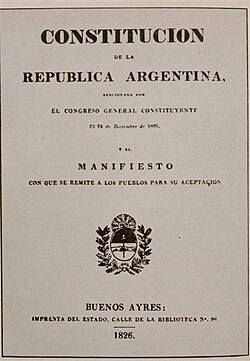
The Deliberations of the Assembly
The Assembly began its work in December 1824, led by President Manuel Antonio Castro and Vice President Narciso Laprida. To avoid the backlash that destroyed the 1819 document, the Assembly passed a "Fundamental law" stating that the new constitution would only take effect once accepted by the provinces.
International Relations and Territorial Changes
During this period, the Assembly handled critical diplomatic matters. In 1825, it approved a treaty of friendship with Britain, which recognized Argentine independence, allowed British subjects religious freedom, and ended the slave trade. Additionally, the Assembly recognized the independence of Upper Peru, which became the nation of Bolivia.
The Assembly also dealt with the Luso-Brazilian invasion of the Banda Oriental. After the "Thirty-Three Orientals" rebelled against Brazilian forces and requested reincorporation into the United Provinces, the Assembly voted unanimously to accept them. This move prompted Emperor Pedro I of Brazil to declare war on the United Provinces.
Centralization of Power and the Presidency
The pressures of war led the Assembly to centralize power to strengthen the military. They organized the national wealth, established a national bank, and restructured the Armed Forces of the Argentine Republic. To increase representation, the Assembly lowered the population requirement for representatives from 15,000 to 7,500, which effectively doubled the number of delegates.
On February 6, 1826, the Assembly created the office of the President of the United Provinces of the Río de la Plata. Bernardino Rivadavia was elected president with 35 votes. This appointment was not without controversy; Juan Bautista Bustos, the governor of Córdoba, rejected Rivadavia's election, leading Córdoba to withdraw from the Assembly.
The Capital City Controversy
One of the most divisive moves was Rivadavia's proposal to make Buenos Aires the national capital. This plan would have abolished the Buenos Aires Province as a separate entity, transferring the city, its port, and surrounding territory to the national government. Despite fierce resistance from both provincial leaders and Buenos Aires representatives, the law was passed, resulting in the closure of the Buenos Aires legislature.
Key Facts
- President: Bernardino Rivadavia was the first president appointed under this framework.
- Ideological Conflict: The document was a flashpoint between Unitarians (centralists) and Federals (autonomists).
- International Impact: The Assembly recognized Bolivia's independence and signed a friendship treaty with Britain.
- Outcome: The constitution was rejected by most provinces and eventually abolished.
- Capital Dispute: The attempt to turn Buenos Aires into a federal district caused significant political instability.
| Feature | Details |
|---|---|
| Primary Goal | Establish a national organization for the United Provinces of the Río de la Plata. |
| Key Figure | Bernardino Rivadavia (President). |
| Political Leanings | Strongly Unitarian/Centralist. |
| Major Conflict | Opposition from Federalist provinces regarding autonomy and the capital city. |
| External Events | War with the Empire of Brazil; Treaty with Great Britain. |
Frequently Asked Questions
Who was the president under the Constitution of 1826?
Bernardino Rivadavia was elected president by the Assembly on February 6, 1826, receiving 35 votes.
What was the main difference between the Unitarians and the Federals?
The Unitarians supported a centralized political system based in Buenos Aires, while the Federals advocated for the autonomy of the individual provinces.
Why was the Constitution of 1826 rejected?
It was rejected by most provinces because of its strong centralist nature and the controversial decision to make Buenos Aires the national capital, which stripped the province of its own institutions.
How did the Assembly handle the issue of slavery?
Through a treaty of friendship signed with Britain in 1825, the Assembly agreed to end the commerce of slaves.
What happened to the province of Córdoba during this process?
Córdoba, led by governor Juan Bautista Bustos, withdrew from the Assembly in protest of Bernardino Rivadavia's appointment as president.