Argentine Confederation
The Argentine Confederation (Spanish: Confederación Argentina) served as the final predecessor state to the modern Argentine Republic. Spanning from 1831 to 1861, this era was defined by a volatile struggle between two opposing political visions: the Unitarians, who sought a strong centralized government, and the Federalists, who advocated for provincial autonomy.
While the name remains one of the official designations of the country under Article 35 of the Argentine Constitution, the period was marked by shifting capitals, intense civil strife, and foreign interventions that shaped the borders and political identity of the nation.
Key Facts
- Timeline: 1831–1861.
- Key Leaders: Juan Manuel de Rosas (Governor of Buenos Aires) and Justo José de Urquiza (President).
- Capitals: Buenos Aires (1831–1853) and Paraná (1853–1861).
- Government Shift: Transitioned from a loose confederation (1831–1853) to a federal presidential republic (1853–1861).
- Defining Conflict: The secession of the State of Buenos Aires from the rest of the Confederation between 1852 and 1861.
Foundations and the Rise of Federalism
The roots of the Confederation lie in the collapse of the Viceroyalty of the Río de la Plata, a Spanish colony. Following the May Revolution of 1810 and the subsequent War of Independence, the region emerged as the United Provinces of the Río de la Plata. However, internal divisions quickly surfaced.
By 1820, the central government dissolved after the Battle of Cepeda, leaving individual provinces to govern themselves. In 1831, the Federal Party gained dominance, leading to the adoption of the name "Argentine Confederation." During this early phase, the country lacked a formal head of state or common legal institutions; instead, the Governor of Buenos Aires managed foreign relations on behalf of the provinces.
The Era of Juan Manuel de Rosas
Juan Manuel de Rosas, a powerful rancher and Federalist leader, dominated Argentine politics for much of the mid-19th century. After being appointed governor in 1835 with "the sum of public power," Rosas maintained order through a combination of military force and political pragmatism.
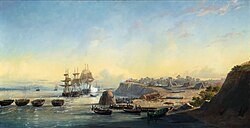
His tenure was marked by frequent international conflict. Rosas faced naval blockades from France and the United Kingdom, as well as wars with Brazil, Bolivia, and Uruguay. One of the most significant military engagements was the Battle of Vuelta de Obligado, where Argentine forces resisted an Anglo-French attempt to navigate the Paraná River.
The Fall of Rosas and the 1853 Constitution
The stability of Rosas's rule fractured when Justo José de Urquiza, the governor of Entre Ríos, demanded the federalization of national income and the establishment of a formal constitution. Urquiza's pronunciamiento (a formal declaration of opposition) led to a military confrontation. In 1852, Urquiza defeated Rosas at the Battle of Caseros, forcing the longtime leader into exile.
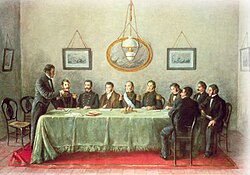
Urquiza sought to institutionalize the state through the San Nicolás Agreement, which paved the way for the 1853 Constituent Assembly. This assembly produced the Argentine Constitution of 1853, establishing a federal presidential republic.
The Secession of Buenos Aires
The transition to a constitutional republic was not seamless. Buenos Aires, resisting the loss of its central influence and the exclusive control of its port, seceded from the Confederation on September 11, 1852. This created two separate entities: the Argentine Confederation (with its capital in Paraná) and the State of Buenos Aires.
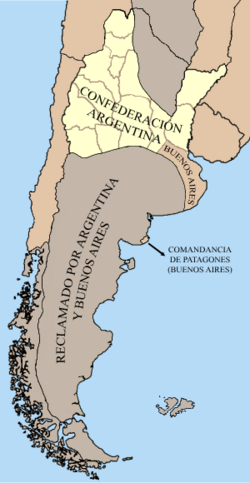
For nearly a decade, these two states existed in a state of tension, characterized by failed military incursions and diplomatic disputes. The Confederation attempted to bring Buenos Aires back into the fold, while Buenos Aires briefly considered declaring itself the "Republic of the Río de la Plata."
Reunification and the Modern Republic
The divide eventually closed through a series of military conflicts and negotiations. After the Battle of Cepeda in 1859, mediation by Francisco Solano López of Paraguay led to a compromise. Buenos Aires agreed to rejoin the Confederation on the condition that the city would not serve as the national capital, allowing it to retain control of its customs house and port.
Following the Battle of Pavón in 1861, led by Bartolomé Mitre, the State of Buenos Aires finally reintegrated. This reunification marked the end of the Argentine Confederation and the birth of the modern Argentine Republic.
Summary of the Argentine Confederation
| Feature | Details |
|---|---|
| Official Names | Confederación Argentina / Argentine Confederation |
| Government Types | Confederation (1831–1853); Federal Presidential Republic (1853–1861) |
| Key Capitals | Buenos Aires, Paraná |
| Currency | Peso moneda corriente |
| Population (1845) | Approximately 1,000,000 |
| Successor State | Argentine Republic (1861) |
Frequently Asked Questions
What was the main difference between Unitarians and Federalists?
Unitarians advocated for a strong, centralized government based in Buenos Aires, while Federalists believed in a decentralized system that granted significant autonomy to the individual provinces.
Who was Juan Manuel de Rosas?
Rosas was the Governor of Buenos Aires and the dominant political figure of the early Confederation. He managed foreign relations for the country and is known for his strong-man rule and conflicts with European powers.
Why did Buenos Aires secede from the Confederation in 1852?
Buenos Aires resisted the federalization efforts of Justo José de Urquiza, specifically opposing the loss of its exclusive control over the port and the national customs revenue.
What was the significance of the Battle of Pavón?
The Battle of Pavón in 1861 resulted in the victory of Buenos Aires over the Confederation, leading to the final reunification of the provinces and the establishment of the modern Argentine Republic.
Is the name "Argentine Confederation" still used today?
Yes, according to Article 35 of the Argentine Constitution, "Confederación Argentina" remains one of the official names of the country, used interchangeably with "República Argentina" and "Provincias Unidas del Río de la Plata."