Andean Ceramics: A History of Pre-Columbian Pottery
Long before the rise of the Inca Empire, the Andean region was home to a succession of great civilizations that flourished for thousands of years. While the Andean preceramic period saw the birth of these societies, the introduction of ceramics—pottery made from clay and hardened by heat—marked a significant technological shift. Appearing around 1800 BCE, these early vessels were likely developed for the practical purpose of boiling agricultural produce.
The earliest evidence of Andean ceramics has been radiocarbon dated to approximately 1800 BCE, though some scholars, including John H. Rowe, suggest the date could be as early as 2100 BCE. These foundational pieces have been unearthed in the Lima area, the Casma River region, and at large settlements such as Huarmey and Las Haldas on the central coast.
Key Facts
- Earliest Dates: Ceramics appeared around 1800 BCE (possibly 2100 BCE) for agricultural boiling.
- Signature Forms: The stirrup spout vessel is a recurring hallmark across multiple Andean cultures.
- Moche Realism: The Moche culture produced some of the most naturalistic portrait vessels in the pre-Columbian Americas.
- Nasca Palette: The Nasca culture utilized one of the largest color palettes in the Americas, featuring up to 13 distinct colors.
- Inca Standardization: The Inca Empire unified regional styles and mass-produced standardized vessels like the urpu.
The Early Horizon: Chavín and Paracas
Between 900 and 200 BCE, Chavín potters on the Peruvian coast developed distinctive stirrup spout vessels—pots with a handle shaped like a stirrup—that were highly burnished and incised. These thin-walled effigy pots often depicted stylized animals, plants, and humans. Two notable substyles emerged: the glossy-on-matte blackware of the Cupisnique style and the red and black Santa Ana style, both of which frequently featured fanged heads.
On the desert south coast, the Paracas culture expanded upon Chavín influences. They created highly detailed ceramics often painted after firing using an acacia resin binder. Their palette consisted of white, black, red-orange, olive green, and warm yellow. Paracas artists introduced the double spout-and-bridge vessel and masks depicting the "Oculate Being," a supernatural entity combining human, owl, and double-headed snake forms.
The Early Intermediate Period: Nasca and Moche
The Nasca culture of the south coast shifted toward slip-painting—applying a mixture of clay and pigment—prior to firing to ensure greater durability. They employed a vast palette of thirteen colors, including rare shades of bluish-grey, maroon, and pale purple. Using revolving turntables, Nasca artists created beakers, ceremonial bowls, and effigy jars often decorated with bold black outlines and curvilinear designs, including the stepped-fret motif.
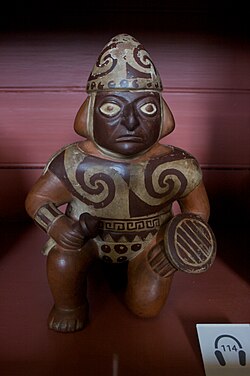
Dominating the north coast from 1 to 600 CE, the Moche culture reached a pinnacle of ceramic artistry. They are renowned for their naturalistic portrait vessels, which were so realistic that individuals can be identified at different stages of their lives. Moche artists used two-press molds to create identical shapes, which were then individualized with narrative, action-packed surface paintings.
While the stirrup-spout vessel remained common, the Moche also crafted whistling double-chambered vessels, dippers, and long-necked jars. A massive 29,000-square-foot workshop discovered at Mount Mayal in the Chicama Valley highlights their industrial scale, specifically specializing in female figurines.
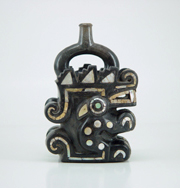
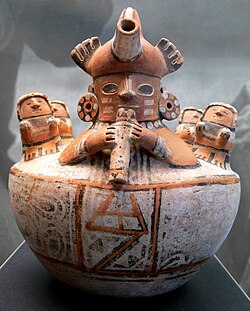
Regional Variations in the Intermediate Period
Other cultures, such as the Recuay, also contributed to the artistic landscape of this era through unique effigy jars.
The Moche's commitment to representational art is further evidenced by their warrior pots, which captured the intensity of ancient Andean conflict.
The Middle Horizon: Tiwanaku and Wari
From roughly 500 to 1000 CE, the Tiwanaku and Wari cultures shared dominance. The Tiwanaku, originating near Lake Titicaca in Bolivia, focused on naturalistic portrait vessels and imagery of a staff-bearing deity. Meanwhile, the Wari culture integrated imagery from their metalwork and textiles, frequently depicting alpacas and llamas.
Wari production was centered in Qunchupata, Peru, where pit kilns and firing rooms with rounded stone floors were used to accommodate large pots. Interestingly, some Wari palaces had private kilns, and evidence suggests that ceramics were often ritually destroyed, with broken potsherds later reused as scrapers or forms for new pottery.
The Late Intermediate Period and the Inca Empire
During the Late Intermediate Period, four civilizations—the Chancay, Chimú, Lambayeque, and Ica—mass-produced luxury ceramics for both nobles and the emerging middle class. Mold-made ceramics became more prevalent than individualized hand-crafted works.
- Lambayeque: Known for press-molded reliefs on blackware.
- Chimú: Specialized in blackware with zoomorphic appliqués (such as sea birds or monkeys) and whistling vessels.
- Chancay: Produced sand-tempered, unpolished ceramics with black-on-white designs, often in the shape of female effigies.
- Ica: Created the finest quality ceramics of the era, utilizing handcrafted polychrome slips in colors like glittery deep purple and maroon.
The Inca Empire (Tawantinsuyo), the world's largest empire by 1500 CE, unified these diverse regional styles into a more understated, geometric aesthetic. They standardized pottery for administrative use, most notably the urpu—a long-necked, pointed-bottom jar used to transport maize and chicha (maize beer). They also used qirus, which were drinking vessels crafted from ceramics, wood, or precious metals.
| Time Period | Approximate Dates | Key Cultures/Sites |
|---|---|---|
| Lithic | 10,000–3,000 BCE | Guitarrero Cave |
| Cotton Pre-Ceramic | 3000–1800 BCE | Norte Chico, Huaca Prieta, Las Haldas |
| Initial Period | 1800–800 BCE | Chinchorro, Las Haldas |
| Early Horizon | 800–200 BCE | Chavín, Paracas, Cupisnique, Pukará |
| Early Intermediate Period | 200 BCE–500 CE | Moche, Nasca, Recuay, Huarpa, Tiwanaku |
| Middle Horizon | 500–900 CE | Moche, Lambayeque, Ica, Wari, Tiwanaku |
| Late Intermediate Period | 900–1400 CE | Chancay, Chimú, Lambayeque, Ica, Inca |
| Late Horizon | 1400–1534 CE | Inca |
Frequently Asked Questions
What was the primary purpose of the first Andean ceramics?
The earliest ceramics, appearing around 1800 BCE, were primarily used for boiling agricultural produce.
What is a stirrup spout vessel?
A stirrup spout vessel is a characteristic Andean pottery form featuring a handle shaped like a stirrup that connects the body of the vessel to the spout.
How did Moche pottery differ from other Andean styles?
Moche pottery was exceptionally naturalistic and representational, featuring realistic portrait vessels and narrative paintings that depicted specific individuals and action scenes.
What was the urpu used for in the Inca Empire?
The urpu was a standardized, long-necked jar with a pointed bottom used for transporting maize and chicha (maize beer).
Which culture used the largest variety of colors in their pottery?
The Nasca culture used the largest palette in Pre-Columbian ceramics in the Americas, utilizing thirteen distinct colors, including rare shades like pale purple and bluish-grey.