Alexander Hamilton: Architect of the American Financial System
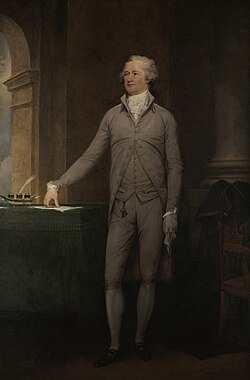
Alexander Hamilton was a pivotal figure in the founding of the United States, serving as a soldier, statesman, and the primary architect of the nation's early economic infrastructure. Born in the British Leeward Islands, Hamilton rose from humble beginnings to become the first United States Secretary of the Treasury, leaving an indelible mark on the American legal and financial landscape.
Throughout his career, Hamilton championed a strong central government and a diversified economy. His vision transitioned the United States from a loose confederation of states into a cohesive global power with a stable currency and a robust industrial base.
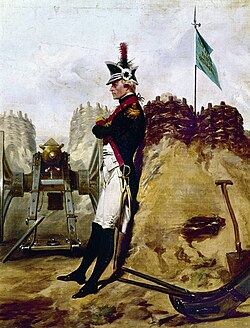
Key Facts
- Role: First U.S. Secretary of the Treasury (1789–1795).
- Military Rank: Major General in the United States Army.
- Key Contribution: Co-authored The Federalist Papers to promote the ratification of the U.S. Constitution.
- Economic Legacy: Established the First Bank of the United States and the U.S. Mint.
- Death: Died at age 47 or 49 following a duel with Aaron Burr in 1804.
Early Life and the Revolutionary War
Born in Charlestown, Nevis, around 1755 or 1757, Hamilton pursued his education at King's College (now Columbia College). His intellectual prowess and leadership quickly became evident during the American Revolutionary War.
Hamilton began his military service in the New York Provincial Company of Artillery before becoming a key aide-de-camp to General George Washington. He served on Washington's staff throughout the conflict, participating in critical engagements including the Battles of Trenton, Princeton, Brandywine, and Germantown. He eventually achieved field command, most notably during the Siege of Yorktown.
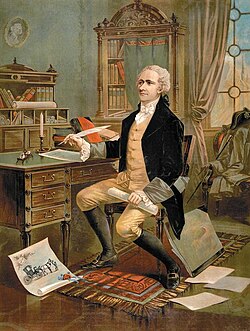
Shaping the U.S. Constitution
After returning to civilian life in 1782, Hamilton became a delegate to the Congress of the Confederation from New York. He grew increasingly concerned with the weaknesses of the existing government and became a driving force behind the creation of a new, stronger federal framework.
Hamilton played a central role in the drafting of the U.S. Constitution. To ensure its ratification, he collaborated on The Federalist Papers, a series of essays designed to explain the necessity of the Constitution to the American public and political leaders.
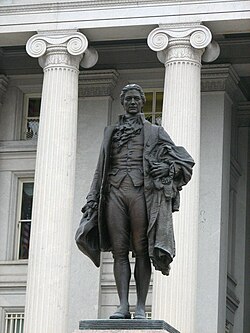
The First Secretary of the Treasury
Appointed by President George Washington in 1789, Hamilton took office as the first Secretary of the Treasury. He faced the daunting task of managing the young nation's massive war debts and establishing a reliable financial system.
Financial Infrastructure and Credit
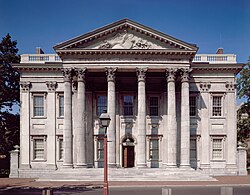
Hamilton's Report on Public Credit proposed that the federal government assume state debts to establish national creditworthiness. He further advocated for the creation of a national bank to manage government funds and issue a single currency.
Industrialization and Revenue
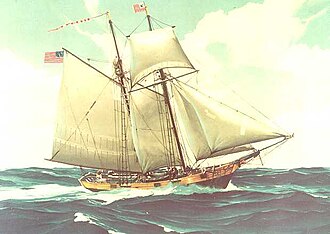
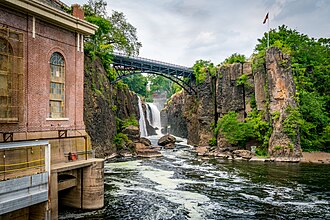
Beyond banking, Hamilton envisioned an America that was not solely dependent on agriculture. He promoted the growth of manufacturing and industry, identifying the potential of natural resources—such as the Great Falls of the Passaic River—to power new factories. To fund these initiatives, he established the U.S. Mint and created the Revenue Cutter Service (the precursor to the Coast Guard) to enforce customs laws.
Political Rivalries and Later Years
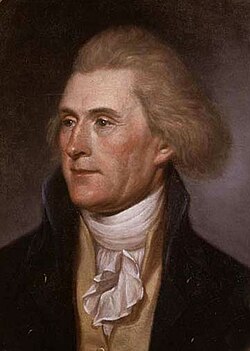
Hamilton's vision for a powerful federal government put him at odds with Thomas Jefferson and James Monroe, who favored states' rights and an agrarian society. This ideological divide led to the emergence of the first American political parties: the Federalists, led by Hamilton, and the Democratic-Republicans, led by Jefferson.
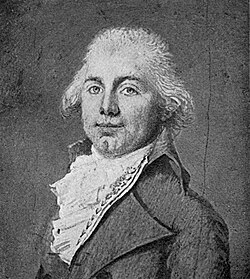
Hamilton's later years were marked by political turmoil and personal scandal, including the Reynolds affair. Despite these challenges, he continued to influence U.S. policy during the Quasi-War, briefly returning to military service as a Major General in the United States Army from 1798 to 1800.
The Duel with Aaron Burr
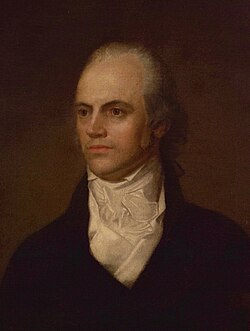
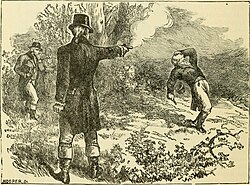
The long-standing political animosity between Hamilton and Aaron Burr culminated in a fatal encounter. After years of rivalry, the two men met for a duel in Weehawken, New Jersey, on July 11, 1804. Hamilton was mortally wounded and died the following day.
Legacy and Cultural Impact
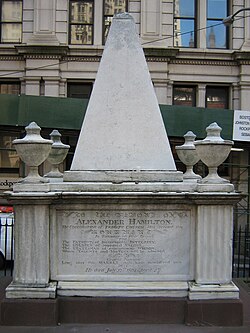
Alexander Hamilton is buried in Trinity Church Cemetery in Lower Manhattan. His influence persists in the structure of the U.S. Treasury, the American banking system, and the legal interpretations of the Constitution.
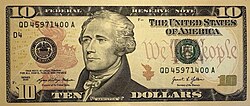
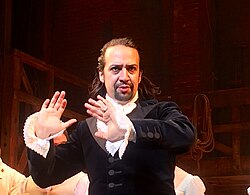
In modern times, Hamilton has remained a figure of public fascination. He has appeared on the ten-dollar bill since 1928 and was the subject of the critically acclaimed musical Hamilton, written by Lin-Manuel Miranda.
| Period | Role/Position | Key Achievement/Event |
|---|---|---|
| 1775–1782 | Continental Army Officer | Aide to George Washington; Siege of Yorktown |
| 1787–1788 | Constitutional Delegate | Co-authored The Federalist Papers |
| 1789–1795 | Secretary of the Treasury | Established National Bank and U.S. Mint |
| 1798–1800 | Major General, U.S. Army | Service during the Quasi-War |
| 1804 | Private Citizen | Fatal duel with Aaron Burr |
Frequently Asked Questions
What was Hamilton's primary goal as Secretary of the Treasury?
Hamilton aimed to establish the financial stability of the United States by creating a national bank, establishing a single currency, and ensuring the federal government could manage and pay off its public debts to build international credit.
How did Hamilton contribute to the U.S. Constitution?
Hamilton was a delegate to the Constitutional Convention and later co-authored The Federalist Papers, a series of essays that argued in favor of the new Constitution's ratification.
Who were Hamilton's main political rivals?
His primary rivals were Thomas Jefferson and James Monroe, who disagreed with his Federalist views on a strong central government and industrialization, preferring a decentralized, agrarian-based republic.
What led to the duel between Hamilton and Aaron Burr?
The duel was the result of years of political rivalry and personal animosity between the two men, which peaked during the election of 1800 and subsequent political disputes.
Did Alexander Hamilton own slaves?
Records indicate that Hamilton himself never owned a slave, although there is historical discussion regarding his wife's ownership of a body servant.