Ain Dara Temple: The Ancient Syrian Sanctuary and Its Tragic Loss
Nestled in the Afrin District of the Aleppo Governorate in Syria, the Ain Dara temple stood for millennia as a testament to the architectural sophistication of the ancient Near East. Located 67 kilometers northwest of Aleppo, this site served as a critical crossroads for trade between Mesopotamia, Anatolia, the Levant, and the Mediterranean. While it once offered scholars a rare glimpse into the religious structures of the Late Bronze and Iron Ages, the site has recently suffered catastrophic damage and looting.
The temple was part of a larger settlement covering 25 hectares, consisting of a Lower Town and an Upper City, or acropolis, which sits 25 meters above the surrounding plain. Habitation at the site dates back to the Chalcolithic period in the fourth millennium BC and continued through to the Ottoman era.
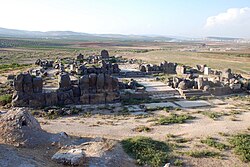
Key Facts
- Location: Ain Dara village, Afrin, Aleppo Governorate, Syria.
- Timeline: Built and used between approximately 1300 BC and 740 BC.
- Cultural Influence: Associated with Hittite and Aramean cultures.
- Dimensions: The temple structure measured 30 meters in length and 20 meters in width.
- Significance: Noted for its striking architectural similarities to the biblical Temple of Solomon.
- Current Status: Heavily damaged by airstrikes (2018) and looted (2019).
Historical Context and Development
Excavations led by Ali Abu Assaf suggest the temple was constructed in three distinct structural phases. The first phase spanned from 1300 to 1000 BC, followed by a second phase from 1000 to 900 BC, and a final phase from 900 to 740 BC.
The Hittite Influence
The temple's origins coincide with the expansion of the Hittite Empire. Around 1350 BC, Suppiluliuma I of Hatti conquered the lands west of the Euphrates, installing his sons as viceroys in Aleppo and Carchemish. Because Ain Dara sat on vital routes from Anatolia into the Northern Levant, it became a strategic and cultural hub during the late reign of Mursili II or the early reign of Muwatalli II. This Hittite control persisted until the empire's collapse around 1190 BC.
Architectural Features
The temple was a complex stone structure designed for ceremonial use, facing southeast and featuring a layout that progressed from public spaces to a secluded inner sanctum.
Exterior and Entrance
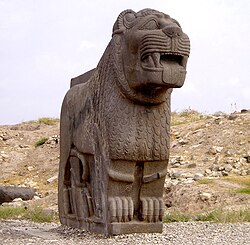
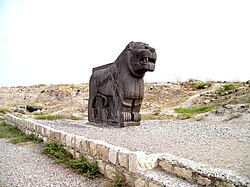
Visitors approached the temple through a sandstone courtyard paved with flagstones, which included a chalkstone basin for ceremonial purposes. The entrance was marked by a portico with two basalt piers and a wide, roofless hall. This area was decorated with a sphinx and two lions flanking three basalt steps.
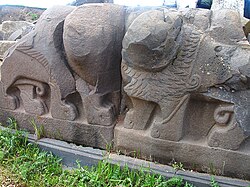
Interior Layout
The interior was divided into three primary sections: the porch, a middle room, and the sanctum sanctorum (the innermost holy place). The middle room, measuring 6 by 15.5 meters, was adorned with lion reliefs and guilloché (an ornamental pattern of interlaced bands). The main square hall measured 16 by 16 meters and contained a raised podium 0.75 meters high, a niche, and a secondary wall.
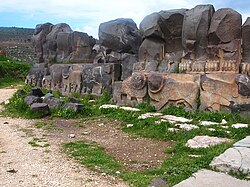
The Divine Footprints
One of the most enigmatic features of the temple was a pair of large, bare footprints carved into the portico floor, each approximately 1 meter in length. These were followed by two additional single footprints. Archaeologists believe these represent the deity Ba'al Hadad striding into his abode. Based on the scale of these carvings, the deity would have stood roughly 20 meters tall.
Parallels with Solomon's Temple
The temple at Ain Dara is most famous among historians for its similarities to the First Temple of Jerusalem (Solomon's Temple), as described in the Hebrew Bible. Because Ain Dara predates the First Temple, it provides a physical archetype for the architectural style described in biblical texts.
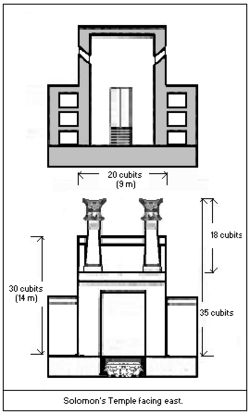
Archaeologists have identified 33 architectural elements at Ain Dara that align with 65 features mentioned in the Books of Kings. Key similarities include:
- A three-room configuration: portico, main chamber, and shrine.
- A location on a high place overlooking a city.
- The presence of a raised podium.
- The use of lion and cherubim-like reliefs.
| Feature | Ain Dara Temple | Solomon's Temple (Biblical) |
|---|---|---|
| Layout | Portico $\rightarrow$ Middle Room $\rightarrow$ Sanctum | Portico $\rightarrow$ Main Hall $\rightarrow$ Holy of Holies |
| Dimensions | 30m x 20m | 35m x 9m |
| Key Elements | Raised podium, basalt lions | Raised podium, cherubim |
| Setting | Acropolis overlooking valley | High place overlooking Jerusalem |
The Destruction of a Heritage Site
The discovery of the site began in 1955 with the finding of a colossal basalt lion, leading to systematic excavations between 1980 and 1985.
However, the site became a casualty of the Syrian conflict. In late January 2018, Turkish airstrikes during the Afrin offensive caused massive damage. Reports indicate that approximately 60% of the structure was reduced to rubble, including the entire front facade.
The tragedy continued in December 2019, when the emblematic basalt lion—a masterpiece of Iron Age sculpture—was stolen by members of the Hamza Division, a Turkish-backed militia. By January 2022, remote sensing data revealed that almost all mounds at the site, excluding the temple complex itself, had been bulldozed.
Frequently Asked Questions
What makes the Ain Dara temple historically significant?
It is one of the oldest known temples of its kind and provides a critical physical parallel to the architectural descriptions of Solomon's Temple in the Bible, helping historians understand Iron Age religious structures.
Who was the temple dedicated to?
While not explicitly written, the giant footprints carved into the floor suggest the temple was dedicated to the storm god Ba'al Hadad.
What happened to the "Lion of Afrin"?
The colossal basalt lion, discovered in 1955, was looted and stolen in December 2019 by Turkish-backed Syrian rebel forces during Operation Peace Spring.
How much of the temple was destroyed in 2018?
Reports from the Syrian Directorate-General of Antiquities and Museums indicate that at least 60% of the structure was destroyed by Turkish airstrikes, including the entire front facade.
How does the layout of Ain Dara compare to Solomon's Temple?
Both share a long-room plan with a three-part configuration consisting of an entrance portico, a main hall, and an inner shrine, as well as a location on a high point overlooking a city.