Acheulean Tool Tradition: The Dawn of Advanced Stone Technology
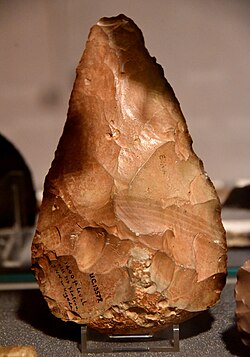
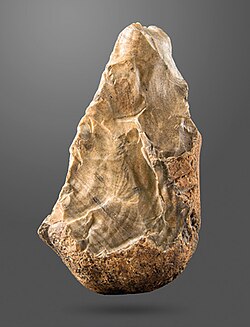
The Acheulean represents a pivotal leap in human evolution, marking the transition from simple stone flakes to sophisticated, intentionally shaped tools. Emerging during the Lower Paleolithic era, this cultural tradition is defined by the production of large, bifacially flaked cutting tools—most notably the iconic hand-axe and cleaver. These tools were not merely accidental shapes but the result of a mental blueprint, reflecting a significant cognitive advancement in early hominins.
Spanning vast regions of Africa, Europe, and Asia, the Acheulean tradition is most frequently associated with Homo erectus, though early versions may have been crafted by Homo ergaster. This technological era bridged the gap between the primitive Oldowan industry and the more complex toolkits of the Middle Paleolithic.
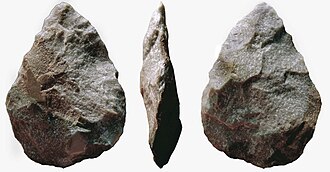
Key Facts
- Timeframe: Approximately 1.95 million to 130,000 years ago.
- Primary Tools: Bifacial hand-axes and cleavers.
- Geographic Reach: Africa, West Asia, South Asia, East Asia, and Europe.
- Associated Species: Primarily Homo erectus and Homo ergaster.
- Defining Feature: Symmetrical flaking on both sides of the stone core.
The Evolution and Dating of Acheulean Technology
Determining the exact timeline of the Acheulean requires complex geological techniques. Researchers utilize radiometric dating (such as potassium-argon dating) and magnetostratigraphy (the study of the Earth's magnetic field reversals recorded in rocks) to establish chronology.
While early estimates placed the tradition at 1.5 million years ago based on finds in Ethiopia and South Asia, more recent evidence has pushed the date further back. In 2003, finds in the West Turkana region of Kenya were dated to 1.76 million years ago, and 2023 reports from Ethiopia suggest the tradition may have begun as early as 1.95 million years ago.
The technology likely originated in Africa before spreading to the Middle East, Asia, and Europe between 1.5 million and 800,000 years ago. In Europe, while it was once believed that these tools arrived 500,000 years ago, evidence from Spain now indicates their presence more than 900,000 years ago.
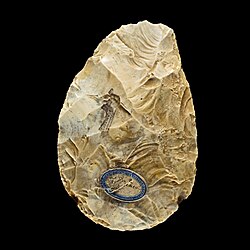
Craftsmanship and Manufacture
From Stone to Soft Hammers
Early Acheulean tools were produced using stone-on-stone percussion. However, later toolmakers introduced soft hammer percussion, utilizing materials such as bone, antler, or wood. This technique allowed for far greater control over the tool's final shape and enabled the resharpening of blunted edges.
The Boxgrove site in southern England, dating to roughly 480,000 years ago, provides some of the earliest evidence of soft hammer use in Eurasia. This shift marked a transition where the stone core itself became the prized object, rather than the flakes produced during the process.
![Acheulean hand-axes from Kent. The types shown are (clockwise from top) cordate, ficron, and ovate.[citation needed]](/images/21/95/219597a3b3f868881a27beea593d224d7b770c08e78fa183622d612b894a88d8.jpg)
Symmetry and Design
Unlike the preceding Oldowan tools, Acheulean implements were worked symmetrically on both sides. This indicates a higher level of care and a predetermined design. In Africa, a clear evolution is visible: tools created before 600,000 years ago tend to be thicker and less symmetric, while later tools are more extensively trimmed and refined.
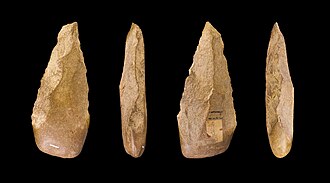
Utility and Application
The efficiency of the Acheulean hand-axe was a massive improvement over earlier technology. Research by Loren Eiseley indicates that these tools provided an average useful cutting edge of 20 centimeters, compared to just 5 centimeters for Oldowan tools.
Wear analysis from the Boxgrove site suggests these tools were used primarily for animal butchery. Interestingly, there is little to no evidence that they were used for digging or woodworking, suggesting a specialized role in processing meat and marrow.
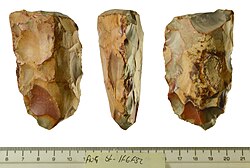
Global Distribution and Human Habitation
The spread of the Acheulean tradition tracks the movement of early humans across the globe. In northern Israel, the Bnot Ya'akov Bridge site shows evidence of habitation as early as 750,000 years ago, featuring a rich layer of stone tools, plant remains, and animal bones.
In Azerbaijan, the Azykh cave has yielded both Acheulean tools and the lower jaw of a hominid referred to as "Azykhantropus." Other significant finds include tools discovered at high altitudes in Egypt, suggesting a wide range of environmental adaptations.
The tradition eventually gave way to more advanced methods. In Europe and the Middle East, the Mousterian industry—which utilized the Levallois technique for preparing stone cores—began to displace the Acheulean around 320,000 years ago, with the transition largely complete by 125,000 years ago.
Acheulean Summary Table
| Feature | Oldowan (Preceded) | Acheulean | Mousterian (Followed) |
|---|---|---|---|
| Primary Focus | Flakes/Choppers | Bifacial Cores (Hand-axes) | Prepared Cores (Levallois) |
| Symmetry | Low/Asymmetric | High/Symmetric | High/Specialized |
| Cutting Edge | ~5 cm average | ~20 cm average | Variable/Refined |
| Key Species | Homo habilis | Homo erectus/ergaster | Neanderthals |
![Depiction of a Terra Amata hut in Nice, France dated to 400 thousand years ago, as postulated by Henry de Lumley.[2]](/images/c3/05/c305bdce40ae7b036e5fb10378dd937f76fc5e5ee6af293ae78e29e876e5dded.gif)
Frequently Asked Questions
What is a biface?
A biface is a stone tool that has been flaked on both sides to create a sharp edge and a symmetrical shape, characteristic of the Acheulean hand-axe.
Who were the primary makers of Acheulean tools?
The tools are most commonly associated with Homo erectus, though evidence suggests Homo ergaster may have been the earliest users.
How did the Acheulean differ from the Oldowan tradition?
While Oldowan tools were simple flakes and choppers, Acheulean tools were larger, symmetrical, and intentionally shaped into specific forms like hand-axes, providing a much longer cutting edge.
Where did the Acheulean tradition originate?
Geological evidence indicates that the Acheulean originated in Africa before spreading into Asia and Europe.
What was the primary use of the Acheulean hand-axe?
Based on wear analysis from sites like Boxgrove, these tools were primarily used for the butchery of animals.