Aberdeen Railway Station: A Hub of Scottish Transit and Heritage
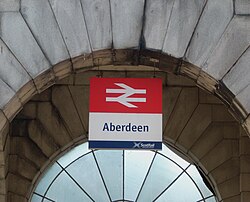
Located in the heart of the city on Guild Street, Aberdeen railway station serves as the primary rail gateway for northeast Scotland. As the busiest station in the region north of Edinburgh and Glasgow, it acts as a vital terminus for the Dundee–Aberdeen and Aberdeen–Inverness lines, connecting the "Granite City" to the rest of Great Britain.
The station is managed by ScotRail and owned by Network Rail, providing a seamless transition for passengers moving between inter-city, regional, and sleeper services. Its strategic location adjacent to the Union Square complex makes it a central point for urban mobility.
Key Facts
- Location: Guild Street, Aberdeen, Scotland.
- Status: Category A Listed Building (designated March 2, 1990).
- Platforms: 6 active platforms (numbered 2–7).
- Primary Operators: ScotRail, LNER, CrossCountry, and Caledonian Sleeper.
- Recent Growth: Passenger volume grew from 0.394 million in 2020/21 to 2.378 million in 2024/25.
A History of Evolution
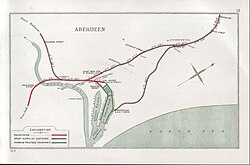
The current station opened on November 4, 1867, as Aberdeen Joint, replacing the previous termini at Aberdeen Guild Street and Aberdeen Waterloo. This consolidation, enabled by the Denburn Valley Line, allowed lines from the south and the Deeside commuter line to integrate with northern routes.
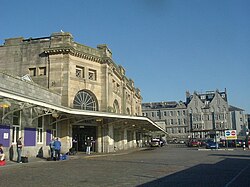
Between 1913 and 1916, the station underwent a massive rebuild costing £180,000. This expansion introduced 13 platforms and a total frontage of 2.5 miles, with the longest platform reaching 1,596 feet. The architecture utilized granite from Kemnay and freestone from Northumberland, reflecting the local aesthetic of the region.
Nationalisation and Rationalisation
Following the Railways Act 1921, the station was shared between the London and North Eastern Railway (LNER) and the London Midland and Scottish Railway (LMS). Upon nationalisation in 1948, it became part of British Rail. The 1960s and 70s saw a period of contraction; services to Peterhead, Ellon, and the Deeside Line were cut, and the number of platforms was reduced from thirteen to seven by 1973.
Despite these cuts, the era brought high-speed InterCity 125 services to London and a major renovation in the 1980s. By the mid-1990s, the station transitioned through privatisation, moving from Railtrack to its current ownership under Network Rail.
Modern Redevelopment and Facilities
In recent years, Aberdeen station has undergone significant modernization to improve the passenger experience. A major refurbishment took place between 2007 and 2008, followed by a comprehensive redevelopment from 2020 to 2022. This latest phase included the relocation of the ticket office and first-class lounge to create more retail space and the installation of modern glazed frontages.
A highlight of the recent work was the restoration of the North Corner Pavilion Building. Completed in December 2021, this sympathetic restoration won the Arch Company Award for Urban Heritage at the 2022 National Railway Heritage Awards.
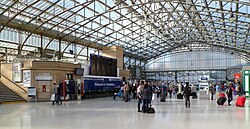
Today, passengers have access to a waiting room on the main concourse and a WHSmith outlet. Further shopping and dining options are available via direct access to the integrated Union Square complex.
Passenger Statistics and Connectivity
The station has seen a steady recovery and growth in passenger numbers following the pandemic. Edinburgh remains the most frequent destination for travelers departing from Aberdeen.
| Year | Entries and Exits | Interchanges |
|---|---|---|
| 2020/21 | 0.394 million | 27,863 |
| 2021/22 | 1.537 million | 0.125 million |
| 2022/23 | 1.961 million | 0.179 million |
| 2023/24 | 2.288 million | 0.202 million |
| 2024/25 | 2.378 million | 0.219 million |
Integrated Transport Links
- Buses: Regional and national services, including the Jet 727 to Aberdeen Airport, operate from the nearby Aberdeen bus station.
- Ferries: The Aberdeen ferry terminal is located approximately 450 metres away, providing NorthLink Ferries services to the Orkney and Shetland Islands.
Frequently Asked Questions
Which train operators serve Aberdeen station?
The station is served by ScotRail, London North Eastern Railway (LNER), CrossCountry, and the Caledonian Sleeper.
Is Aberdeen station a protected building?
Yes, the station building and road overbridge are designated as a Category A Listed Building by Historic Environment Scotland.
How do I get to the airport from the station?
Passengers can use the Jet 727 bus service, which departs from the Aberdeen bus station located on the opposite side of the Union Square shopping centre.
What are the main destinations from Aberdeen?
Key destinations include Edinburgh, Glasgow, Inverness, and London (via both King's Cross and Euston).
Are there ferry connections available?
Yes, the NorthLink Ferries terminal is within walking distance (about 450 metres), offering travel to Kirkwall in Orkney and Lerwick in Shetland.