Inverness Railway Station: The Gateway to the Scottish Highlands
Serving as the vital transport hub for the city of Inverness and the wider Highland region, Inverness railway station is more than just a transit point; it is the terminus for several of Scotland's most scenic rail routes. From the rugged landscapes of the Far North to the urban centers of Glasgow and Edinburgh, the station connects the Highlands to the rest of the United Kingdom.
The station acts as the terminus for the Highland Main Line, the Aberdeen–Inverness line, the Kyle of Lochalsh line, and the Far North Line. Its strategic location in the city center makes it an essential link for both residents and tourists exploring the north of Scotland.
Key Facts
- Opened: 5 November 1855.
- Ownership: Owned by Network Rail and managed by ScotRail.
- Capacity: 7 platforms in total.
- Passenger Volume: Approximately 1.173 million entries and exits in 2024/25.
- Connectivity: Direct links to London, Aberdeen, Glasgow, and Edinburgh.
History and Evolution
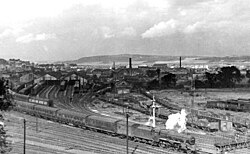
Designed by architect Joseph Mitchell, the station first opened on 5 November 1855 as the western terminus of the Inverness and Nairn Railway. In its earliest form, it was modest, featuring a single 200-foot (61 m) covered platform with three rail lines dedicated to arrivals, departures, and carriages.
As rail travel grew in popularity, the station underwent several expansions. By 1865, the platform was lengthened to 300 feet (91 m) and a large shed was added. Further extensions occurred in 1876 under Murdoch Paterson, increasing platform lengths to 500 feet (150 m). A significant technological milestone was reached in 1908 when the platforms were first illuminated by electricity.
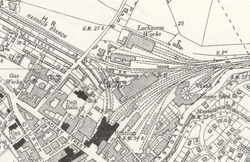
The mid-20th century brought structural modernization. Between 1966 and 1968, British Rail replaced the original station buildings with a new design by Thomas Munro and Company. More recently, the station has been the focus of urban regeneration. A major reconstruction project announced in 2020 aims to reduce CO2 emissions in the city center, incorporating hydrogen vehicle fueling and e-bike stations.
Station Layout and Facilities
The station is situated at a triangular junction, which dictates its unique layout. Platforms 1–4 serve the Highland Main and Aberdeen lines approaching from the east. Platforms 5–7 serve the Far North and Kyle of Lochalsh lines approaching from the northwest.
The platforms vary in length to accommodate different train sizes: Platform 1 can hold 13 coaches, Platform 2 can hold 15, and Platforms 3 and 4 hold eight each. Platforms 5–7 are smaller, accommodating up to five coaches.
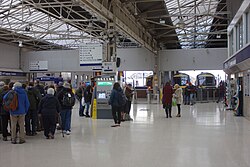
Passengers have access to a comprehensive range of facilities within the main concourse, including:
- Ticket office and automated ticket machines.
- Dining and leisure: A cafe, bar, and barber shop.
- Travel essentials: Left luggage, a lost property office, and a cash machine.
- Accessibility: Step-free access and three dedicated car parks.
The Rose Street Curve
A notable technical feature is the Rose Street Curve, a rarely used section of track that bypasses the station. This link allows trains to move between the Far North/Kyle of Lochalsh lines and the Highland Main/Aberdeen lines without entering the terminus. While it has fallen into disuse, it was used as recently as 2019 for weekly Saturday services from Kyle of Lochalsh to Elgin.
Passenger Traffic and Services
Inverness has seen a steady recovery in passenger numbers following the pandemic, with usage climbing from 0.232 million in 2020/21 to over 1.17 million by 2024/25.
| Period | Entries and Exits | Interchanges |
|---|---|---|
| 2020/21 | 231,894 | 9,422 |
| 2021/22 | 753,228 | 33,187 |
| 2022/23 | 974,808 | 38,939 |
| 2023/24 | 1,169,550 | 51,133 |
| 2024/25 | 1,172,640 | 54,976 |
Rail Connections
The station is served by three primary operators:
- ScotRail: Provides frequent services to Glasgow Queen Street, Edinburgh Waverley, Aberdeen, Elgin, Dingwall, Wick, and Kyle of Lochalsh.
- London North Eastern Railway (LNER): Operates the Highland Chieftain, a daily service to London King's Cross.
- Caledonian Sleeper: Offers a nightly sleeper service to London Euston (excluding Saturday nights).
Onward Travel and Location
Located between Falcon Square, Academy Street, and Strothers Lane, the station is centrally positioned. It is a short walk from the Eastgate Shopping Centre, Inverness Castle, and the Museum & Art Gallery.
For those traveling beyond the rail network, the Inverness bus station is just 150 meters away on Margaret Street. Key connections include:
- Scottish Citylink: Routes to Ullapool (connecting to Stornoway ferries) and Fort William via the Great Glen.
- Stagecoach Highlands: A frequent 30-minute service to Inverness Airport from Strothers Lane.
Frequently Asked Questions
Which rail lines terminate at Inverness station?
Inverness is the terminus for the Highland Main Line, the Aberdeen–Inverness line, the Far North Line, and the Kyle of Lochalsh line.
How do I get to Inverness Airport from the station?
The Stagecoach Highlands route 11 runs every 30 minutes from Strothers Lane, located just around the corner from the station, with a journey time of approximately 25 minutes.
Is there a direct train to London from Inverness?
Yes, LNER operates the daily Highland Chieftain to London King's Cross, and the Caledonian Sleeper provides a nightly service to London Euston (except Saturdays).
What is the Rose Street Curve?
It is a bypass track that allows trains to move between the northern lines and the eastern lines without entering Inverness station, though it is now rarely used.
Does the station have accessibility features?
Yes, Inverness railway station provides step-free access for passengers.