Zahlé: The Vibrant Capital of Lebanon's Beqaa Valley
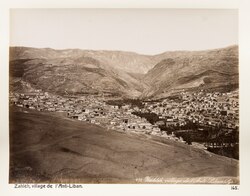
Nestled at the junction of Mount Lebanon and the Beqaa Valley, Zahlé is a city of strategic importance and rich cultural heritage. As the capital and largest city of the Beqaa Governorate, it stands as the third-largest city in Lebanon, trailing only Beirut and Tripoli. Located approximately 55 km east of Beirut, Zahlé is renowned for its scenic landscapes, historic architecture, and its role as a commercial hub for eastern Lebanon.
Established in the 18th century by Christian settlers, the city has maintained a predominantly Greek Catholic character. Its position at a mean elevation of 1,000 meters provides a temperate climate and a commanding view of the surrounding valley, making it a center of trade and social life for centuries.
Key Facts
- Status: Capital of the Beqaa Governorate.
- Population: Approximately 100,000 in the city, with a metropolitan area of nearly 300,000.
- Geography: Located between Mount Lebanon and the Beqaa Valley at an elevation of 900m to 1,150m.
- Religion: Predominantly Christian (approx. 82.58%), with significant Shia and Sunni Muslim communities.
- Sister City: Twinned with Bordeaux, France, since 2006.
History and Evolution
Human activity in the region dates back five millennia, though Zahlé as a structured settlement emerged in the 18th century. Initially a small village of 200 houses, it faced early challenges due to geographic isolation, suffering fires in 1777 and 1791. However, the 19th century marked a period of rapid expansion.
By 1850, the population grew to between 7,000 and 8,000 residents. Several factors fueled this growth, including the Egyptian Occupation (1831–1841), which opened Lebanon to European trade, and the Crimean War, which spiked European demand for grain. Zahlé evolved into the primary depot for the Beqaa's grain harvest and a center for livestock, leather, and textiles, trading extensively with Damascus, Aleppo, and Beirut.
The 20th century brought political volatility. During the Lebanese Civil War, the city saw significant military presence, including an agreement in 1975 that allowed Syrian soldiers to take strategic positions. Despite these conflicts, the city has remained a resilient center of education and commerce.
Demographics and Global Diaspora
Zahlé is characterized by a diverse religious landscape. According to 2014 voter registration data, Christians comprise 82.58% of the population, including Greek Catholics (28.27%), Maronite Catholics (23.77%), and Greek Orthodox (12.62%). The Muslim community makes up 16.81%, consisting of Shia (10.24%) and Sunni (6.55%) Muslims.
The city has a profound history of emigration. In the early 20th century, many residents moved to South America, particularly Brazil, Colombia, Argentina, and Venezuela. Later waves during the civil war headed toward North America and Australia. Today, an estimated 250,000 people of Zahlé descent live abroad.
Economy and Infrastructure
The economy of Zahlé is rooted in its strategic location and agricultural surroundings. It serves as a vital link between the coast and the interior. The city is connected to Beirut via the Beirut-Damascus road and to Baalbek via the trans-Beqaa road.
Education is a cornerstone of the community, with the city hosting branches or campuses of several prestigious institutions, including the Lebanese University, Saint Joseph University, and the Antonine University.
Main Sights and Landmarks
Berdawni Promenade
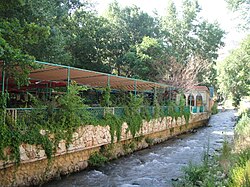
The Berdawni River is the heart of the city's social life. The "Al Wadi" (the valley) is a 300-meter promenade sheltered by limestone cliffs. Lined with cafes and restaurants specializing in traditional Lebanese meze and arak, it is a premier destination for socialization, though it typically closes during the cold winter months.
Our Lady of Zahlé and Bekaa
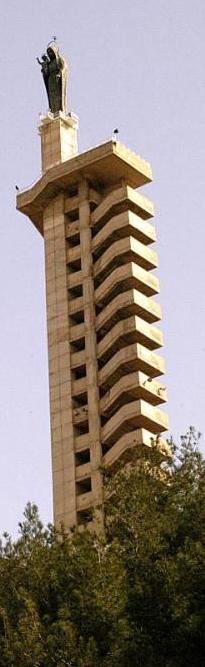
This landmark is a 54-meter-high concrete tower clad in white marble, topped with a 10-meter bronze statue of the Virgin Mary. Visible from miles away, the tower includes a chapel at its base and offers panoramic views of the city and the Bekaa Valley.
The Town Hall (Old Serail)
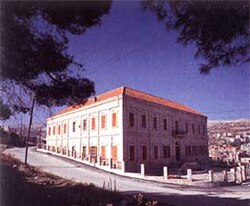
Built in 1850, the Old Serail is an Ottoman-era building featuring a blend of local and Ottoman architecture with a central garden atrium. While it once served as a prison, it now functions as the city's Town Hall.
The Catholic Cathedral and Grand Hotel Kadri
The Cathedral of Our Lady of Salvation, dating back to 1720, is a massive stone complex featuring a 40-meter bell tower and an underground cemetery. Nearby, the Grand Hotel Kadri stands as a testament to traditional stone architecture. Once a hospital during WWI, it has been restored to serve as a luxury venue for visiting dignitaries.
Memshieh Park
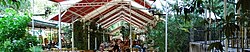
Zahlé's oldest park, Memshieh, is known for its shade, marble tables with mosaic maps of Lebanon, and sculptures of local figures. In 2003, the city attempted a world record for the largest natural Christmas tree by lighting up a 25-meter fir tree in the park.
Archaeological Interest
While the city center has few ruins, the surrounding area is rich in history. The Château Ksara winery is famous for its Roman-era vaults. In the suburb of Karak Nuh, a stone structure in the local mosque is traditionally believed to be the Tomb of Noah, though it is likely a Roman aqueduct.
Nearby sites include Roman rock sculptures in Qabb Ilyas, rock-cut tombs in Furzol, and the Bronze Age settlement of Kamed al Lawz. The world-famous Roman complex of Baalbek is also located just 36 km to the northwest.
Climate and Culture
Zahlé experiences a climate with distinct seasons. Summers are hot and dry, with record highs reaching 44.3°C, while winters are cold and wet, often bringing heavy snowfall that can occasionally block roads to Beirut. Annual precipitation averages around 641.9 mm.
Culturally, the city is defined by its faith and traditions. The feast of Prophet Elias (Elijah) on July 20 is celebrated with fireworks. The Corpus Christi procession, held every June since 1825, commemorates the city being spared from the bubonic plague.
| Category | Detail |
|---|---|
| Coordinates | 33°50′N 35°55′E |
| Elevation | 900m to 1,150m |
| City Area | 8 km² |
| Metro Area | 40 km² |
| Primary Religion | Christian (Greek Catholic) |
| Key Industry | Trade, Agriculture, Education |
Frequently Asked Questions
What is the significance of the Berdawni River?
The Berdawni River is the center of Zahlé's social life, featuring a popular 300-meter promenade called "Al Wadi" where visitors enjoy traditional Lebanese meze and cafes under the shade of limestone cliffs.
Which famous people are from Zahlé?
The city has produced many notable figures, including singer Shakira (of Lebanese-Colombian descent), poet Said Akl, and former Lebanese President Elias Hrawi.
What is the most prominent landmark in the city?
The most prominent structure is the tower of Our Lady of Zahlé and Bekaa, a 54-meter white marble tower topped with a bronze statue of the Virgin Mary.
Is Zahlé an archaeological site?
While the city itself has few ruins, it is close to major sites like the Roman complex of Baalbek and the Roman vaults of the Château Ksara winery.
How is Zahlé connected to other cities?
Zahlé is connected to Beirut (55 km west) via the Beirut-Damascus road and to Baalbek (36 km northeast) via the trans-Beqaa road.