Yellow-headed Caracara
The yellow-headed caracara (Daptrius chimachima) is a versatile New World bird of prey belonging to the family Falconidae. Part of the order Falconiformes—which includes true falcons and their kin—this adaptable raptor is found across North and South America, ranging from Nicaragua down to Uruguay.
Key Facts
- Conservation Status: Least Concern (IUCN 3.1).
- Population: Estimated at least five million mature individuals.
- Diet: Omnivorous, relying heavily on scavenging.
- Range: From Nicaragua to Uruguay, including various Caribbean islands.
- Physical Traits: Distinctive creamy yellow head and pea-green legs.
Taxonomy and Systematics
Formally described in 1816 by French ornithologist Louis Vieillot, the bird was originally named Polyborus chimachima. The name is derived from "Chimachima," an Argentinian onomatopoeic word for the caracara, based on accounts by Spanish naturalist Félix de Azara from 1802.
Historically, the yellow-headed caracara was grouped with the chimango caracara in the genus Milvago. However, molecular genetic studies revealed that Milvago was polyphyletic (meaning the group did not share a single common ancestor). To resolve this, the genus Daptrius was expanded to include these species.
Recognized Subspecies
- D. c. cordatus: Found in the savannas of southwestern Costa Rica, through South America (including Trinidad), and Brazil north of the Amazon River.
- D. c. chimachima: Found in Brazil south of the Amazon River, eastern Bolivia, Paraguay, and northern Argentina.
Paleontological records also indicate a larger, stouter paleosubspecies, D. c. readei, which lived in Florida during the Late Pleistocene.
Physical Description
The yellow-headed caracara typically measures between 40 and 45 cm (16 to 18 in) in length. There is a slight size difference between the sexes: males weigh between 277 and 335 g, while females are slightly heavier at 307 to 364 g. Their wingspan ranges from 74 to 95 cm (29 to 37 in).
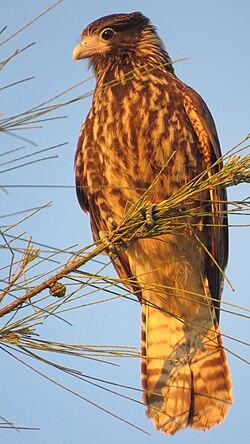
Adults of the nominate subspecies are characterized by buff to creamy yellowish-white heads, necks, and underparts, accented by a thin dark streak through the eyes. Their backs and wings are blackish-brown, featuring a whitish patch at the base of the primaries that becomes visible during flight. The tail is buff with dusky bars and a black band near the tip. A striking feature is the reddish-brown iris surrounded by bare, bright yellow skin, complemented by pea-green legs and feet.
Immature birds differ from adults by having browner upperparts and brown streaks on their underparts. The D. c. cordata subspecies exhibits a darker buff color on the head and underparts and has narrower tail bars.
Distribution and Habitat
The distribution of the yellow-headed caracara is split between its two subspecies. D. c. cordata inhabits southwestern Nicaragua, western Costa Rica, Panama, and mainland South America from Colombia through Venezuela and the Guianas, extending through Ecuador and Peru (east of the Andes) to northern Brazil. It is also found on Aruba, Trinidad, and Tobago.
The nominate D. c. chimachima occupies eastern Bolivia, Paraguay, northern Argentina, northern Uruguay, and Brazil south of the Amazon. In these southern regions, its range overlaps with that of the chimango caracara.
These birds prefer lightly treed open landscapes. Common habitats include savannas with palms, ranchlands, pastures, gallery forests (forests along riverbanks), and the edges of denser forests. While they generally stay between sea level and 1,000 m (3,300 ft), they have been recorded as high as 2,500 m (8,200 ft) in Colombia.
Behavior and Ecology
Movement and Feeding
While generally sedentary, some individuals wander, as evidenced by records in northern Central America. The yellow-headed caracara is an omnivore with a strong reliance on scavenging. Its diverse diet includes:
- Animals: Carrion, insects, crabs, fish, reptiles, amphibians, mammals, and bird eggs/nestlings.
- Plants: Maize, coconut, and oil palm fruits (Elaeis guineensis), as well as seeds.
- Unusual sources: Horse dung and ticks removed from cattle, capybaras, and tapirs.
They primarily forage by walking on the ground, though they occasionally hunt in flight. Interestingly, they have been observed searching for small invertebrates in the fur of brown-throated three-toed sloths. Other bird species in mixed-feeding flocks typically do not perceive them as a threat.
Breeding and Vocalization
Nesting seasons vary by region, occurring from December to April in Costa Rica, and during multiple windows in Colombia and Venezuela. In Brazil, egg-laying occurs between July and September. They typically build stick nests up to 15 m (50 ft) high in trees or palms, though they are opportunistic and have nested in tree cavities, on marshy mounds, or even in man-made containers like buckets on walls.
Clutch sizes range from one to four eggs. The incubation period lasts approximately 22 days, with fledging occurring 17 to 20 days after hatching. While the female handles most of the incubation, both parents provide care for the young for about three additional weeks.
Vocalizations are most frequent during the breeding season or during food disputes. Their calls range from scratchy, wailing "keeeah" sounds to growling "kraaa-kraaa-kraaa" and piercing "chay" calls.
Conservation Status
The IUCN classifies the yellow-headed caracara as Least Concern. With a population of at least five million mature individuals and an expanding range, the species faces no immediate threats. In fact, the conversion of forests into cattle ranches and small-scale farms often creates more of the open lowland habitat the species prefers.
| Feature | Details |
|---|---|
| Scientific Name | Daptrius chimachima |
| Average Length | 40–45 cm |
| Wingspan | 74–95 cm |
| Dietary Type | Omnivorous / Scavenger |
| Primary Habitat | Savannas, ranchlands, and open landscapes |
| Conservation Status | Least Concern |
Frequently Asked Questions
What do yellow-headed caracaras eat?
They are omnivorous scavengers. Their diet consists of carrion, insects, small vertebrates (fish, reptiles, amphibians), bird eggs, fruits like coconut and oil palm, seeds, and even ticks from large mammals.
Where is the yellow-headed caracara found?
They are distributed across North and South America, from Nicaragua through Central America and into South America as far south as Uruguay, including parts of the Caribbean.
How does the yellow-headed caracara differ from other caracaras?
They are distinguished by their creamy yellowish-white heads and underparts, reddish-brown irises surrounded by yellow skin, and distinctive pea-green legs.
Are yellow-headed caracaras endangered?
No, they are listed as Least Concern by the IUCN. Their population is estimated at over five million mature individuals and is believed to be increasing as more open landscapes are created.
Where do they build their nests?
They usually build stick nests in trees or palms up to 15 meters high, but they are highly adaptable and may nest in cavities, on the ground in marshes, or even in human-made objects like buckets.