Yellow-breasted Chat
The yellow-breasted chat (Icteria virens) is a distinctive large songbird native to North and Central America. Known for its striking colors and eclectic vocalizations, this bird occupies a unique place in the avian world, standing as the sole member of its own family, Icteriidae. While it may resemble other songbirds at a glance, its size, behavior, and genetic lineage set it apart from its relatives.
Historically, the chat was grouped with the New World warblers (Parulidae) due to its appearance. However, modern scientific analysis has revealed a more complex evolutionary history, leading to its current classification as a monotypic family—meaning it is the only species within its family.

Key Facts
- Scientific Name: Icteria virens
- Family: Icteriidae (Monotypic)
- Conservation Status: Least Concern (IUCN 3.1)
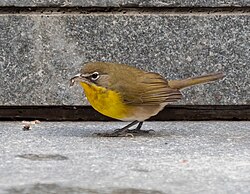
- Distinctive Feature: Bright yellow throat and breast with a large white eye ring.
- Diet: Omnivorous, eating insects and berries.
- Behavior: Known for mimicking other bird calls and using feet to hold food.
Taxonomy and Scientific History
The yellow-breasted chat was first formally described in 1758 by the Swedish naturalist Carl Linnaeus in the tenth edition of Systema Naturae. Linnaeus originally placed the bird in the thrush genus Turdus, naming it Turdus virens (where virens is Latin for 'green'). His description was based on the work of English naturalist Mark Catesby, who had illustrated the bird in The Natural History of Carolina, Florida and the Bahama Islands.
The bird's classification has shifted significantly over the centuries. In 1808, French ornithologist Louis Pierre Vieillot introduced the genus Icteria. By 1858, American naturalist Spencer Baird established the family Icterieae. For many years, it was considered the largest member of the New World warbler family (Parulidae). However, a 2017 taxonomic shift moved it to the monotypic family Icteriidae. Recent phylogenomic studies suggest that while it is distinct, it is most closely related to the New World blackbirds (Icteridae).
Physical Description
The yellow-breasted chat is significantly larger than most warblers, often weighing more than twice as much. It typically measures between 17 and 19.1 cm (6.7 to 7.5 in) in length, with a wingspan ranging from 23 to 27 cm (9.1 to 10.6 in). Its body mass generally falls between 20.2 and 33.8 g.
Visually, the bird is unmistakable. It features olive-colored upper parts, a white belly, and a vibrant yellow throat and breast. Key identifying markers include its large white eye rings and blackish legs. Its bill is relatively long and heavy, measuring 1.3 to 1.6 cm.
Vocalizations and Mimicry
The chat's song is a variable and odd mixture of whistles, hoots, clucks, and cackles. Unlike many of its relatives, the yellow-breasted chat is a mimic, often imitating the calls of other birds. This ability, combined with its habit of hiding in dense brush, can lead inexperienced birdwatchers to mistake it for gray catbirds or brown thrashers.
Distribution and Habitat
This species is found throughout North America. Its breeding grounds extend from the southern plains of Canada down to central Mexico. During the winter, most individuals migrate to Mexico and Central America, though some remain in northern coastal regions.
The yellow-breasted chat prefers areas with dense shrubbery. In modern times, this often includes rural areas and abandoned farmland where overgrown vegetation provides the necessary cover for their shy nature.
Behavior and Breeding
Known as a "skulking" species, the yellow-breasted chat is often heard long before it is seen. It spends much of its time hidden in thickets, though it becomes more conspicuous during the breeding season, when it may sing from exposed perches or even while flying.
Nesting and Offspring
Nests are bulky cups constructed from grasses, bark, and weed stems, typically placed in thick shrubs about 2.5 meters (8 ft 2 in) above the ground. A clutch usually consists of three to five creamy-white eggs with reddish-brown speckles. The female incubates the eggs for 11 to 12 days, and both parents assist in raising the young, who fledge in 8 to 11 days.
Interestingly, chats are vigilant guards against brood parasitism by brown-headed cowbirds. However, they are less monogamous than other warblers; DNA fingerprinting in Kentucky revealed that 17% of nestlings in one study were not sired by the social father.
Diet and Feeding Habits
The yellow-breasted chat is an omnivore. Its diet consists primarily of berries (such as wild grapes and blackberries) and a wide variety of insects, including beetles, grasshoppers, bees, wasps, and moths. A unique behavior for a passerine (perching bird) of its size is the chat's tendency to occasionally grip its food with its feet before eating.
Conservation Status
While the yellow-breasted chat is currently listed as Least Concern globally, populations in eastern North America have seen a decline. This is primarily due to habitat loss caused by urban development and deforestation. Forest fragmentation has also made them more susceptible to brood parasitism by brown-headed cowbirds.
| Feature | Details |
|---|---|
| Scientific Name | Icteria virens |
| Average Length | 17 – 19.1 cm |
| Weight | 20.2 – 33.8 g |
| Primary Habitat | Dense shrubbery, riparian scrub, abandoned farmland |
| Diet | Insects, berries, spiders |
| Migration | North America to Mexico/Central America |
Frequently Asked Questions
Is the yellow-breasted chat a type of warbler?
While it was historically classified as the largest member of the New World warbler family (Parulidae), it is now placed in its own distinct family, Icteriidae, based on taxonomic and genetic studies.
What makes the yellow-breasted chat's song unique?
Its song is a highly variable mix of cackles, whistles, and hoots, and the species is known for its ability to mimic the calls of other bird species.
Where can the yellow-breasted chat be found?
They are found across North America, breeding from southern Canada to central Mexico and wintering in Mexico and Central America.
What do yellow-breasted chats eat?
They are omnivores that feed on a variety of insects (such as beetles and grasshoppers) and berries, including wild grapes and blackberries.
Why are their populations declining in eastern North America?
The decline is mainly attributed to habitat loss and degradation resulting from deforestation and urban development, as well as increased brood parasitism by brown-headed cowbirds.