Yazoo and Mississippi Valley Railroad: A Legacy of the American South
The Yazoo and Mississippi Valley Railroad (Y&MV) stands as a significant chapter in the industrial expansion of the American South. Incorporated in 1882, this rail network served as a vital artery for commerce and travel, connecting the heart of the Mississippi Delta with major urban hubs. Operating as part of the larger Illinois Central Railroad (IC) system, the Y&MV facilitated the movement of goods and people across a vast and challenging landscape.
The Growth and Expansion of the Y&MV
The railroad's journey began with construction starting in Jackson, Mississippi, extending toward Yazoo City. As the network grew, it pushed further through the fertile Mississippi Delta, eventually reaching Memphis, Tennessee. This expansion was not merely organic; it was fueled by strategic acquisitions by the Illinois Central Railroad.
In 1886, the IC acquired the Mississippi and Tennessee Railroad. This was followed in 1892 by the purchase of the line running from Memphis to New Orleans, which led to the creation of the Louisville, New Orleans and Texas Railway. Eventually, these various lines were merged into the Y&MV, creating a comprehensive regional network.
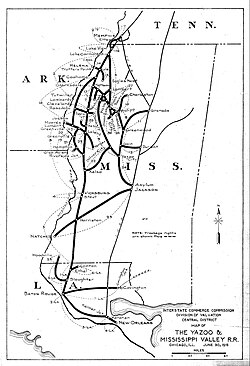
Primary Rail Corridors
The Y&MV operated several critical main lines that defined its operational reach:
- Memphis to New Orleans: A major route passing through Vicksburg and Baton Rouge.
- Memphis to Tutwiler: Serving the northern reaches of the Delta.
- Clarksdale to Yazoo City: Connecting key agricultural hubs.
- Clarksdale to Jackson: Linking the Delta to the state capital.
- Jackson to Natchez: Extending the reach toward the southwest.
Technical Specifications and Operations
To ensure compatibility with the broader American rail network, the Y&MV utilized standard gauge track, which is a track width of 4 feet 8.5 inches (1,435 mm). This standardization allowed for the seamless transfer of railcars between different companies without the need for reloading cargo.
| Feature | Details |
|---|---|
| Headquarters | Chicago, Illinois |
| Operational Period | 1882 – 1946 |
| Primary Locale | Memphis, TN to New Orleans, LA |
| Track Gauge | 4 ft 8 1/2 in (Standard Gauge) |
| Parent Company | Illinois Central Railroad (IC) |
The End of an Era
The independence of the Y&MV came to an end in the mid-1940s. Between 1945 and 1946, the Illinois Central Railroad began a process of absorbing its various subsidiaries to streamline operations. Consequently, the Yazoo and Mississippi Valley Railroad ceased to operate as a separate entity.
In the years following this absorption, further restructuring within the railroad industry led to the eventual termination of passenger services on these specific lines, leaving behind only the remnants of a once-bustling transit system.
Key Facts
- Incorporated in 1882 as part of the Illinois Central Railroad system.
- Connected major cities including Memphis, Jackson, Vicksburg, Baton Rouge, and New Orleans.
- Merged the Mississippi and Tennessee Railroad and the Louisville, New Orleans and Texas Railway.
- Operated using the standard gauge of 4 ft 8 1/2 in.
- Ceased independent operations between 1945 and 1946.
Frequently Asked Questions
When was the Yazoo and Mississippi Valley Railroad incorporated?
The railroad was incorporated in 1882.
Which larger railroad system did the Y&MV belong to?
The Y&MV was part of the Illinois Central Railroad (IC) system.
What was the track gauge used by the Y&MV?
The railroad used the standard gauge of 4 feet 8 1/2 inches (1,435 mm).
Which cities were connected by the Y&MV main lines?
The main lines connected Memphis, New Orleans, Vicksburg, Baton Rouge, Tutwiler, Clarksdale, Yazoo City, Jackson, and Natchez.
Why did the Y&MV stop operating as an independent railroad?
Between 1945 and 1946, the Illinois Central Railroad absorbed its subsidiaries, including the Y&MV, to consolidate operations.