Vicksburg, Shreveport and Pacific Railroad: A History of Conflict and Consolidation
The story of the Vicksburg, Shreveport and Pacific Railroad is a reflection of the turbulent history of the American South, marked by the devastation of the Civil War and the subsequent era of industrial consolidation. From its early struggles during military conflict to its eventual absorption into a larger rail network, the line served as a critical artery for transport in the region.
War and Reconstruction
The railroad's early operations were severely disrupted by the American Civil War. In 1862, the Confederate Army seized the line, and by 1863, a significant portion of the infrastructure had been disassembled. The Union Army further crippled the network by dismantling the entire line east of Monroe.
Following the conclusion of the war, the company faced severe financial instability. It entered receivership on December 30, 1865, and proceeded into foreclosure on February 5, 1866. Recovery began in 1868 when the company was purchased by the North Louisiana and Texas Railroad Company.
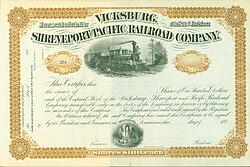
International Investment and Expansion
The late 19th century brought a shift toward international ownership. Between 1881 and 1882, the Vicksburg, Shreveport, and Pacific Railroad was acquired by the Alabama, New Orleans, Texas, and Pacific Junction Railways Company, Limited, based in London, England. This acquisition was facilitated through the Erlanger Interests, a prominent group of European financiers.
The Waskom Extension
A notable segment of the regional infrastructure was the track between Shreveport and Waskom (spelled "Wascom" in 1917 documentation). This specific extension was constructed by the Vicksburg, Shreveport, & Texas Railroad Company and leased to the Texas and Pacific Railway in 1862. Eventually, the Texas and Pacific Railway completed its own independent tracks from Waskom to Shreveport on September 12, 1882.
Decline and Merger
As the rail industry evolved, the company's independent operations began to wind down. In 1926, the railroad was leased to the Yazoo and Mississippi Valley Railroad for a term of 365 years. The final chapter of its corporate identity concluded on May 29, 1959, when it merged with the Illinois Central Railroad.
The physical footprint of the line also contracted over time. At its peak, there were twenty-four stops between Shreveport and Delta Point; however, by 1967, this number had dwindled to only twelve depots.
Key Facts
- Civil War Impact: Seized by Confederates in 1862; partially disassembled in 1863; Union Army removed all tracks east of Monroe.
- Financial Crisis: Entered receivership in December 1865 and foreclosure in February 1866.
- European Ownership: Acquired by a London-based company via Erlanger Interests (1881-1882).
- Final Merger: Merged into the Illinois Central Railroad on May 29, 1959.
- Infrastructure Decline: Stops between Shreveport and Delta Point dropped from 24 to 12 by 1967.
| Year/Date | Event/Owner |
|---|---|
| 1862-1863 | Seized and disassembled during the Civil War |
| 1868 | Purchased by North Louisiana and Texas Railroad Company |
| 1881-1882 | Acquired by Alabama, New Orleans, Texas, and Pacific Junction Railways Company, Ltd. |
| 1926 | Leased to Yazoo and Mississippi Valley Railroad |
| May 29, 1959 | Merged with Illinois Central Railroad |
Frequently Asked Questions
What happened to the railroad during the Civil War?
The line was seized by the Confederate Army in 1862. By 1863, much of it was disassembled, and the Union Army subsequently removed all tracks located east of Monroe.
Who owned the railroad in the late 19th century?
Between 1881 and 1882, the railroad was acquired by the London-based Alabama, New Orleans, Texas, and Pacific Junction Railways Company, Limited, through the Erlanger Interests of Europe.
When did the railroad merge with the Illinois Central Railroad?
The merger took place on May 29, 1959.
What was the Waskom extension?
The Waskom extension refers to the tracks between Shreveport and Waskom. Originally built by the Vicksburg, Shreveport, & Texas Railroad Company and leased to the Texas and Pacific Railway in 1862, the Texas and Pacific eventually completed its own tracks on this route in 1882.
How did the number of stops change over time?
The line once featured twenty-four stops between Shreveport and Delta Point, but this number decreased to twelve depots by 1967.