Yagua People: History, Culture, and Language of the Amazon Basin
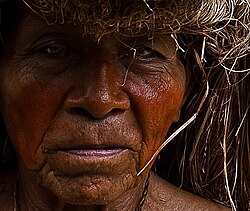
The Yagua are an indigenous people residing within the lush landscapes of the Amazon basin, spanning the borders of northeastern Peru and southern Colombia. With a population estimated at approximately 6,000 as of 2000, they maintain a unique cultural identity despite centuries of external pressure and geographic dispersion. Today, they are primarily found near the Amazon, Napo, Putumayo, and Yavari rivers, with some communities having migrated northward toward Leticia, Colombia.
Their presence is marked by a resilience that persists across roughly 30 scattered communities. These settlements are distributed across a vast region approximately 200 miles wide and 350 miles long, covering about 70,000 square miles between the second and fifth parallels and the 70th to 75th meridians west.
Key Facts
- Population: Approximately 6,000 (2000 census).
- Location: Northeastern Peru and southern Colombia.
- Language: Yagua (a Peba-Yaguan language) and Spanish.
- Related Groups: The now-extinct Yameo and Peba peoples.
- Religion: A blend of traditional tribal beliefs and Christianity.
The Origins and Meaning of the Name
The Yagua are known by several names, including Llagua, Yahua, Yava, Yegua, and Nijyamïï Nikyejaada. Interestingly, the term "Yagua" does not originate from their own language, but there are two primary theories regarding its etymology.
The Quechua Influence
One theory suggests the name comes from the Quechua word yawar, meaning "blood" or "the color of blood." This likely refers to the Yagua tradition of painting their faces with achiote, the blood-red seeds of the annatto plant (Bixa orellana). This connection is supported by the fact that the Yagua language contains more Quechua words than Spanish words, suggesting early contact with the Incas or the imposition of Quechua by Spanish missionaries during the colonial era.
The Spanish Influence
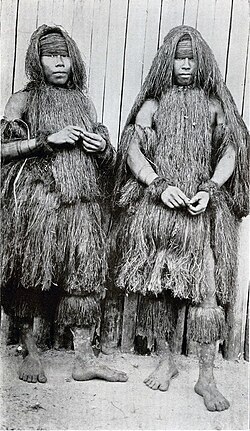
Alternatively, in Spanish, yagua means "royal palm." Spanish explorers may have applied this name because the Yagua traditionally crafted much of their clothing from palm fiber.
Within their own language, the term nijyąąmíy means "people." While this is a generic term for all human beings, it is often used to distinguish the Yagua from mááy ("white people") and munuñúmiy ("savages," "enemies," or "non-Yaguas").
Historical Journey and European Contact
The first documented European contact likely occurred in January 1542, when Spanish explorer Francisco de Orellana encountered a village called Aparia near modern-day Pebas. Orellana captured two chiefs, Aparia and Dirimara—names that may correspond to the Yagua words for "red macaw clan" (jápiiryá) and "shaman" (rimyurá).
Regular contact intensified in 1686 with the establishment of a Jesuit mission at San Joaquin de los Omagua. For nearly two centuries, the Yagua primarily interacted with Jesuit and Franciscan missionaries. However, this period was marked by instability; in the early 18th century, Portuguese raiding parties attacked Spanish missions, causing severe casualties and forcing many tribes to disperse.
The Impact of the Rubber Boom
The most devastating period for Yagua unity was the "rubber boom" of the late 19th and early 20th centuries. European settlers from Brazil arrived to extract natural latex, leading to the exploitation of indigenous people as slave labor. Many Yagua died from conflict and European diseases, while others fled deep into the jungle to survive. This era caused a significant decline in the Yagua's sense of common culture and unity.
Sociology and Modern Life
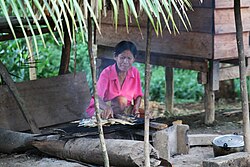
Modern Yagua society is characterized by small villages, typically consisting of only 2 to 30 families. Because these communities are separated by tremendous distances, interaction between different Yagua villages is rare. Consequently, most economic activity occurs with non-Yagua, Spanish-speaking populations.
This dynamic creates significant social and economic pressure to learn Spanish and assimilate into general Peruvian or Colombian culture. Despite these pressures, the Yagua language and culture remain viable, particularly in larger, more isolated communities where some children grow up speaking only Yagua. Native arts and crafts continue to serve as a vital economic activity.
Mythology and Oral Tradition
Yagua mythology is traditionally shared at night. To lend authenticity to their stories, narrators often begin with the phrase, "My deceased father (mother, grandfather, grandmother etc.) used to tell me," grounding their ancestral knowledge in family lineage.
| Category | Details |
|---|---|
| Primary Regions | Northeastern Peru and Southern Colombia |
| Language Family | Peba-Yaguan |
| Estimated Population | 6,000 (as of 2000) |
| Traditional Clothing | Palm fiber |
| Key Historical Event | The Rubber Boom (late 19th/early 20th century) |
Frequently Asked Questions
What is the origin of the name 'Yagua'?
There are two theories: it may come from the Quechua word yawar (blood), referring to their use of red achiote face paint, or from the Spanish word for "royal palm," referring to their palm-fiber clothing.
What language do the Yagua speak?
They speak Yagua, which is a Peba-Yaguan language. While some remain monolingual, the majority are bilingual in Spanish due to economic and social pressures.
How did the rubber boom affect the Yagua people?
The rubber boom led to widespread exploitation, slave labor, and deaths from European diseases and conflict, resulting in the extreme geographic dispersion of their communities.
Who are the Yagua's closest linguistic relatives?
The Yagua language is closely related to the Peba and Yameo languages, both of which are now extinct.
What is the typical size of a Yagua village?
Yagua villages are characteristically small, usually consisting of between 2 and 30 families.