XScale Processor Families: Evolution of Intel and Marvell Mobile SoCs
The XScale core served as a cornerstone for mobile and embedded computing during the early 2000s. Manufactured by Intel and later Marvell, this architecture powered a vast array of microcontrollers, ranging from the early Personal Digital Assistants (PDAs) and smartphones to high-performance network processors. By leveraging the ARM architecture, XScale provided a balance of power efficiency and computational performance that defined an era of mobile technology.
Key Facts
- Broad Application: XScale cores were used in application processors (PXA), I/O processors (IOP), network processors (IXP), control plane processors (IXC), and consumer electronics (CE).
- Market Dominance: PXA processors were widely adopted in smartphones and PDAs running Windows Mobile, Symbian OS, and Palm OS between 2000 and 2006.
- Architectural Shift: The line evolved from the ARMv5 XScale cores to Marvell's Sheeva microarchitecture and eventually to ARM Cortex-A series cores.
- Innovation: Introduced Wireless MMX (iwMMXt), adding 43 SIMD instructions to accelerate multimedia decoding and gaming.
The PXA Application Processor Series
Designed in Austin, Texas, the PXA System on a Chip (SoC) line is famous for its Texas-town codenames. These processors evolved through four primary generations, moving from basic mobile phone support to high-definition video playback.
First Generation: PXA210 and PXA25x
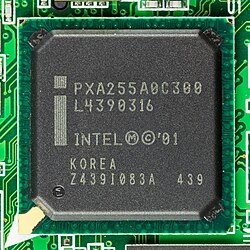
The PXA210 served as the entry-level model for mobile phones, released in February 2002 with clock speeds of 133 MHz and 200 MHz. The PXA25x family (codenamed Cotulla) included the PXA250 and PXA255. The PXA255 improved upon the PXA250 by doubling the internal bus speed to 200 MHz, reducing core voltage to 1.3 V, and adding data cache writeback functionality to resolve performance bottlenecks.
Second Generation: PXA26x
Released in March 2003, the Dalhart family (PXA260–PXA263) focused on miniaturization. The PXA260 utilized a TPBGA package 53% smaller than the PXA25x. Models PXA261 through PXA263 integrated Intel StrataFlash memory directly into the package, offering capacities from 16 MB to 32 MB.
Third Generation: PXA27x
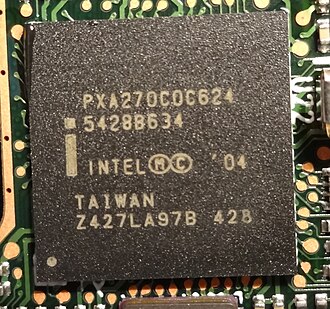
The Bulverde family, released in April 2004, represented a major leap in capability. The PXA270 reached speeds up to 624 MHz, while the PXA271 and PXA272 integrated stacked StrataFlash and SDRAM. This generation introduced SpeedStep for dynamic power management and Wireless MMX, which utilized 16 extra 64-bit registers to perform multiple additions or MACs (Multiply-Accumulate) in a single cycle.
Fourth Generation: PXA3xx
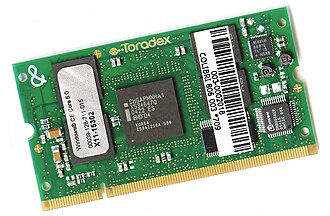
Codenamed Monahans and announced in August 2005, this series was designed for high-definition video playback. While demonstrated at 1.25 GHz, the final Marvell-branded versions (PXA300, PXA310, and PXA320) scaled up to 806 MHz. The PXA320 became a high-volume shipping product, maintaining software compatibility with its siblings.
Specialized XScale Implementations
Mobile Phone SoCs: PXA800F and PXA90x
The PXA800F (Manitoba) was a 2003 SoC for GSM/GPRS phones, featuring a 312 MHz core and 4 MB of integrated flash. Its most notable implementation was in the O2 XM phone. Its successor, the PXA90x (Hermon), added 3G support using a 130 nm process.
Marvell's Evolution: PXA93x to PXA98x
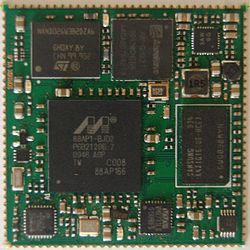
After acquiring the XScale business, Marvell introduced the Tavor tri-core architecture (PXA930/935), which supported ARMv5TE, ARMv6, and ARMv7 instruction sets. The PXA930 (65 nm) was used in the BlackBerry Bold 9700. Later, the PXA940 provided ARM Cortex-A8 compliance for the BlackBerry Torch 9800, and the PXA98x series moved to dual-core ARM Cortex-A9 designs used in tablets like the Samsung Galaxy Tab 3 7.0.
Other XScale Processor Families
Network and I/O Processors
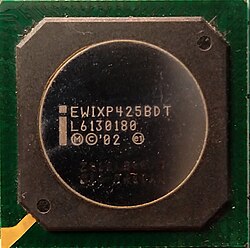
- IXP Network Processors: These range from the IXP4XX (small office) to the IXP2850 (high performance). In IXP2XXX devices, the XScale core handles the control plane (routing updates, memory management), while dedicated microengines handle the data plane.
- IOP I/O Processors: Designed to offload I/O tasks from the main CPU, the IOP3XX series replaced older 80219 and i960 chips, with speeds ranging from 100 MHz to 1.2 GHz.
Control Plane and Consumer Electronics
The IXC1100 was a low-power control plane processor reaching 533 MHz. Additionally, Intel launched the CE 2110 (Olo River) in 2007, specifically targeting the consumer electronics market.
XScale Processor Summary
| Family | Codename | Core Type | Max Clock Speed | Key Feature |
|---|---|---|---|---|
| PXA21x/25x | Cotulla | ARMv5 XScale1 | 400 MHz | Entry-level mobile/PDA |
| PXA26x | Dalhart | ARMv5 XScale1 | 400 MHz | Stacked StrataFlash memory |
| PXA27x | Bulverde | ARMv5 XScale2 | 624 MHz | Wireless MMX & SpeedStep |
| PXA3xx | Monahans | ARMv5 XScale3 | 806 MHz | HD video playback |
| PXA93x | Tavor | Tri-core (v5/v6/v7) | 1000 MHz | ARMv7 compatibility |
Frequently Asked Questions
What is Wireless MMX?
Wireless MMX (iwMMXt) is a set of 43 SIMD (Single Instruction, Multiple Data) instructions introduced in the PXA27x family. It allows the processor to handle multiple data points in parallel, significantly boosting the speed of multimedia encoding, decoding, and gaming.
How did the PXA255 differ from the PXA250?
The PXA255 featured a doubled internal bus speed (200 MHz vs 100 MHz), a lower core voltage of 1.3 V for better power efficiency, and the addition of writeback functionality for the data cache to improve performance.
What is the role of the XScale core in IXP2XXX network processors?
In IXP2XXX devices, the XScale core is dedicated to control plane functionality, such as managing routing table updates and memory management, while the actual data processing is handled by specialized microengines.
Which XScale processor was used in the BlackBerry Bold 9700?
The BlackBerry Bold 9700 utilized the PXA930, which was built on Marvell's 65 nm Tavor tri-core architecture.
What was the purpose of the IOP processor line?
The IOP (I/O Processor) line was designed to increase overall system performance by offloading I/O functionality from the device's main CPU, specifically for computers and storage devices.