Witherspoon Street School for Colored Children
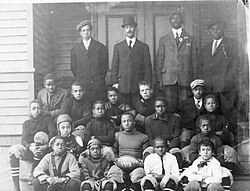
The Witherspoon Street School for Colored Children stands as a significant landmark in the educational history of Princeton, New Jersey. For nearly a century, this institution served as the primary center of learning for the African-American youth of the community, reflecting both the challenges of a segregated era and the enduring pursuit of academic achievement.
Established in 1858, the school provided essential education until the Princeton Public Schools were finally integrated in 1948. Its journey from a small facility to a larger campus mirrors the growth of the local African-American population and the evolving needs of its students.
Key Facts
- Founded: 1858
- Location: 35 Quarry Street, Princeton, New Jersey
- Architectural Style: Colonial Revival
- Integration Date: 1948
- Historic Status: Listed on both the National Register of Historic Places (NRHP) and the New Jersey Register of Historic Places (NJRHP)
- Current Use: The Quarry Street building has been converted into apartments
Evolution of the Campus
The school originally operated out of a building located at 184 Witherspoon Street, which still stands today. However, as enrollment grew, the need for more space became apparent, leading to the construction of a new facility at 35 Quarry Street in 1909.
To accommodate a growing student body, the Quarry Street building underwent two major expansions, first in 1939 and again in 1966. These additions shaped the building's current architectural footprint.
Architecture and Design
The school is a prime example of Colonial Revival architecture, a style characterized by its symmetry and classical details. Built primarily with brick, the structure is topped with a distinctive, ornate cupola centered on the roof, adding a sense of civic importance to the building.
Despite its architectural dignity, the school's history is marked by the disparities of the time. In 1948, the Journal of Negro Education noted a stark contrast in school capacities: while the school for white children was overcrowded, the Witherspoon Street School had empty spaces, highlighting the systemic inequalities of the segregated system.
Historic Recognition
Due to its profound significance in the history of American education, the school has received official state and national recognition. It was designated as part of the New Jersey Register of Historic Places on January 6, 2005, and added to the National Register of Historic Places on March 9, 2005.
| Category | Details |
|---|---|
| Address | 35 Quarry Street, Princeton, NJ 08542 |
| NRHP Reference No. | 05000125 |
| NJRHP No. | 4390 |
| Construction Dates | 1858 (Original), 1909 (Quarry St), 1939 & 1966 (Expansions) |
| Coordinates | 40°21′11.3″N 74°39′46.6″W |
Frequently Asked Questions
When did the Witherspoon Street School stop operating as a segregated school?
The school ceased operating as a segregated institution in 1948, when the Princeton Public Schools were integrated.
Where was the school originally located?
The school was originally located at 184 Witherspoon Street before moving to 35 Quarry Street in 1909.
What is the current use of the Quarry Street building?
The former school building at 35 Quarry Street has since been converted into an apartment building.
What architectural style was used for the school?
The building was constructed in the Colonial Revival style and features a brick exterior with an ornate cupola on the roof.
Why is the school listed on the National Register of Historic Places?
It was added to the National Register of Historic Places on March 9, 2005, specifically for its significance in the history of education.