Wild Bill Hickok: The Lawman, Scout, and Legend of the American West
James Butler "Wild Bill" Hickok remains one of the most iconic figures of the American frontier. A man of contradictions, Hickok served as a scout, a federal deputy, and a city marshal, carving out a reputation for lethal precision with a firearm. While history remembers him as a quintessential gunfighter, the reality of his life was a complex blend of genuine law enforcement, military service, and a carefully cultivated public persona.
The Duel with Davis Tutt
Hickok's rise to notoriety began in Springfield, Missouri, following a series of disputes with a local gambler named Davis Tutt. The conflict centered on unpaid gambling debts and romantic rivalries, but it peaked when Hickok lost a gold watch of great sentimental value to Tutt in a poker game. Despite an initial agreement to avoid conflict, the tension escalated when Hickok saw Tutt wearing the watch in public.
On July 21, 1865, the two men engaged in a quick-draw duel in the town square—an event recorded as the first of its kind. Standing sideways, both men drew and fired; Tutt missed, but Hickok struck him through the heart from approximately 75 yards (69 m) away. Tutt's final words, "Boys, I'm killed," marked the end of the encounter.
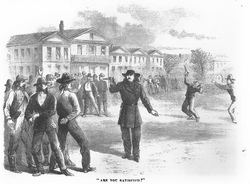
Though arrested for murder, the charge was reduced to manslaughter. On August 3, 1865, a jury acquitted Hickok after Judge Sempronius H. Boyd instructed them that the "fair fight" unwritten law could apply if the threat was imminent. This verdict sparked public backlash, but it also caught the attention of the press. Colonel George Ward Nichols of Harper's New Monthly Magazine interviewed Hickok, introducing him to the world as "Wild Bill Hitchcock" and exaggerating his exploits, claiming he had killed hundreds of men.
Service as a Deputy U.S. Marshal and Scout
Following the trial, Hickok moved to Kansas, where he was recommended as a deputy federal marshal at Fort Riley. During the Indian Wars, he served as a scout for General George A. Custer's 7th Cavalry. His reputation during this era was polarized; while some reports described him as a fierce fighter, others questioned the veracity of his claims. For instance, while witnesses confirmed he killed two attackers during a May 1867 ambush at Fort Harker, other claims—such as killing 10 Indians in July of that year—were contradicted by witnesses who stated the party returned without seeing a single enemy.
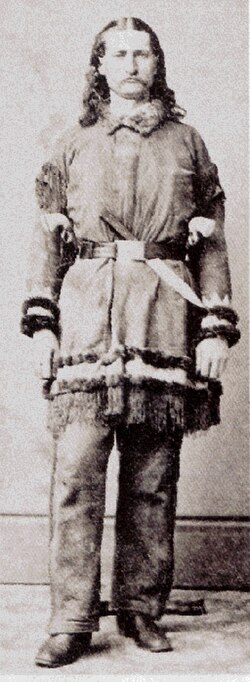
In December 1867, Hickok settled in Hays City, Kansas, as a deputy U.S. marshal. One of his notable assignments in March 1868 involved transporting 11 Union deserters to Topeka for trial. For this mission, he was provided a military escort that included the famous Buffalo Bill Cody. Hickok's versatility was further displayed in August 1868, when he brought 200 Cheyenne Indians to Hays as a tourist attraction for "excursionists."
By September 1868, Hickok was scouting for the 10th Cavalry Regiment, a segregated black unit. During a rescue mission in the Bijou Creek basin on September 4, he was wounded in the foot while saving cattlemen surrounded by Indians.
Marshal of Hays and the Cost of Order
Hickok returned to Hays in July 1869 and was elected city marshal and sheriff of Ellis County on August 23. His tenure was marked by swift and often violent justice. In his first month, he killed two men: Bill Mulvey, a drunkard who threatened to kill Hickok, and Samuel Strawhun, a cowboy causing a disturbance in a saloon. In both cases, Hickok claimed he was restoring order, and juries generally found the shootings justifiable.
His time in Hays also saw a violent encounter on July 17, 1870. Two troopers from the 7th U.S. Cavalry, Jeremiah Lonergan and John Kyle, attacked Hickok in a saloon. After Kyle's weapon misfired, Hickok shot Lonergan in the knee and killed Kyle with two shots.
The Abilene Years and John Wesley Hardin
On April 15, 1871, Mayor Joseph McCoy hired Hickok as the marshal of Abilene, Kansas. During this period, Hickok crossed paths with the notorious gunfighter John Wesley Hardin. Hardin, who claimed to have killed at least 27 men, alleged in his autobiography that he had once disarmed Hickok using the "road agent's spin"—a deceptive move used to flip a gun during a surrender.
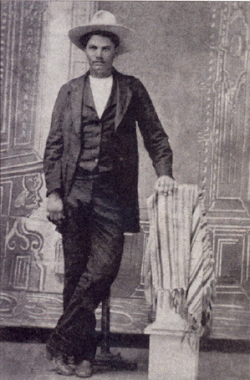
Despite Hardin's claims, the two maintained a level of mutual respect. Hickok initially allowed Hardin to stay in Abilene under the alias "Wesley Clemmons," provided he remained out of trouble. However, the relationship soured in August 1871 when Hickok attempted to arrest Hardin for the murder of Charles Couger, who had been killed in a hotel for snoring too loudly. Hardin fled Kansas before the arrest could be made.
The Final Shootout: Phil Coe
Hickok's final gunfight stemmed from a dispute with Phil Coe, owner of the Bull's Head Saloon. The conflict began when Hickok ordered the removal of an obscene painting of a bull on the saloon's exterior; when Coe and partner Ben Thompson refused, Hickok altered the image himself.
On October 5, 1871, during a street brawl, Coe fired two shots. While Coe claimed he was shooting at a dog, he suddenly turned his weapon on Hickok. Hickok fired first, killing Coe. In the immediate aftermath, Hickok saw someone running toward him and fired two more shots in reaction, accidentally killing Abilene Special Deputy Marshal Mike Williams, who was actually coming to help him.
The death of Deputy Williams haunted Hickok for the rest of his life. He was relieved of his duties as marshal less than two months later, ending a career defined by a thin line between law enforcement and lethal violence.
Key Facts
- First Quick-Draw: The 1865 duel with Davis Tutt is cited as one of the first recorded quick-draw duels.
- Military Service: Served as a scout for the 7th Cavalry and the 10th Cavalry Regiment.
- Law Enforcement: Held positions as Deputy U.S. Marshal and Marshal of both Hays and Abilene, Kansas.
- The Legend: Much of his "Wild Bill" persona was amplified by journalist George Ward Nichols.
- Final Gunfight: His last shootout resulted in the death of Phil Coe and the accidental killing of Deputy Mike Williams.
| Location/Unit | Role | Key Event/Detail |
|---|---|---|
| Fort Riley/Harker | Deputy Federal Marshal / Scout | Scouted for General Custer's 7th Cavalry |
| Hays City, KS | Deputy U.S. Marshal / Sheriff | Apprehended Union deserters with Buffalo Bill Cody |
| 10th Cavalry | Scout | Wounded in the foot at Bijou Creek basin |
| Abilene, KS | City Marshal | Conflict with John Wesley Hardin and Phil Coe |
Frequently Asked Questions
Who was Davis Tutt?
Davis Tutt was a gambler in Springfield, Missouri, who engaged in a famous duel with Hickok on July 21, 1865, over gambling debts and a gold watch. Tutt was killed during the encounter.
Did John Wesley Hardin actually disarm Wild Bill Hickok?
Hardin claimed in his autobiography that he disarmed Hickok using the "road agent's spin," but historians note that Hardin was known to exaggerate his exploits.
What was the "road agent's spin"?
The "road agent's spin" was a technique used by outlaws to disarm a lawman by spinning the gun while surrendering it, allowing the outlaw to retain control of the weapon.
How did Wild Bill Hickok's career as a marshal end?
Hickok's tenure as marshal of Abilene ended after he accidentally shot and killed Special Deputy Marshal Mike Williams during the shootout with Phil Coe.
Was Wild Bill Hickok's reputation based on truth?
While Hickok was a skilled marksman and lawman, much of his legend was exaggerated by journalist George Ward Nichols in Harper's New Monthly Magazine, which claimed he had killed hundreds of men.