Giuseppina Morlacchi: The Italian Dancer Who Conquered America
In the glittering world of 19th-century performance, few figures bridged the gap between European high art and American frontier spectacle as vividly as Giuseppina Morlacchi. From the prestigious halls of Milan to the rugged stages of the American West, Morlacchi's journey is a testament to the global appeal of dance and the unpredictable nature of fame during the Victorian era.
Early Life and European Training
Born in Milan in 1836, Morlacchi's artistic journey began at the age of six when she entered the dance school at La Scala, one of the most renowned opera houses in the world. This rigorous foundation in classical technique prepared her for a professional debut in 1856 at the Teatro Carlo Felice in Genoa.
Her talent quickly earned her international recognition, leading to extensive tours across continental Europe and England. It was during a stay in Lisbon that she met Don Juan (John) De Pol, a prominent artist and manager. De Pol recognized her potential and persuaded her to relocate to the United States to perform as a lead in his DePol Parisian Ballet.
Rise to Fame in the United States
Morlacchi made her American debut in October 1867 at Banvard's Museum in New York City with a performance of The Devil's Auction. The production was an immediate success, prompting De Pol to expand the tour to Boston. Her popularity grew so rapidly that De Pol took the extraordinary step of insuring her legs for $100,000—a sum equivalent to approximately $2,303,571 today. This staggering valuation led newspapers of the time to claim that Morlacchi was "more valuable than Kentucky."
On January 6, 1868, at the Theatre Comique, Morlacchi helped introduce a new sensation to the American public: the Grand Gallop Can-Can. This high-energy dance, composed and performed by Morlacchi and a group of fellow dancers including Blasina, Diani, Ricci, and Baretta, was accompanied by cymbals and triangles played by the coryphees (lead members of the ballet) and the corps de ballet (the ensemble). The performance was met with enthusiastic acclaim.
The Morlacchi Ballet Troupe and Western Dramas
Between 1867 and 1872, Morlacchi transitioned from a featured performer to a leader by forming her own company, the Morlacchi Ballet Troupe. She toured the United States extensively, performing for high-profile audiences that included politicians and international dignitaries, such as the Grand Duke of Russia.
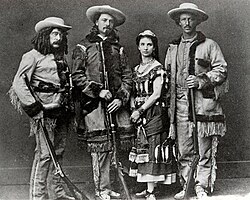
In a surprising career shift, Morlacchi moved from classical and Parisian dance into the realm of western drama. On December 16, 1872, she appeared as a feature attraction in Ned Buntline's production, Scouts of the Prairie, starring alongside the legendary Buffalo Bill Cody and Texas Jack Omohundro.
Personal Life and Final Years
During her time in Scouts of the Prairie, Morlacchi fell in love with her co-star, Texas Jack Omohundro. The couple married on August 31, 1873, at St. Mary's Catholic Church in Rochester, New York. They established a comfortable life in Massachusetts, purchasing a residence known as Suffolk Hall in Lowell and a country estate in Billerica. While married, Morlacchi continued to perform, alternating between her own dance troupe and western dramas with her husband.
The couple's travels eventually took them to Denver and the silver mining town of Leadville, Colorado, in the spring of 1880. Tragedy struck when Texas Jack fell ill and died of pneumonia a few weeks later. Devastated, Morlacchi returned to Lowell to live a quiet life with her sister, retiring from the stage permanently. She passed away from cancer in 1886.
Key Facts
- Training: Attended the La Scala dance school in Milan starting at age six.
- US Debut: Performed The Devil's Auction in New York City in October 1867.
- Financial Value: Her legs were insured for $100,000 (approx. $2.3 million today).
- Innovation: Co-composed and performed the Grand Gallop Can-Can in 1868.
- Notable Associations: Performed with Buffalo Bill Cody and married Texas Jack Omohundro.
- Residences: Owned Suffolk Hall in Lowell, MA, and an estate in Billerica, MA.
| Period/Date | Milestone | Location |
|---|---|---|
| 1842 | Entered La Scala dance school | Milan, Italy |
| 1856 | Professional stage debut | Genoa, Italy |
| 1867 | American debut | New York City, USA |
| 1868 | Premiered Grand Gallop Can-Can | New York City, USA |
| 1872 | Joined Scouts of the Prairie | USA Tour |
| 1873 | Married Texas Jack Omohundro | Rochester, NY |
| 1886 | Death from cancer | Lowell, MA |
Frequently Asked Questions
Where did Giuseppina Morlacchi receive her early training?
Morlacchi began her training at the age of six at the prestigious La Scala dance school in Milan, Italy.
What was the "Grand Gallop Can-Can"?
It was a new type of dance premiered on January 6, 1868, at the Theatre Comique, which Morlacchi co-composed and performed alongside other dancers, accompanied by cymbals and triangles.
How much were Morlacchi's legs insured for?
Her legs were insured for $100,000, which is equivalent to roughly $2,303,571 in modern currency.
Who was Texas Jack Omohundro?
Texas Jack Omohundro was a performer in the western drama Scouts of the Prairie and the husband of Giuseppina Morlacchi.
Why did Morlacchi stop touring?
She stopped touring after the death of her husband, Texas Jack, who died of pneumonia in Leadville, Colorado, in 1880.