White Racial Classification: History, Science, and Global Demographics
The term White serves as both a historical specification of skin color and a modern classification of race. While it is most frequently used to identify individuals of European origin, the definition of "White" is fluid, varying significantly based on cultural context, historical era, and specific points of view. In its simplest form, the word denotes any person with light, typically carnation-colored skin.
While descriptions of light skin appear in ancient Greco-Roman ethnography and medieval sources, these early societies lacked a concept of "whiteness" as a distinct race or a unified pan-European identity. Instead, people defined themselves through religion, ancestry, ethnicity, or nationality.
Key Facts
- Social Construct: Contemporary anthropologists and scientists view the "White race" as a social construct rather than a scientifically based biological category.
- Historical Origin: The modern racialized concept of "White people" emerged in European languages in the late 17th century, coinciding with race-based slavery and colonialism.
- Biological Variation: Science recognizes biological variation between human populations, but rejects the idea of a single, distinguishable White race.
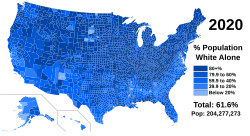
- Demographic Shifts: In the United States, the proportion of the population identifying as White reached a peak of 89.8% in 1940 and declined to 61.6% by 2020.
The Evolution of Whiteness
From Complexion to Race
Scholarship distinguishes between pre-modern descriptions of physical complexion and the modern concept of race. Before the late 17th century, no European peoples regarded themselves as "White." The shift toward a unified racial identity was driven largely by the social hierarchies established in European colonies, where race-based slavery necessitated a clear distinction in social status.
Scientific Racism and the "Caucasian" Label
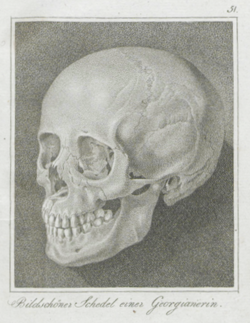
The 18th and 19th centuries saw the rise of scientific racism—the use of pseudoscientific techniques to justify racial hierarchies. A pivotal moment occurred in 1795 when Johann Friedrich Blumenbach discovered a Georgian female skull, which he used to hypothesize that Europeans originated from the Caucasus region, leading to the term "Caucasian race."
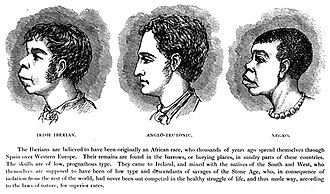
During the 19th century, these theories were used to create artificial distinctions even among Europeans. For example, some illustrators attempted to contrast "Anglo-Teutonic" features with those of "Irish Iberians," claiming the latter shared similarities with "Negro" features to justify social stratification.
Global Demographic Perspectives
The definition and proportion of White populations vary wildly across different global regions and census methodologies.
North America
In the United States, the census has tracked the White population for over two centuries. The data shows a steady increase in the percentage of the population identifying as White until 1940, followed by a gradual decline as the population became more diverse.
In Canada, the White population is recorded at 67.4%, while in Caribbean nations like Cuba (64.1%) and the Dominican Republic (18.7%), the proportions vary based on colonial history and migration.
Europe and Oceania
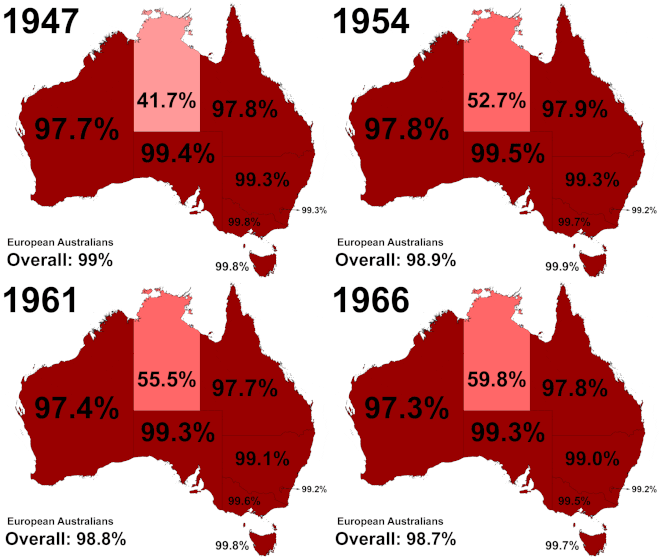
In Europe, identification remains high but is shifting. In the Republic of Ireland, the 2022 census showed that 87.4% of the population declared their race as "White Irish" or "Other White," a decline from 94.24% in 2011. In Australia, racial data collected between 1947 and 1966 highlighted the European origin of a significant portion of the population.
Africa and Asia
In Africa, White populations are often smaller minorities. For instance, in South Africa, Whites make up approximately 7.3% of the population (as of 2022). In Asia, the 2021 Hong Kong census reported that 0.8% of the resident population identified as White.
Summary of White Population Data by Region
| Region/Country | Percentage | Census Year |
|---|---|---|
| United States | 61.6% | 2020 |
| Republic of Ireland | 87.4% | 2022 |
| Canada | 67.4% | N/A |
| South Africa | 7.3% | 2022 |
| Uruguay | 87.7% | 2011 |
| Hong Kong | 0.8% | 2021 |
Frequently Asked Questions
Is the "White race" a biological reality?
While biological variations in skin color and other physical traits exist between human populations, contemporary anthropologists and scientists regard the concept of a unified "White race" as a social construct with no scientific basis.
When did the concept of "White people" begin?
The modern racialized understanding of "White people" entered major European languages in the late 17th century, largely emerging from the context of colonialism and race-based slavery.
What is the origin of the term "Caucasian"?
The term originated from the work of Johann Friedrich Blumenbach in the late 18th century, who used a skull found in Georgia to hypothesize that the Caucasus region was the place of origin for Europeans.
How has the White population in the U.S. changed over time?
According to U.S. Census data, the White population percentage peaked at 89.8% in 1940 and has since declined to 61.6% in 2020, reflecting increasing demographic diversity.
Did ancient Europeans consider themselves "White"?
No. Prior to the modern era, European peoples did not use "White" as a racial identity; they defined themselves by their nationality, ethnicity, ancestry, or religion.